Trump administration won't tap contingency fund to keep food aid
flowing, memo says
[October 25, 2025]
By KEVIN FREKING
WASHINGTON (AP) — The Trump administration is rejecting the idea of
using roughly $5 billion in contingency funds to keep food aid flowing
into November amid the government shutdown, according to a Department of
Agriculture memo that surfaced Friday. States temporarily covering the
cost of benefits next month will not be reimbursed, the memo says.
Democratic lawmakers and various advocacy groups have been calling on
the administration to use the contingency fund to provide partial
benefits into November though the Supplemental Nutrition Assistance
Program, commonly referred to as SNAP.
But the two-page document states that “contingency funds are not legally
available to cover regular benefits.”
The prospect of SNAP benefits running out as a result of the shutdown
has become a major concern in the states. Lawmakers from both political
parties are blaming the other for the hardship that would ensue. The
program helps about 1 in 8 Americans buy groceries.
The document states that the contingency fund is reserved for such
things as helping individuals in disaster areas. It cited Tropical Storm
Melissa, which could become a major hurricane in the coming days, as an
example of why it's important to have funds available to mobilize
quickly in the event of a disaster. The document was obtained by The
Associated Press and was first reported by Axios.

The document blames Democrats for the government shutdown that began
Oct. 1 and states that November SNAP benefits would be paid on time “if
not for Congressional Democrats blocking government funding.”
House Democratic leader Hakeem Jeffries earlier Friday told reporters
the administration has the resources to ensure than not a single
American goes hungry on Nov. 1. He accused Republicans of “trying to
weaponize hunger” and called it unconscionable. In a statement later
Friday he said it would be a “disgusting dereliction of duty” to halt
the food assistance.
Meanwhile, Democrats in the House and Senate have written Agriculture
Secretary Brooke Rollins requesting that she use the contingency fund to
cover the bulk of November benefits.
"Choosing not to ensure SNAP benefits reach those in need this November
would be a gross dereliction of your responsibilities to the American
people,” said a letter sent Friday by 214 House Democrats.
[to top of second column]
|

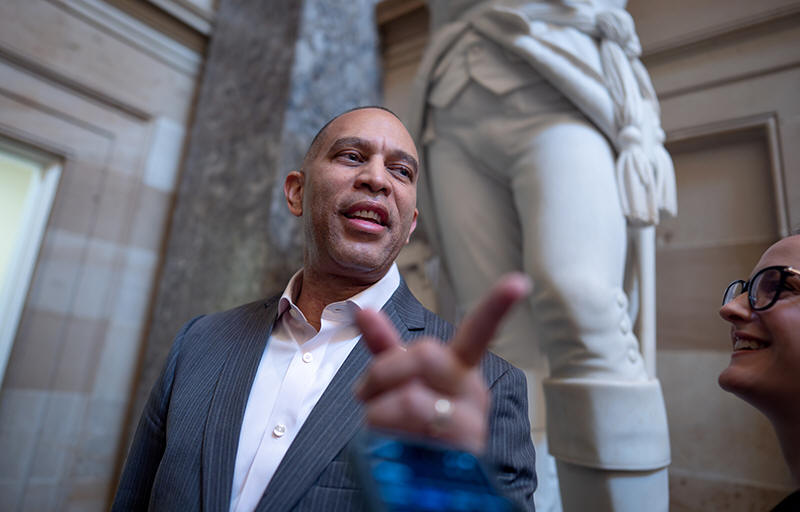
House Minority Leader Hakeem Jeffries, D-N.Y., responds to a
reporter in Statuary Hall on day 24 of the government shutdown, at
the Capitol in Washington, Friday, Oct. 24, 2025. (AP Photo/J. Scott
Applewhite)

The latest department guidance on the contingency fund appears to
contrast in some respects with the department's 55-page plan for
operations in the event of a shutdown. That plan stated that it's
evident Congress has intended for SNAP operations to continue since
the program has been provided with multi-year contingency funds to
cover state administrative expenses and to pay for participant
benefits should a funding lapse occur in the middle of the fiscal
year.
The department guidance that surfaced Friday says the contingency
fund is not available to support the current budget year's benefits
because “the appropriations for regular benefits no longer exists.”
The shutdown began when a short-term measure to fund the government
failed to advance in the Senate. The current impasse is now the
second-longest on record. The administration took steps leading up
to the shutdown to ensure SNAP benefits were paid in October, with
states and lawmakers looking for guidance from the administration
for what would happen next month.
The SNAP program is administered by the states. Officials in
Louisiana, Vermont and Virginia pledged Thursday to keep food aid
flowing to recipients in their states, even if the federal program
is stalled because of the shutdown. Other states have explored using
their own funds to prop up the program but have run into technical
roadblocks.
Some states have been telling SNAP recipients to be ready for the
benefits to stop. Arkansas, for example, is advising recipients to
identify food pantries and other groups that might be able to help,
and to ask friends and family for aid.
All contents © copyright 2025 Associated Press. All rights reserved
 |