China pitches itself as alternative to US protectionism after signing
expanded ASEAN free trade pact
[October 28, 2025] By
EILEEN NG and DAVID RISING
KUALA LUMPUR, Malaysia (AP) — China signed an expanded version of a free
trade agreement Tuesday with the Association of Southeast Asian Nations,
with Chinese Premier Li Qiang pitching expanded economic ties with his
country as an alternative to the protectionist policies of U.S.
President Donald Trump.
Li Qiang told an ASEAN-China summit meeting after the signing that
closer cooperation could help overcome global economic uncertainties. He
said “pursuing confrontation instead of solidarity brings no benefit” in
the face of economic coercion and bullying, in a swipe at the U.S.
“Unity is strength,” he said, citing remarks by President Xi Jinping
made during a Southeast Asia visit earlier this year.
His remarks were met with skepticism by Philippine President Ferdinand
Marcos Jr., whose country has clashed with China over competing claims
in the South China Sea, as have other ASEAN nations.
Marcos welcomed the expanded trade pact, but stressed that “this
cooperation cannot exist alongside coercion.”
Pact could ease already-booming regional trade
The signing of the ASEAN-China Free Trade Area 3.0 came on the final day
of the annual ASEAN summit and related meetings and was witnessed by Li
Qiang and Malaysian Prime Minister Anwar Ibrahim, who is serving as
ASEAN chair this year.

It’s the third revision of the long-standing agreement, which was first
signed in 2002 and came into force in 2010. The free trade area covers a
combined market of more than 2 billion people and lowers tariffs on
goods and boosting flows of services and investment.
Two-way trade has surged from $235.5 billion in 2010 to nearly $1
trillion last year. ASEAN and China are each other's top trading
partners.
Li stressed “mutual reliance” between China and ASEAN members Brunei,
Cambodia, East Timor, Indonesia, Laos, Malaysia, Myanmar, the
Philippines, Singapore, Thailand, Vietnam, calling them “good neighbors
and good brothers that are close in geography, culture and sentiment.”
“Unilateralism and protectionism have seriously impacted the global
economic and trade order, while external forces are increasing their
interference in the region — many countries have been unreasonably
subjected to high tariffs,” he said.
“By relying on each other and coordinating our actions, we can safeguard
our legitimate rights and interests.”
Southeast Asian political analyst Bridget Welsh said the upgraded pact
would benefit both sides, especially in the areas of supply chains and
sustainability.
“It also speaks to a global reality that non-U.S. countries are coming
together to strengthen trade relationships for their prosperity as a
recoupling with the U.S. is ongoing,” she said,
ASEAN juggles relationships with China and US
The prospect of a deepening trade conflict between China and the U.S.
has risked weakening economic growth worldwide.
Trump at the ASEAN summit on Sunday announced new economic details with
Cambodia, Malaysia, Thailand and Vietnam, though all countries are still
subject to new tariffs he has brought in.

[to top of second column] |
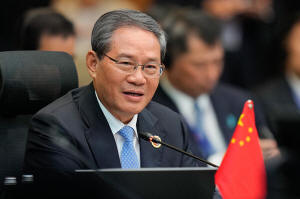
China's Premier Li Qiang gives his opening remark for the 28th ASEAN
Plus Three Summit in Kuala Lumpur, Malaysia, Monday, Oct. 27, 2025.
(AP Photo/Vincent Thian, Pool)
 Anwar stressed at the ASEAN meeting
with China that the bloc seeks friendly relations with all
countries.
“The day before we were with President Donald Trump of the United
States of America, and today we are back with China,” he said. "And
that reflects ASEAN centrality ... This is what we consider steady
engagement that fosters trust that enables us to work through
challenges together.”
There were signs that tensions between the U.S. and China were
cooling ahead of a planned meeting between Trump and Xi, which is
expected to take place in South Korea on Thursday. Top negotiators
from each country said a trade deal was coming together, which could
prevent a potentially damaging confrontation between the world’s two
largest economies.
Officials said the ASEAN-China Free Trade Area 3.0 is expected to
broaden integration across the region by covering new areas such as
digital trade, the green economy, sustainability and support for
small and medium-sized enterprises, which make up the majority of
ASEAN businesses. The agreement is designed to make trade benefits
more accessible, improve market entry for smaller players,
streamline non-tariff procedures and lower regulatory barriers.
Territorial tensions remain
Marcos said the pact could help modernize trade practices and enable
both sides to better respond to emerging economic challenges, but
urged China to “commit to cooperation and meaningful engagement,
especially in the South China Sea.”
Marcos said it was “regrettable” that Philippine vessels and
aircraft continue to face “dangerous actions and harassment” in the
South China Sea. He reiterated Manila’s objections to Beijing’s plan
to establish a “nature reserve” over a hotly disputed shoal in the
area.
“Actions like these cannot hide under the veneer of marine
environmental protection because they have no legal basis or effect,
blatantly disregard international law, and infringe on the
Philippines’ sovereignty,” he said. Still, Marcos added that Manila
would continue to engage constructively with China to manage
differences.

ASEAN members Vietnam, the Philippines, Malaysia, and Brunei — along
with Taiwan — have overlapping claims with China, which asserts
sovereignty over nearly the entire South China Sea. Chinese and
Philippine vessels have repeatedly clashed in the vital sea trade
route.
Marcos has vowed to accelerate the conclusion of a Code of Conduct
to govern behavior in the disputed waters when the Philippines
assumes the ASEAN chairmanship next year.
In Beijing, Chinese Foreign Ministry spokesperson Guo Jiaku on
Monday accused the Philippines of “deliberate infringements and
provocations at sea,” blaming Manila for escalating tensions.
Welsh, the analyst, said regional officials treat the South China
Sea dispute as a separate track from security ties and don't expect
it to impact economic ties with China.
All contents © copyright 2025 Associated Press. All rights reserved |