Statewide warehouse pollution reduction bill fails to meet committee
deadline
[April 01, 2026]
By Gabriel Castilho and Medill Illinois News Bureau
SPRINGFIELD — A proposal that would have created the first statewide
regulations aimed at curbing pollution generated by fulfillment centers,
parcel hubs and sorting facilities failed to receive a committee vote in
either chamber of the General Assembly.
Illinois hosts more than 2,400 warehouses and about 2 million people
live within half a mile of one, according to the nonprofit Environmental
Defense Fund advocacy group. Among the main distribution centers within
the state are ones operated by Amazon, Walmart and IKEA, whose trucks
use the interstate highway system and the nearby roads to deliver their
products.
Senate Bill 3732 and its companion House Bill 5600 — both titled the
Warehouse Pollution Reduction Act — would have established annual
emissions-reduction targets and a system of points for air pollution
mitigation measures for those facilities and the trucks traveling to and
from them.
But both the House and Senate declined to even bring the measures for a
committee vote, making their passage in this year’s General Assembly
unlikely.
“You hope all your bills pass,” said Senate sponsor Rachel Ventura,
D-Joliet. “If I didn’t think it had a chance at all to pass, I wouldn’t
have filed the bill. I think this is going to be a longer conversation.”
Warehouse pollution
The bill would have held warehouses responsible for the pollution
generated by the trucks that use the facility by establishing a system
of fees whose value would depend on the cost of enforcing the new rules.
The fee would be deposited in a Warehouse Pollution Management Fund,
created by the bill to provide for its implementation and proper
regulation.
“That truck pollution, especially the diesel particulate matter, has
caused a lot of asthma in our area,” Ventura said.

“We give them the option of how they want to mitigate that, so, for some
companies, it probably makes a lot more sense for them to upgrade their
fleet,” Ventura added. “Maybe they don’t want to do anything with their
fleet. Maybe they decide, ‘you know what, financially, we want to pay
into the fund and allow somebody else to clean up the air.’”
Ventura said her bill is modeled after Southern California’s Warehouse
Indirect Source Rule, implemented in 2021 to address the South Coast
region’s air quality problems. Ventura’s district, according to the
Environmental Defense Fund, has the highest number of warehouses in the
state.
Sen. Seth Lewis, R-Bartlett, whose district has the 4th-most warehouses,
said he is concerned this will take away local control over how each
municipality will manage their warehouses.
“She’s trying to destroy the local economy by imposing overburdensome
regulations on a successful industry,” Lewis said. “She is welcome to do
that in her own community, but when she wants it in my community, she’s
going to get a fight — not only from me, but from all the mayors.”
[to top of second column]
|
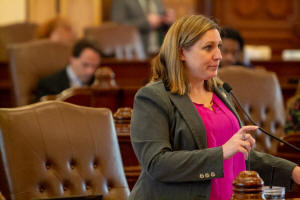
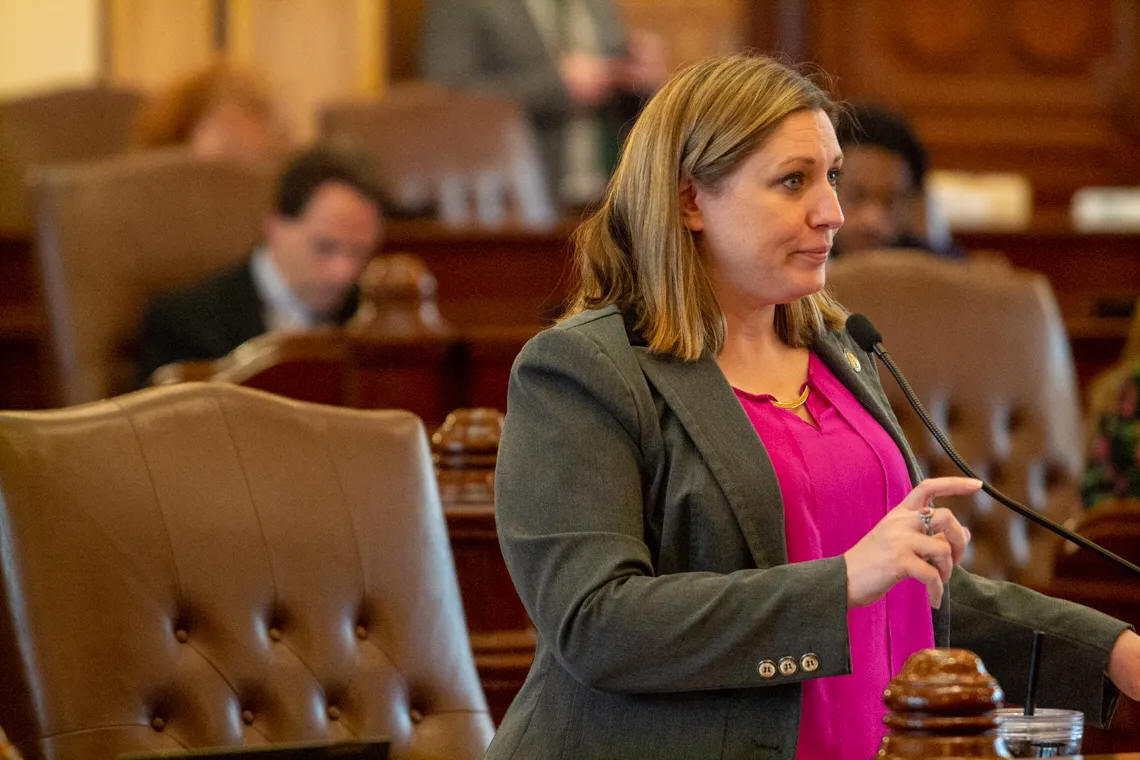
Sen. Rachel Ventura, D-Joliet, speaks on the Senate floor in May
2025. (Medill Illinois News Bureau photo by Gabriel Matias Castilho)

Matthew Hart, executive director of the Illinois Movers’ and
Warehousemen’s Association, said he has not yet seen any benefit for
consumers in the bill. He said the association, along with the Illinois
Trucking Association (where he also serves as the executive director),
is keeping a close eye and is in talks with the sponsors of the bill.
“We want to make sure that we protect the businesses that are here, that
are serving our customers here,” Hart said. “It becomes more expensive
if you force us to deliver stuff from warehouses that are farther away,
who don’t have to comply with all these extra stringent regulations.”
Both Hart and Lewis warned that imposing new regulations on the
warehouses might drive those businesses to neighboring states.
“For some reason, many of my colleagues believe that we can isolate
Illinois and people will want to do business here, and the answer is:
They don’t,” Lewis said. “They will figure out a way in which to not
invest in Illinois and invest in other states.”
While 92% of the leased warehouses with over 100,000 square feet are
concentrated in the Chicago area and surrounding counties, the
warehouses in Peoria, Decatur, Bloomington, Champaign and Lincoln would
also be subject to the bill. According to the Environmental Defense Fund
study, none of the facilities in those cities had air pollution monitors
— which would be required under the bill.
Looking Forward
The bill has no bipartisan support at this point.
Republican opponents like Sen. Andrew Chesney, R-Freeport, said this
bill was a “hard no” for him and that he suspects most Republicans would
oppose it.
“It’s a job killer bill,” he said. “We need to look at deregulating
Illinois and putting it in a position where all types of industries want
to flourish and want to come and grow.”
Ventura said the bill fits in line with Illinois’ recent environmental
priorities.
“The truth of it is that we do need companies to make sure they are
being fair and appropriate partners in our communities,” she said. “And
right now, we have a whole industry that’s not.”
Gabriel Castilho is a graduate student in journalism
with Northwestern University’s Medill School of Journalism, Media
and Integrated Marketing Communications, and is a fellow in its
Medill Illinois News Bureau working in partnership with Capitol News
Illinois.
Capitol News Illinois is
a nonprofit, nonpartisan news service that distributes state
government coverage to hundreds of news outlets statewide. It is
funded primarily by the Illinois Press Foundation and the Robert R.
McCormick Foundation.
 |