With Minneapolis medical center's survival threatened, staff and leaders
call for state action
[April 08, 2026]
By MADDIE ROBINSON/MinnPost
As a dire financial outlook has pushed Minneapolis’ Hennepin County
Medical Center (HCMC) to the brink of closure, health care workers and
union leaders are calling for legislative action, which could be
introduced at the state Capitol as soon as Tuesday.
HCMC, part of the larger Hennepin Healthcare provider system, is
Minnesota’s busiest Level 1 adult and pediatric trauma center. It is
also a safety-net hospital, meaning it accepts patients regardless of
their insurance status or ability to pay, and has been a training site
for more than half of Minnesota’s practicing physicians. In 2025, the
hospital saw nearly 115,000 patients, including more than 94,000
emergency department visits.
“HCMC is not just a Minneapolis hospital. It’s Minnesota’s safety net.
It is Minnesota’s last line of care,” said Jeremy Olson-Ehlert, a
registered nurse at HCMC and second vice president of the Minnesota
Nurses Association (MNA), at an April 1 press conference at the Capitol.
The hospital is also in financial straits, facing up to $50 million in
operating losses in 2026 and staring down $1.7 billion in losses over
the next 10 years, according to projections shared in March with the
Hennepin County Board’s budget committee. Right now, the hospital can’t
even make its $33 million biweekly payroll and must rely on the county
to cover the overdraft, Hennepin County Commissioner Jeffrey Lunde told
MinnPost. Lunde chairs the Hennepin Health Board.

The hospital’s financial hardships can be attributed to multiple factors
over many years, including the shutdown of Minnesota-based health
insurer UCare, which owes HCMC $115 million, and the running cost to
treat uninsured or publicly insured patients, who make up the hospital’s
majority.
Massive changes to Medicaid eligibility under the One Big Beautiful Bill
Act, set to go into effect in 2027, are expected to exacerbate HCMC’s
challenges. About 140,000 Minnesotans are at risk of losing their health
coverage in the coming decade, according to an analysis by the Minnesota
Department of Human Services.
Lunde said that without action from lawmakers by the May 18 end to the
legislative session, HCMC would begin closing in June.
[to top of second column]
|

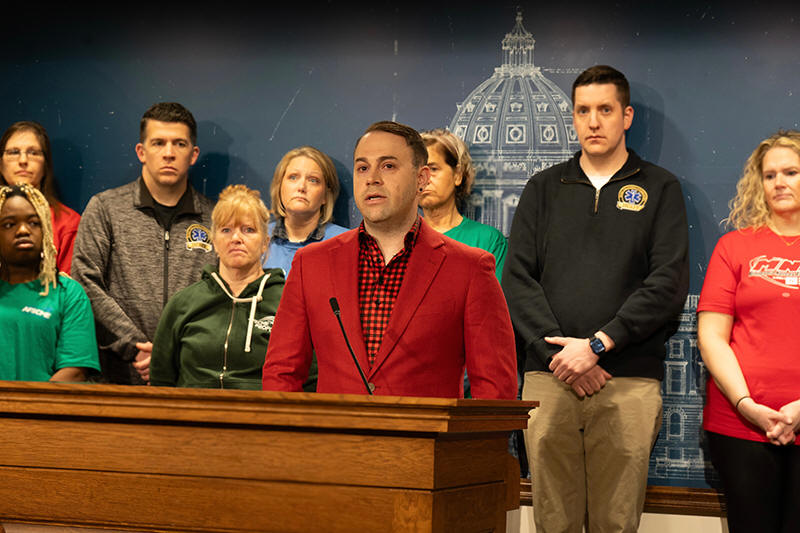
Jeremy Olson-Ehlert, an RN at HCMC and second vice president of the
Minnesota Nurses Association, speaks about the medical center's
future at a news conference on April 1, 2026 at the Minnesota State
Capitol in St. Paul, Minn. (Taylor Canas/MinnPost via AP)
 No other place to go
The impact would be catastrophic and felt throughout the state,
several speakers said at the April 1 press conference.
“Patients will wait significantly longer in emergency departments,
and hospitals across Minnesota will lose a partner that they rely
on,” Olson-Ehlert said. “There is no backup plan, there is no extra
capacity, and there is no other place for these patients to go.”
Lunde echoed those concerns, saying HCMC’s closure would overwhelm
places like Regions Hospital in St. Paul and North Memorial in
Robbinsdale, the only other Level 1 trauma centers in the Twin
Cities. He also warned that wait times for the ER could skyrocket
from one to two hours to up to 10.
Some cost-saving measures are already underway. In February, HCMC
cut its beds by 100, to 390 total. In January, the hospital stopped
accepting most non-emergency transfers from outside of Hennepin
County, putting a strain on rural hospitals.
“We’re not only a safety net hospital for patients, we’re also a
safety net hospital for other hospitals,” Lunde said.
The current solution being eyed is to repurpose the county’s 0.15%
sales tax used to pay off bonds for the Minnesota Twins stadium into
a 1% tax that would generate about $340 million annually for HCMC.
Lunde said he expects a bill in support of the tax to be introduced
Tuesday in the House when the Legislature reconvenes after the
Easter/Passover break. It will be introduced by a member of the DFL
Party, he said, with a Republican co-signer.
“We’ve met with the speaker, the senate minority leader, the senate
majority leader, leadership in the House, because we’ve been very
focused on we need a bipartisan bill, and we need bipartisan
support,” Lunde said.
All contents © copyright 2026 Associated Press. All rights reserved |