Artemis II astronauts make long-distance call to the space station as
they head home from the moon
[April 08, 2026]
By MARCIA DUNN
HOUSTON (AP) — Still aglow from their triumphant lunar flyby, the
Artemis II astronauts made more history Tuesday: calling their friends
aboard the International Space Station hundreds of thousands of miles
away as they headed home from the moon.
It was the first moonship-to-spaceship radio linkup ever. NASA's Apollo
crews had no off-the-planet company back in the 1960s and 1970s, the
last time humanity set sail for deep space.
"We have been waiting for this like you can’t imagine,” Artemis II
commander Reid Wiseman called out.
For Christina Koch on Artemis II and Jessica Meir aboard the space
station, it marked a joyous space reunion despite being 230,000 miles
(370,000 kilometers) apart. The two teamed up for the world's first
all-female spacewalk in 2019 outside the orbiting lab.
Koch told her “astro-sister” that she'd hoped to meet up with her again
in space “but I never thought it would be like this — it's amazing.”
“I'm so happy that we are back in space together,” Meir replied, “even
if we are a few miles apart.”
Houston's Mission Control arranged the cosmic chitchat between the four
lunar travelers and the space station's three NASA and one French
residents.
Koch described being awe-struck by not just the beauty of Earth, “but
how much blackness there was around it.”
“It just made it even more special. It truly emphasized how alike we
are, how the same thing keeps every single person on planet Earth
alive,” she told the space station crew. “The specialness and
preciousness of that really is emphasized” when viewing the home planet
from the moon.

By late Tuesday afternoon, the Artemis II astronauts had beamed back
more than 50 gigabytes' worth of pictures and other data from the
previous day's lunar rendezvous, which set a new distance record for
humanity. The highlight: an Earthset photo reminiscent of Apollo 8's
Earthrise shot from 1968.
"While they are inspirational and, I think, allow all of us to really
feel a little bit of what they were feeling, there's also a lot of
science hidden inside of those images," said Mission Control's lead
lunar scientist Kelsey Young. “The conversations and the science lessons
learned are just beginning."
During a debriefing with Young, the astronauts recounted how they
spotted a cascade of pinpricks of light on the lunar surface from
impacting cosmic debris. The flashes lasted mere milliseconds and
coincided by chance with Monday evening's total solar eclipse.
Young said it was too soon to know whether the crew witnessed an actual
meteor shower or more random, run-of-the-mill micrometeoroid hits.
Either way, there were “audible screams of delight” in the science
operations center, she said.
[to top of second column]
|
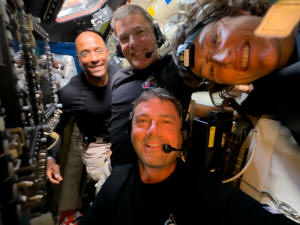
In this image provided by NASA, Artemis II crew members, from left,
Victor Glover, Jeremy Hansen, Reid Wiseman and Christina Koch, pause
to turn the camera around for a selfie midway through their lunar
observation period of the Moon during a lunar flyby, Monday, April
6, 2026. (NASA via AP)

Koch described being awe-struck by not just the beauty of Earth,
“but how much blackness there was around it.”
“It just made it even more special. It truly emphasized how alike we
are, how the same thing keeps every single person on planet Earth
alive,” she told the space station crew. “The specialness and
preciousness of that really is emphasized” when viewing the home
planet from the moon.
The first lunar explorers since Apollo 17 in 1972, Wiseman and his
crew are aiming for a splashdown off the San Diego coast on Friday
to wrap up the nearly 10-day test flight. The recovery ship USS John
P. Murtha left port Tuesday for the target zone.
It sets the stage for next year's Artemis III, a lunar lander
docking demo in orbit around Earth. Artemis IV will follow in 2028
with two astronauts attempting to land near the lunar south pole.
As for the Orion capsule’s pesky potty, Mission Control assured the
astronauts that no maintenance was required Tuesday. The toilet has
been on-and-off limits to the crew ever since last week’s launch,
prompting them to rely on a backup bag-and-funnel system for
urinating.
NASA Administrator Jared Isaacman told the crew following the lunar
flyby Monday night: “We definitely have to fix some of the plumbing”
ahead of the next Artemis mission. Engineers suspect a clogged
filter in the overboard flushing system.
Aside from the toilet and other relatively minor matters, the
mission has gone well, Isaacman noted at a news conference Tuesday,
“but I'll breathe easier when we get through reentry and everybody's
under chutes and in the water.”
___
The Associated Press Health and Science Department receives support
from the Howard Hughes Medical Institute’s Department of Science
Education and the Robert Wood Johnson Foundation. The AP is solely
responsible for all content.
All contents © copyright 2026 Associated Press. All rights reserved
 |