US and Iran agree to 2-week ceasefire as Trump pulls back on threats
[April 08, 2026]
By BASSEM MROUE, JON GAMBRELL and SAMY MAGDY
TEHRAN, Iran (AP) — U.S. President Donald Trump pulled back on his
threats to launch devastating strikes on Iran late Tuesday, as the U.S.
and Iran agreed to a two-week ceasefire that includes the reopening of
the Strait of Hormuz.
Trump swerved to deescalate the war less than two hours before the
deadline he set for Tehran to capitulate to a deal or face attacks on
its bridges and power plants meant to destroy Iranian “civilization.”
Iran’s Supreme National Security Council said it has accepted the
ceasefire and that it would negotiate with the United States in Pakistan
beginning Friday. Neither Iran nor the United States said when the
ceasefire would begin, and attacks took place in Israel, Iran and across
the Gulf region early Wednesday.
Israel backed the U.S. ceasefire with Iran but the deal doesn’t cover
fighting against Hezbollah in Lebanon, Prime Minister Benjamin Netanyahu
said early Wednesday.
His office said in the statement that Israel supported Trump’s decision
to suspend strikes subject to Iran immediately opening the Strait of
Hormuz and stopping all attacks on the U.S. Israel and countries in the
region. His office said Israel also supports U.S. efforts to ensure Iran
no longer poses a nuclear or missile threat.
The ceasefire calls for Israel and Hezbollah to halt fighting in
Lebanon, according to the prime minister of Pakistan, which has been
mediating talks.
The ceasefire process was clouded in uncertainty after Iran released
different versions of the 10-point plan intended to be the basis for
negotiations. The version in Farsi included the phrase “acceptance of
enrichment” for its nuclear program. But for reasons that remain
unclear, that phrase was missing in English versions shared by Iranian
diplomats to journalists.

Trump initially had said Iran proposed a “workable” 10-point plan that
could help end the war launched by the U.S. and Israel in February. But
he later called it fraudulent, without elaborating. Trump has said
ending Iran’s nuclear program entirely was a key point of the war.
Pro-government demonstrators in the streets of Iran’s capital screamed:
“Death to America, death to Israel, death to compromisers!” after the
ceasefire announcement Wednesday morning. They also burned American and
Israeli flags in the street.
It shows the ongoing anger from hard-liners, who had been preparing for
what many assumed would be an apocalyptical battle with the United
States.
Iran and Oman to collect shipping fees in Strait of Hormuz
Iranian Foreign Minister Abbas Araghchi said passage through the strait
would be allowed under Iranian military management. It wasn’t
immediately clear whether that meant Iran would completely loosen its
chokehold on the waterway.
The plan allows for both Iran and Oman to charge fees on ships
transiting through the strait, according to a regional official who
spoke on condition of anonymity to discuss negotiations they were
directly involved in. The official said Iran would use the money it
raised for reconstruction.
In addition to control of the strait, Iran’s demands for ending the war
include withdrawal of U.S. combat forces from the region, the lifting of
sanctions and the release of its frozen assets.
Since the war began, Trump has repeatedly backed off deadlines just
before they expire.
In doing so again Tuesday, Trump said in a social media post he had come
to the decision “based on conversations” with Pakistan Prime Minister
Shehbaz Sharif and Gen. Asim Munir, Pakistan’s powerful army chief.
Sharif, in a post on X hours earlier, urged Trump to extend his deadline
by two weeks to allow diplomacy to advance. He used the same post to ask
Iran to open the strait for two weeks.

“Almost all of the various points of past contention have been agreed to
between the United States and Iran, but a two week period will allow the
Agreement to be finalized and consummated,” Trump said.
There are concerns in Israel about the agreement, according to a person
familiar with the situation who spoke on condition of anonymity because
they were not allowed to speak to the media. The person said Israel
would like to achieve more.
Iran’s stockpile of highly enriched uranium is still buried at
enrichment sites. The program had been one of the main issues cited by
both Israel and the U.S. in launching the war.
[to top of second column]
|
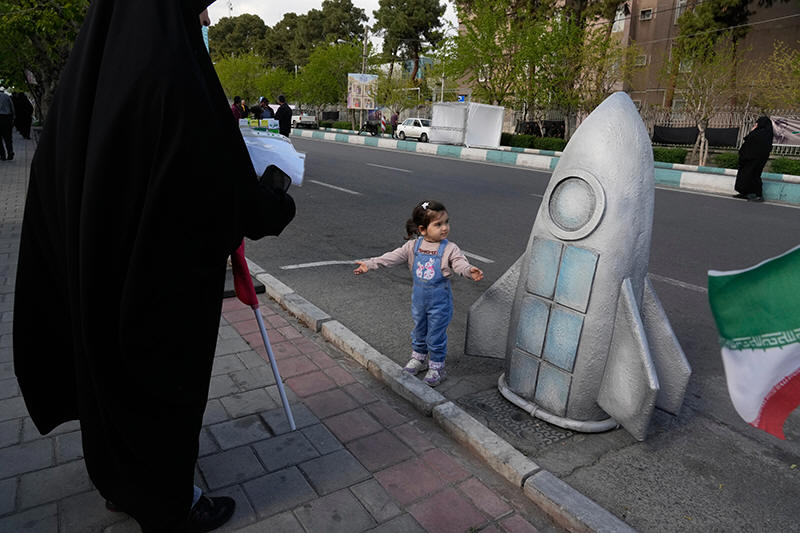
A girl stands next to replica of a space craft in a memorial for
school children who were killed during a strike on a school in
southern town of Minab on Feb. 28, in downtown Tehran, Iran,
Tuesday, April 7, 2026. (AP Photo/Vahid Salemi)

Earlier Trump threats raised alarms
“A whole civilization will die tonight, never to be brought back
again,” if a deal isn’t reached, Trump said in an online post
Tuesday morning. But he also seemed to keep open the possibility of
an off-ramp, saying that “maybe something revolutionarily wonderful
can happen.”
Trump’s expansive threat did not seem to account for potential harm
to civilians, prompting Democrats in Congress, some United Nations
officials and scholars in military law to say such strikes would
violate international law.
Tehran’s representative at the U.N., Amir-Saeid Iravani, said the
threats “constitute incitement to war crimes and potentially
genocide” and that Iran would "take immediate and proportionate
reciprocal measures” if Trump launches devastating strikes.
The U.S. and Israel have battered Iran with attacks targeting its
military capabilities, leadership and nuclear program. Iran has
responded with a stream of strikes on Israel and Gulf Arab
neighbors, causing regional chaos and outsized economic and
political shock.
Late Tuesday, Pakistan's prime minister urged Trump to extend his
deadline by two weeks to allow diplomacy to advance. In a post on X,
Shehbaz Sharif, whose country has been leading negotiations, also
asked Iran to open up for two weeks the Strait of Hormuz.
China, which is Tehran’s biggest trade partner, encouraged the
Iranians to find a way to a ceasefire as talks progressed, according
to two officials who were not authorized to comment publicly and
spoke on condition of anonymity.
Before the deadline, airstrikes hit two bridges and a train station,
and the U.S. hit military infrastructure on Kharg Island, a key hub
for Iranian oil production.
While Iran cannot match the sophistication of U.S. and Israeli
weaponry or their dominance in the air, its chokehold on the strait
since the war began in late February is roiling the world economy
and raising the pressure on Trump both at home and abroad to find a
way out of the standoff.

Airstrikes hit Iran, which fires on Saudi Arabia and Israel
Even as the ceasefire was announced, missile alerts continued in the
United Arab Emirates, Israel, Saudi Arabia, Bahrain and Kuwait early
Wednesday, hinting at the chaos surrounding the diplomatic moves. A
gas processing facility in Abu Dhabi was ablaze after incoming
Iranian fire, officials said.
Israel was continuing its attacks on Iran, said an Israeli military
official who spoke on condition of anonymity in line with military
regulations. Iran also kept up fire on Israel.
The U.S. military has halted all offensive operations against Iran
but continues defensive actions, said an official, who spoke on
condition of anonymity to describe sensitive military operations.
Earlier Tuesday the Israeli military said it attacked an Iranian
petrochemical site in Shiraz, the second day in a row it hit such a
facility. The military later said it also struck bridges in several
cities that were being used by Iranian forces to transport weapons
and military equipment.
More than 1,900 people have been killed in Iran since the war began,
but the government has not updated the toll for days.
In Lebanon, where Israel is fighting Iran-backed Hezbollah
militants, more than 1,500 people have been killed. and more than 1
million people have been displaced. Eleven Israeli soldiers have
died there.
In Gulf Arab states and the occupied West Bank, more than two dozen
people have died, while 23 have been reported dead in Israel, and 13
U.S. service members have been killed.
___
Gambrell reported from Dubai, United Arab Emirates. Magdy reported
from Cairo. Associated Press writers Farnoush Amiri at The United
Nations; Aamer Madhani, Konstantin Toropin, Seung Min Kim, Michelle
L. Price, Joshua Boak and Will Weissert in Washington; John
Leicester in Paris; Nicole Winfield in Rome; Amir-Hussein Radjy in
Cairo and Natalie Melzer in Jerusalem contributed to this report.
All contents © copyright 2026 Associated Press. All rights reserved |