Mullin pledges progress on disaster relief during his first official
trip as DHS secretary
[April 08, 2026]
By REBECCA SANTANA and GABRIELA AOUN ANGUEIRA
CHIMNEY ROCK, N.C. (AP) — Homeland Security Secretary Markwayne Mullin
on Tuesday toured North Carolina areas devastated by Hurricane Helene in
2024, revealing plans to prioritize relief to disaster-impacted
communities on his first official trip since replacing Kristi Noem,
whose leadership cast uncertainty over federal disaster response.
While the trip focused on emergency management, Mullin also weighed in
on immigration enforcement, a centerpiece policy of the Trump
administration, which his department also oversees. He suggested he
might halt customs processing at airports serving cities whose local
governments resist the administration's immigration policies, a move
that would align with his predecessor's hardline approach.
At his confirmation hearing last month, Mullin tried to project a softer
tone on immigration enforcement, after a backlash over high-profile
operations and the deaths of two Americans at the hands of federal
officers. Mullin also signaled a different approach to the Federal
Emergency Management Agency following criticism of Noem's policies.
At a roundtable discussion Tuesday, Mullin said FEMA was focused on
catching up on past disaster work and clearing a backlog of needs that
stacked up during his predecessor's tenure ahead of the Atlantic
hurricane season, which begins June 1.
“Disasters are happening constantly,” Mullin said, adding that he would
brief President Donald Trump Tuesday on the 22 still pending major
disaster declaration requests from states and tribes across the U.S.
“We’re trying to push this stuff forward as fast as possible."

Mullin also said he “may have identified” a candidate for permanent
administrator of FEMA, which is on its third temporary leader since
Trump took office, but declined to name them.
Asked if eliminating FEMA — which Trump has threatened to do — was still
on the table, Mullin said “reforming FEMA would be a better term.”
Mullin's visit comes less than a week after he ended Noem's directive
that all DHS expenditures over $100,000 be personally approved by the
secretary's office, a rule that critics said bottlenecked FEMA
reimbursements and compromised disaster response and recovery.
Mullin threatens to remove CBP officers from some airports
While Mullin has already made strides on disaster response, he has yet
to set forth a clear vision for immigration enforcement, although he is
expected to align with the president’s vision. That was apparent in his
comments about removing Customs and Border Protection officers from
airports in so-called “sanctuary cities.”
“If they’re not enforcing immigration laws, then why would I be
processing immigration in their city?” Mullin said, adding that the idea
was still under consideration. He suggested he would raise the idea in
his briefing to Trump.
Mullin gave no further details. But withdrawing CBP officers from
airports could disrupt international travel and trade. CBP officers
check all incoming travelers into the country as well as the billions of
dollars of trade that enters through land crossings and airports.
The Trump administration has already threatened to withdraw funding to
Democratic cities and states that it says do not cooperate with
immigration enforcement.
North Carolina is still hard-hit
Few disaster-hit areas experienced the impacts of FEMA's recent tumult
as acutely as North Carolina, where about $1.6 billion in FEMA public
assistance dollars has been obligated so far and where roughly 2,000
projects are still in some stage of FEMA approval, according to a letter
North Carolina Gov. Josh Stein sent Mullin after his swearing in.
North Carolina Sen. Thom Tillis excoriated Noem for delays in
reimbursements to his state just days before her firing, telling her at
a Senate hearing she had "failed” at FEMA.
Mullin said at the roundtable that Trump had told him he wanted North
Carolina to be his first stop and had told Mullin “people in North
Carolina love me.”

[to top of second column]
|

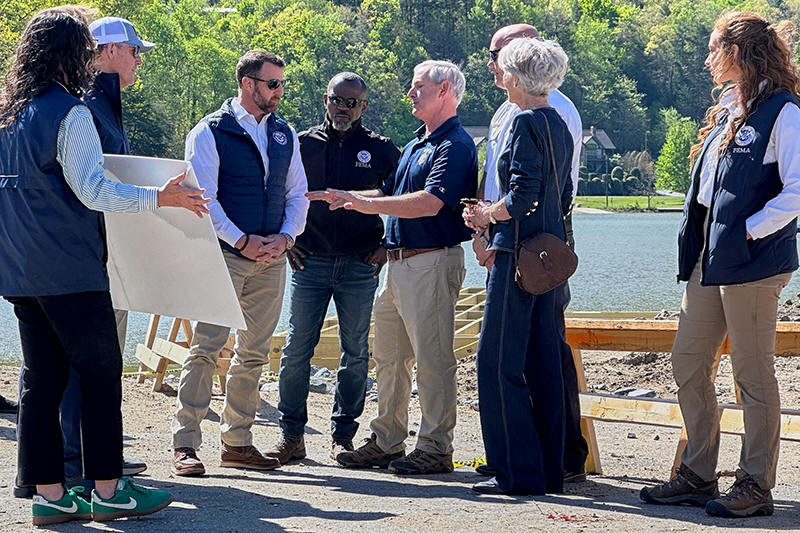
Homeland Security Secretary Markwayne Mullin, center left, listens
to a briefing on hurricane recovery efforts, Tuesday, April 7, 2026
in Lake Lure, N.C. This is his first official trip since replacing
Kristi Noem. (AP Photo Rebecca Santana)

North Carolina carries outsize political significance this year.
Tillis, one of the state’s Republican senators, is retiring, raising
Democratic hopes of a pickup this fall. The race is sure to attract
hundreds of millions in campaign spending and pits Democrat Roy
Cooper, the state’s former governor, against Michael Whatley, the
former chairman of the Republican National Committee.
Helene, a 350-mile-wide (560 kilometers) hurricane, ravaged multiple
southeastern states in September 2024.
The storm caused 108 deaths in North Carolina and $60 billion in
damages. It destroyed homes, businesses and utility infrastructure.
Entire communities were cut off, prompting helicopter rescues after
roads and bridges washed away.
Hurricane damage is still visible, with cars and remnants of homes
washed up on banks, remains of knocked-out bridges and piles of
thick trees and branches that rushed down the river when it swelled
to a torrent of water.
Misinformation shrouded FEMA's response to Hurricane Helene
Rep. Chuck Edwards, a Republican representing some of the impacted
areas who lost one of his own businesses in the storm, said Tuesday
he also grew frustrated with what he called FEMA’s “bureaucracy” and
the difficulties local communities faced in receiving payments.
“Still plenty of bureaucracy there,” said Edwards, who praised
Mullin’s removal of the $100,000 rule.
FEMA’s presence in North Carolina had a tense start as distrust grew
among some impacted residents, fueled in part by then-candidate
Trump’s own misinformation about the Biden administration and FEMA’s
response in the swing state.
Edwards found himself debunking FEMA-related misinformation shortly
after the storm, issuing a statement to his constituents that FEMA
was not diverting donations to the border or seizing property, among
other claims.
After an armed man was arrested in Lake Lure for making threats
toward FEMA workers, the agency temporarily suspended door-to-door
home visits in the affected areas.

Stein, a Democrat, welcomed Mullin's visit. “It is encouraging that
Secretary Mullin is getting down to business,” he told The
Associated Press in a statement Tuesday.
On Monday, FEMA approved $26 million in buyouts of damaged and
destroyed North Carolina homes, saying in a statement that Mullin
encouraged the agency to “redouble its efforts” to help survivors.
Mullin’s remarks drew a sharp contrast from his predecessor Noem,
who repeatedly called for FEMA to be eliminated “as it exists
today." Trump floated the idea of eliminating FEMA altogether on a
North Carolina visit just days into his second term, calling the
agency a “very big disappointment.”
Trump has repeatedly expressed a desire to push more responsibility
for disasters down to states, and a presidentially appointed FEMA
Review Council is expected to soon release a report recommending
sweeping reforms of how and to what extent the federal government
supports disaster-impacted communities.
While most FEMA staff are still being paid during the record-long
partial government shutdown, many offices were ordered to slow or
stop work shortly after the shutdown began on Feb. 14.
Meanwhile, the agency's Disaster Relief Fund is running low, with
about $3.6 billion remaining. The DHS appropriations bill would
replenish the fund with over $26 billion.
All contents © copyright 2026 Associated Press. All rights reserved |