More Federal Reserve officials see possible rate hikes this year,
minutes show
[April 09, 2026] By
CHRISTOPHER RUGABER
WASHINGTON (AP) — The number of Federal Reserve policymakers willing to
consider an interest rate hike this year rose between the January and
March meetings, as higher gas prices stemming from the Iran war
threatened to worsen inflation in the coming months.
Minutes of the Fed's March 17-18 meeting, released Wednesday, showed
that “some” of the central bank's 19 policymakers on its rate-setting
committee supported changing their post-meeting statement to reflect the
potential for a future rate hike. That is an an increase from “several”
in January. The Fed doesn't disclose precise numbers of how many
officials supported each position, but in Fed jargon, ‘some’ is
considered more than ‘several.’
And “many” of the officials pointed to the risk that higher oil and gas
prices could keep inflation elevated for “longer than expected, which
could call for rate increases" to push inflation back down.
For about 18 months, the Fed has leaned toward cutting rates, and in its
meetings has alternated between cuts and no change to rates. The slow
shift toward considering potential hikes marks a major change from that
trend. At the beginning of this year, financial markets expected several
rate reductions. Now investors don’t expect a cut until late 2027,
future prices show.
Ultimately, the Fed kept its key rate unchanged at its March meeting at
about 3.6%. It has stood pat in its first two meetings this year after
cutting its rate three times at the end of 2025. Chair Jerome Powell, at
a news conference after the meeting, downplayed projections by officials
that the Fed could reduce its rate once this year.
Another reduction depended on underlying inflation cooling steadily this
year, Powell said. "If we don’t see that progress then you won’t see the
rate cut,” he said then.

[to top of second column] |
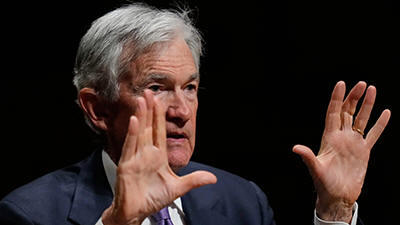
Federal Reserve Chair Jerome Powell gestures while addressing
students at Harvard University, Monday, March 30, 2026, in
Cambridge, Mass. (AP Photo/Charles Krupa)
 The minutes, released three weeks
after the meeting, underscore the Fed's dilemma as it seeks to fill
its congressional mandates of low inflation and maximum employment.
Fed officials acknowledged that the Iran conflict could also force
households to cut back spending to offset higher gas prices,
according to the minutes, which would slow growth and raise
unemployment.
The central bank typically raises rates to cool the
economy and combat inflation, while it would cut them to bolster
growth and hiring. Navigating this “two-sided” risk of higher
unemployment and higher inflation poses a difficult challenge for
the Fed.
On Friday, the first signs of the impact the gas price spike is
having on inflation will emerge, as the government is scheduled to
release the March inflation report. Economists forecast it will show
a huge 0.9% increase in March from February, with prices rising 3.4%
compared to a year earlier. In February, inflation was just 2.4%.
The Fed targets a 2% inflation rate, and officials will likely be
unnerved by a steady increase.
Earlier this week, Beth Hammack, president of the Federal Reserve
Bank of Cleveland, said that estimates by her bank show inflation
will likely rise even higher this month. “Inflation has been running
above our target for more than five years now,” she added in an
interview, voicing a common concern among many policymakers, and a
further increase would mean it is “moving in the wrong direction.”
All contents © copyright 2026 Associated Press. All rights reserved |