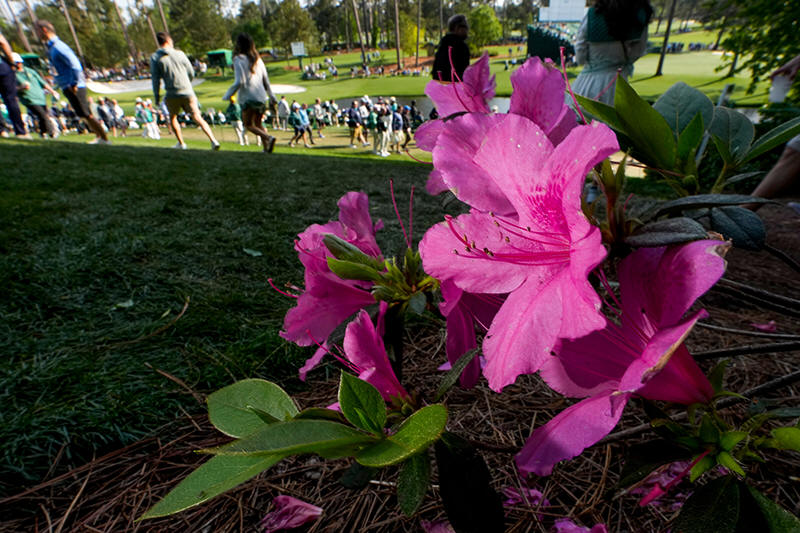
Masters in bloom: More than azaleas
and dogwood make up golf's most beautiful garden
[April 09, 2026]
By DOUG FERGUSON
AUGUSTA, Ga. (AP) — Azaleas and dogwoods are as synonymous with the
Masters as Jack Nicklaus and Tiger Woods, which is a little unfair —
not to the other 55 Masters champions, but to the other 350 species
of flora that make Augusta National a golf course unlike any other.
The par-3 16th is famous for Woods hitting that pitch that made a
U-turn at the top of the slope, hung on the edge of the cup and
dropped during his 2005 victory. No eyes were on the beautiful
Redbud shrub with its vibrant pink blooms.
The par-3 12th hole is associated with its name on the scorecard,
“Golden Bell,” a yellow bloom native to Asia. Ask just about any
player at the Masters if they've ever seen a Golden Bell and it's
doubtful. It blooms in late winter. The Masters is golf's rite of
spring.
“I’ve played the 12th enough. I’m sure I’ve seen one somewhere,”
Rory McIlroy said.
Pebble Beach is the felicitous meeting of land and sea. Augusta
National is the greatest garden in golf, because that's what it was
before Bobby Jones went looking for land to build his golf course
and found the 365-acre Fruitland Nurseries.
“Perfect! And to think this ground has been lying here all these
years waiting for someone to come along and lay a golf course on
it,” Jones said when he first laid eyes on the property.
He took out an option for $70,000.
Augusta National doesn't speak in numbers — from the size of the
gallery to how fast the greens are running on the Stimpmeter — but
the course is believed to have some 80,000 flowering plants and
trees on its immaculate landscape.

The flora is such an integral part of Augusta National that each
hole is named for a tree or a shrub that can be found on that hole.
“I know azalea is one of them,” Dustin Johnson said.
Good guess. It took him a few seconds to associate “Azalea” with the
iconic par-5 13th, which has approximately 1,600 azalea bushes, many
of them surrounding the back of the green.
Remarkably, Johnson knew the seventh hole was named, “Pampas,” a
grass bush native to Argentina that grows about 12 feet high and
blooms in late summer. The hole used to be 340 yards with no
bunkers. Now it's 450 yards, straight and narrow and tough.
“Perfect name,” Johnson said, “because it is an ass of a hole.”
Johnson also knew there was a dogwood or two on the scorecard
without knowing exactly where (Pink Dogwood for No. 2, White Dogwood
for No. 11). And there's no shame in that.
Two-time champion Scottie Scheffler — the No. 1 player in the world,
and with a degree from Texas in finance, not horticulture — paused
under the live oak next to the clubhouse when asked how many plants
he could name associated with each hole.
“Magnolia for 5?” he asked. He hit one of his purest shots on the
fifth hole when he won in 2022. He didn't have to venture into the
magnolia trees behind the tree.
[to top of second column] |
Azalea backdrop Sungjae Im, of South Korea, as he chips onto the
green on the16th hole during a practice round ahead of the Masters
golf tournament at the Augusta National Golf Club, Tuesday, April 7,
2026, in Augusta, Ga. (AP Photo/Matt Slocum, File)

He also named Azalea and Golden Bell — “I got more than I thought,”
he said — but whiffed on Holly, the red-berry bushes found on both
sides of the 18th tee.
McIlroy, the defending champion, has a greater appreciation of
history and heritage than most golfers. He didn't think he could get
the names on all 18 holes before rattling off Firethorn (15),
Azalea, Golden Bell, Pink Dogwood ... and then he stumbled.
“White Dogwood, 10?” he said.
No. The 10th hole is Camelia, another one that typically blooms well
before the Masters.
The beauty of Augusta National cannot be overstated, and its history
of flora is rich. Fruitland Nurseries dates to 1858, a partnership
between a Belgian baron named Louis Berckmans and his son, Prosper.
They imported trees and plants from all over the world. The nursery
ceased operations in 1918 after they died. What remained were a long
row of magnolias that had been planted before the Civil War, and the
azalea bush that Prosper Berckmans popularized.
A word about the famous azaleas at Augusta National.
No, the club's horticulture staff does not pack them in ice to keep
the blooms from bursting before the Masters. There have been the
occasional “green” Masters without many blooms, and that almost was
the case this year. The blooms are fading but still colorful.
The staff will get to work two days after the Masters is over,
fertilizing and pruning. And it takes great care — the azalea bushes
are pruned by hand, a project that can take three months.
There is one palm tree at Augusta National, just to the right of the
green on the par-3 fourth. The name of the hole later was changed
from Palm to Flowering Crabapple with its red, pink and white blooms
(they usually pop right after the Masters).
That tripped up Chris Gotterup, one of the 22 newcomers to the
Masters this year.
“Is every hole named after a flower?" Gotterup said Monday. “Because
we were playing 4 today. Is palm a flower?”
It all weaves together in a magnificent landscape, a deceptive
beauty as the backdrop to intense pressure trying to win one of
golf's grandest prizes. Jones might have summed it up best.
"Never was the iron gauntlet of challenge more skillfully concealed
in velvet.”
All contents © copyright 2026 Associated Press. All rights reserved
 |