For Chinese visa-seekers in the US, the path to good fortune lies in …
Chick-fil-A?
[April 10, 2026] By
FU TING
ARLINGTON, Va. (AP) — On a recent weekend afternoon, at a Chinese comedy
show in northern Virginia, the host asked the audience, “What food do
you like?” The loudest answer echoed through the hall: “Chick-fil-A!”
“You still haven’t gotten your H-1B lottery, ha?” quipped the host,
citing the most popular work visa among Chinese students.
It's an easy-to-get joke in the Chinese student community, where those
eager for U.S. visas believe their chances at success might hinge upon
something unexpected: an American chicken sandwich and the company
behind it.
Chick-fil-A has no branches in China. But the brand has enticed Chinese
students in the U.S. for a simple reason: “Chick-fil-A” sounds like
“check files.” In a culture that puts great stock in soundalike words
and numbers, it is believed to bring good luck to those with complicated
visa applications.
“It feels like I am one step closer to the green card after having a
Chick-fil-A meal,” says Zhou Yilu, an AI software engineer in his late
30s who lives in Wilmington, Delaware.
Since arriving in the United States as a student 14 years ago, Zhou has
had a roller-coaster experience with his visa status. He was repeatedly
asked to add paperwork while switching among four types of visas, one of
which was approved days ahead of its expiration. That was when Zhou
turned to the popular poultry purveyor.
No one can say who originally had the idea, but it has been kicking
around the Chinese student community for years, especially for visa
applications such as the H-1B, which is based on a lottery system and
has become harder to secure.

Some 3D-print the Chick-fil-A logo on coasters. Some embroider the logo
into a small cross-stitch pendant for key chains. Others set Chick-fil-A’s
logo as their profile picture on social media, sometimes converting it
from red to green — as in green card.
Chick-fil-A didn’t respond to emails seeking comment.
They believe they're one wordplay away from ‘stay’
Chinese people, particularly younger ones, have long been enthusiastic
about wordplay.
On the night before Christmas, for example, eating apples — “pingguo” in
Mandarin — flourishes because the word echoes “ping’an ye,” which means
Christmas Eve. Brides carry lettuce bouquets because lettuce —
“shengcai” — sounds like “getting rich.” Who doesn’t like catching that
at a wedding? A much older use of wordplay lies in Chinese people’s
aversion to the number four, which sounds like the word for death in
Mandarin.
The Chick-fil-A superstition reflects how difficult it is for immigrants
to overcome the obstacles to work legally in the U.S., even for those
with prestigious educational backgrounds and high-level job titles.
More than 46,000 Chinese students and workers were approved for H-1B
visas in 2024. Approved Chinese applicants account for 11.7%, the
second-largest group by country, after India at 70%.
Fan Wu, a data scientist living in Indianapolis, didn't win his H-1B
lottery despite changing his social media profile picture to the
fast-food chain’s red logo and traveling to Hawaii to pray at a Japanese
Taoist temple.
“I was forced to turn to these mysteries,” he says. “The lottery itself
is a matter of chance. It depends on luck, and we need another mystery
to echo it.”
It goes beyond chicken. The need for better fortune in visa lotteries
has given rise to a new profession — agents who pray in temples across
the Pacific on behalf of others.

[to top of second column] |
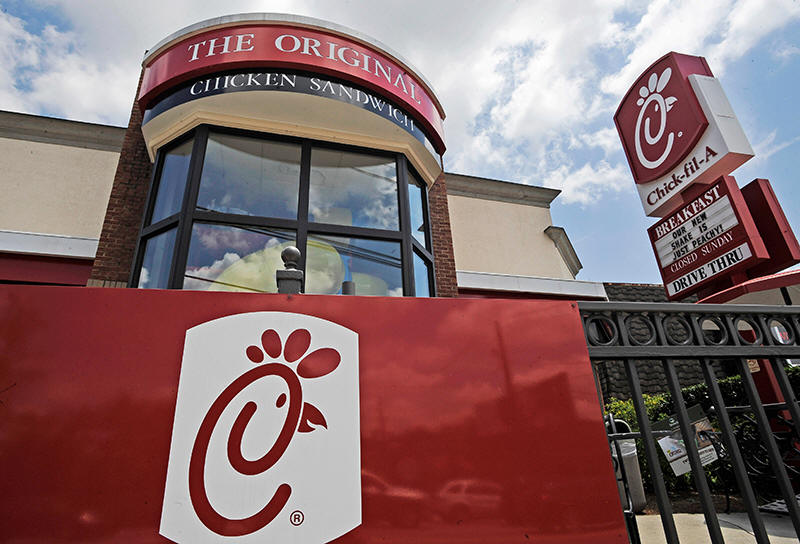
A Chick-fil-A fast food restaurant in Atlanta on July 19, 2012. (AP
Photo/Mike Stewart, File)
 When the students reach out to
24-year-old Meng Yanqing in Beijing, across the world, through the
social media platform Xiaohongshu, Meng lines up to enter and pray
at the popular Lama Temple, holding a paper between his palms that
expresses his wish for an H-1B visa. That involves “precise
positioning” with their personal information, such as passport
numbers and birthdays.
“I respect them, they have their demands, and I
offer the service,” says Meng, who also helps his clients buy
consecrated bracelets from the temple and send them across the
Pacific to the U.S. “I truly hope the best for them.”
The visa issue is always looming
The Trump administration’s abrupt decision to impose a $100,000 fee
on H-1B visas a few months ago stunned Chinese students and workers,
created chaos and fostered a more chilling atmosphere. It was later
explained that it only applied to the new visas. But the
roller-coaster experience added anxiousness to a landscape for
Chinese students that already includes language and cultural
barriers and a tight job market.
Some experts believe employers’ sponsorship of green cards through
visas like H-1B is why the United States can attract some of the
best and brightest.
“A real talent pipeline,” says Juliet Gelatt, associate director of
U.S. Program under Migration Policy Institute based in Washington,
“we’ve really benefited as a country and as an economy from bringing
in smart young people from all around the world, including from
China.”
The air of suspicion surrounding Chinese immigrants, especially in
high-tech industries, makes it even harder. Experts warn that it
reduces the U.S.’s ability to attract international talent.
One manager at a new energy company in his late 20s finally changed
his profile picture to the chicken logo after months of waiting for
his visa. Like many Chinese, he would give only his surname, Yang,
and otherwise spoke anonymously, fearing trouble with his visa
status. Of his status in the United States, he says, “It feels like
living under someone else’s roof.”

The United States limits participation in the H-1B visa lottery.
STEM majors are eligible for three years of optional practical
training under their F-1 student visa, while other majors are
eligible for one year. After that, they turn to Chick-fil-A while
seeking a work visa to continue their work in the United States.
For Harriet Peng, a data analyst living in northern Virginia, eating
a chicken sandwich and having the company's T-shirt on the back of
her chair weren't enough. After losing the lottery repeatedly, she
went to a temple in upstate New York to pray in person — or, as she
puts it, to “make some efforts using scientific materialist methods
in metaphysics.”
The temple contains many sculptures of gods, each representing a
particular aspect of life, such as fortune or childbirth. There is,
she says, no god for visas.
Nevertheless, Peng jokes, “I knelt in front of almost every god and
prayed, in case they all know each other.”
All contents © copyright 2026 Associated Press. All rights reserved |