Inflation may jump by most in nearly four years as gas prices spike in
wake of Iran war
[April 10, 2026] By
CHRISTOPHER RUGABER
WASHINGTON (AP) — Soaring gas prices are expected to produce a spike in
inflation when the government reports consumer prices for March on
Friday, likely unnerving the inflation fighters at the Federal Reserve
and heightening the political challenges of rising costs for the White
House.
Inflation probably rose to 3.4% in March compared with a year ago,
economists estimate, which would be a sharp increase from February's
2.4% increase. On a monthly basis, prices are forecast to have risen
0.9% in March from the previous month, according to a survey of
economists by data provider FactSet. That would be largest monthly
increase since 2022.
Until now there had been a slight moderating trend in inflation since
last fall. A reading of 3.4% would be the highest in nearly two years,
and is far above the Fed's 2% target.
“There is going to be a headline sticker shock here,” said Michael
Metcalfe, head of macro strategy at State Street, which produces
PriceStats, a measure of inflation culled from millions of online
prices. Their data suggests inflation could leap by 1.5% just in March
from February.
Excluding the volatile food and energy categories, core prices are
projected to have risen 2.7% in March from a year earlier, up from 2.5%
in February. From February to March, core prices are expected to have
risen 0.3%, a faster pace than is consistent with the Fed's target.
Gas prices soared about 20% in March, a move that saps consumers'
ability to spend on other goods and services and as a result could also
slow economic growth. At least in the short run, many Americans can only
make limited changes to their daily driving habits, which are largely
determined by where they live, shop, and work. As a result, most people
will pay higher prices for gas, and potentially cut back elsewhere.
Gas prices averaged $4.17 a gallon nationwide Thursday, up 69 cents from
a month ago.

The big question for consumers and the economy is whether the surge in
oil and gas prices will create a sustained, broader inflation shock,
similar to what occurred in the aftermath of the pandemic in 2021-2022.
Inflation reached a peak of 9.1% in June 2022, as COVID-19 snarled
supply chains and several rounds of stimulus checks pushed up consumer
demand. Prices soared for groceries, furniture, restaurant meals and
many other goods and services.
This time, economists say the job market and consumer spending are
weaker, and there are no large government stimulus checks being issued
to spur demand. The unemployment rate is low, at 4.3%, but companies
aren't scrambling to hire the way they were when the economy emerged
from the pandemic, which led many firms to offer sharp pay increases to
attract and keep workers.
Rapid pay increases and solid income growth helped consumers weather the
higher prices that resulted from the pandemic's supply chain
disruptions, and fueled spikes in demand that led many companies to
raise prices further.
[to top of second column] |
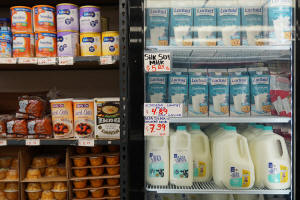
Pantry staples, including infant formula and dairy products, are
sold at a market serving the Central American immigrant community in
the Westlake/Pico Union area of Los Angeles, Tuesday, April 7, 2026.
(AP Photo/Damian Dovarganes)
 “That’s where this really differs,
is that we aren’t seeing anywhere near the strength of demand,” Alan
Detmeister, an economist at UBS, said. In 2021 and 2022, income
growth “was increasing really strongly. We aren't seeing that now,”
he added.
Detmeister thinks the better comparison will likely be to 1990-91,
when higher oil and gas prices stemming from Iraq's invasion of
Kuwait contributed to a recession, but didn't lead to a jump in
inflation, in part because of weaker consumer spending.
The gas price spike's impact on inflation is, in some ways, similar
to President Donald Trump's tariffs, in that their effect will
depend largely on the size and duration of the increase.
For now, economists expect that in March and April the impact will
largely be confined to energy-intensive industries, such as
airlines, package delivery services and public transportation.
Overall, the U.S. economy is much less dependent on oil and gas than
it was in previous decades.
Still, the large jump in inflation — which is almost certain to
continue for several months — has already shifted the debate at the
Federal Reserve, which began the year expecting to cut its key
interest rate at least a couple of times. But a growing number of
Fed officials are now willing to consider hiking rates instead if
core inflation doesn't cool noticeably.
Most officials are almost certain to support keeping the Fed's key
interest rate unchanged in the coming months, at about 3.6%, as they
evaluate how the economy evolves. Investors now don't expect the Fed
to cut rates until late 2027.
Higher gas prices are tricky for the Fed because they can also slow
growth by weighing on consumer spending, potentially causing
layoffs. The Fed would typically cut its rate to encourage more
spending if unemployment rises, while it raises rates to combat
inflation.
More expensive oil and gas will also likely lift grocery prices,
creating more pain for consumers who have already absorbed a roughly
25% jump in food costs since the pandemic. Nearly all groceries are
shipped by diesel-fueled trucks, and diesel fuel prices have risen
even more than those for regular gas. Still, analysts don't expect
food prices to accelerate for another month or two.
All contents © copyright 2026 Associated Press. All rights reserved |