US abortion opponents want Trump's FDA to act on abortion pill
restrictions
[April 10, 2026]
By GEOFF MULVIHILL and MATTHEW PERRONE
U.S. abortion opponents are increasingly frustrated with the lack of
action by President Donald Trump's administration to stem the flow of
abortion pills prescribed online that they view as undermining state
abortion bans.
A court ruling this week in a lawsuit the Louisiana attorney general
brought against Trump's Food and Drug Administration cast a spotlight on
the simmering tension. The judge said the state has a strong case while
declining to block telehealth prescriptions to the pill mifepristone for
now.
Anti-abortion groups are pushing the FDA to move faster with a review
that they hope will result in restrictions on the abortion pill
mifepristone, including blocking its prescribing via telehealth
platforms. The administration says the work takes time.
The groups have focused mostly on the health agency and not the
Republican president whose three U.S. Supreme Court appointees were
instrumental in the 2022 ruling that overturned Roe v. Wade and allowed
the state bans in the first place. But the administration's requests in
the Louisiana lawsuit and similar ones elsewhere to delay rulings until
it finishes a review have sparked anger for some activists.
“The stall tactics are beyond frustrating,” Kristi Hamrick, a
spokesperson for Students for Life of America, said in an interview.
Hamrick said the administration could also block the pills from being
mailed by changing its interpretation of a 19th century law and
enforcing it.

A judge opened the door to pushing the administration
U.S. District Judge David Joseph, who was nominated to the bench by
Trump, gave a mixed ruling Tuesday in a case brought by Louisiana
Attorney General Liz Murrill and a woman who says her boyfriend coerced
her into taking mifepristone to end a pregnancy.
Their overall aim is to roll back FDA rules that have made the pills
more accessible. Murrill, like officials in other states that have filed
similar lawsuits, contends that the availability of the pills via online
providers takes the teeth out of the bans in the 13 states that bar
abortion at all stages of pregnancy, with limited exceptions.
Surveys of abortion providers have suggested that its availability
through telehealth is a reason the number of abortions in the U.S. has
not dropped since the overturn of Roe. While state abortion bans include
prohibitions on abortion using the pills, some Democratic-controlled
states have adopted laws that seek to protect medical providers who
prescribe them over telehealth and mail the pills to states with bans.
Those so-called shield laws are being tested through civil and criminal
cases.
In the Louisiana case, Joseph declined to grant Murrill's request to
block telehealth prescriptions to the pills while the case moves through
the courts. But he said he could do that eventually and the plaintiffs
in the case are likely to succeed on the merits of their arguments
because the state has demonstrated it's suffered “irreparable harm.”
He also ordered the FDA to report to him within six months on the status
of its review of the drug.
On Wednesday, Murrill filed a notice that she's taking the case to the
U.S. 5th Circuit Court of Appeals in hopes of forcing faster action.
The politics aren't simple
Family Research Council President Tony Perkins, an influential
conservative voice who is also a former Louisiana lawmaker, applauded
Murrill's step.
He said people he meets are often shocked to learn that the number of
abortions has not dropped since the 2022 Supreme Court ruling.

[to top of second column]
|
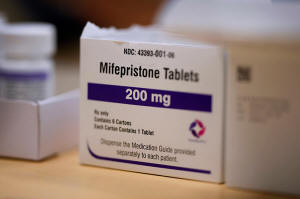
Mifepristone tablets sit on a table at a Planned Parenthood clinic
in Ames, Iowa, July 18, 2024. (AP Photo/Charlie Neibergall, File)
 “Bewilderment sets in,” he said.
“We’re already seeing an enthusiasm gap between the parties. What
the Republicans do not need is a dampening of enthusiasm in their
base.”
He's hoping the administration will restrict abortion pills rather
than risk losing support from conservative, anti-abortion voters in
November's midterm elections.
Other groups are being more cautions.
Madison LaClare, director of federal government affairs at National
Right to Life, said her group trusts the administration to review
mifepristone. Marjorie Dannenfelser, president of SBA Pro-Life
America, avoided harsh words for the president: “The Trump-Vance
administration has an important opportunity right now to prioritize
women’s safety,” she said in a statement.
Still, recent electoral results suggest that voters seeking to keep
abortion available have the political momentum. Since Roe was
overturned, abortion has been on the ballot directly in 17 states.
Voters have sided with the abortion-rights side in 14 of those
questions.
“There seems to be an emerging consensus in the country that people
don’t want to ban abortion,” said Rachel Rebouche, a professor at
the University of Texas School of Law who studies abortion.
The FDA says it's working on it
In a statement Wednesday in response to questions from The
Associated Press, the FDA said it's reviewing the safety of
mifepristone, “including the collection of robust and timely data,
evaluation of data integrity, and implementation of the analyses,
validation, and peer-review.”
After that, the agency said, it will decide whether to make changes
to the rules about how the drug can be prescribed.
It said this kind of study can take a year or more to complete by
academics but the agency is trying to move faster than that. A
spokesperson did not answer questions about when the work began.

Mifepristone has been a political priority for anti-abortion
activists and their allies in Congress since Trump returned to
office last year. In his January 2025 confirmation hearing, Health
and Human Services Secretary Robert F. Kennedy Jr. was repeatedly
asked about the drug by Republican lawmakers and said the president
had requested a safety review.
Frustration over signs that the FDA isn't prioritizing curbing
abortions flared last fall when the FDA approved an additional
generic version of mifepristone.
The drug is most often used for abortion in combination with another
drug, misoprostol.
Mifepristone was approved in 2000 as a safe and effective way to end
early pregnancies.
Because of rare cases of excessive bleeding, the FDA initially
imposed strict limits on who could prescribe and distribute the pill
— only specially certified physicians and only after an in-person
appointment where the person would receive the pill.
Both those requirements were dropped during the COVID years. At the
time, FDA officials said that after more than 20 years of monitoring
mifepristone use, and reviewing dozens of studies involving
thousands of women, it was clear that women could safely use the
pill without direct supervision.
All contents © copyright 2026 Associated Press. All rights reserved |