Taiwan's opposition leader meets China's Xi Jinping as both sides call
for peace
[April 10, 2026]
By HUIZHONG WU and HAN GUAN NG
BEIJING (AP) — Taiwan's opposition leader met Friday with Chinese
President Xi Jinping at Beijing’s Great Hall of the People, the first
such encounter in over a decade, with both sides affirming the need for
maintaining peace around the self-ruled island that China claims as its
territory.
Both Xi and Cheng Li-wun, the head of the Beijing-friendly Kuomingtang
Party, reiterated they wanted to move toward a peaceful reunification of
Taiwan and the mainland, though it remains unclear how they would
achieve it. China hasn't ruled out the use of force and has stepped up
its military exercises around Taiwan, sending warships and fighter jets
closer toward the island and steadily poaching Taiwan’s few remaining
diplomatic allies.
Xi welcomed Cheng and her party's representatives in the Great Hall of
the People, where he usually meets world leaders, to a round of applause
from both sides. “The larger trend of compatriots on both sides of the
strait walking nearer, closer, and together will not change. This is a
historical necessity. We have full confidence in this,” he said.
"Although people on both sides of the Taiwan Strait live under different
systems, we will respect each other and move towards each other,” Cheng
said, adding: “We will seek systemic solutions to prevent and avoid
war.”
She arrived in Beijing on Tuesday after visiting Shanghai and Nanjing.
Cheng has previously described herself as a promoter of peace between
Taiwan and China. She has opposed large increases in Taiwan's defense
spending and her party continues to block President Lai Ching-te's
special defense budget for arms purchases, including building an air
defense system with interception capabilities called the Taiwan Dome.

Taiwan has been governed separately from China since 1949, when a civil
war brought the Communist Party to power in Beijing. Defeated
Kuomingtang forces fled to Taiwan, where they set up their own
government.
Taiwanese President Lai Ching-te did not directly address Cheng’s China
visit, but issued a statement Friday morning urging for the KMT to
approve his special defense budget. He said that “history tells us that
compromising with authoritarian regimes only comes at the cost of
sovereignty and democracy, and will not bring freedom or peace.”
Cheng had said she would push for a “framework for peace" between China
and Taiwan, but did not offer any specifics when asked by reporters in
Beijing after her meeting with Xi. She said she raised the issue of
increasing Taiwan's international profile, such as participation in the
Regional Comprehensive Economic Partnership free trade agreement, and
that Xi responded “positively."
[to top of second column]
|
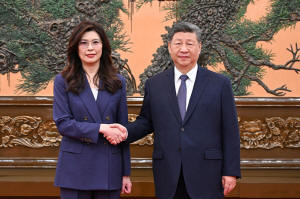
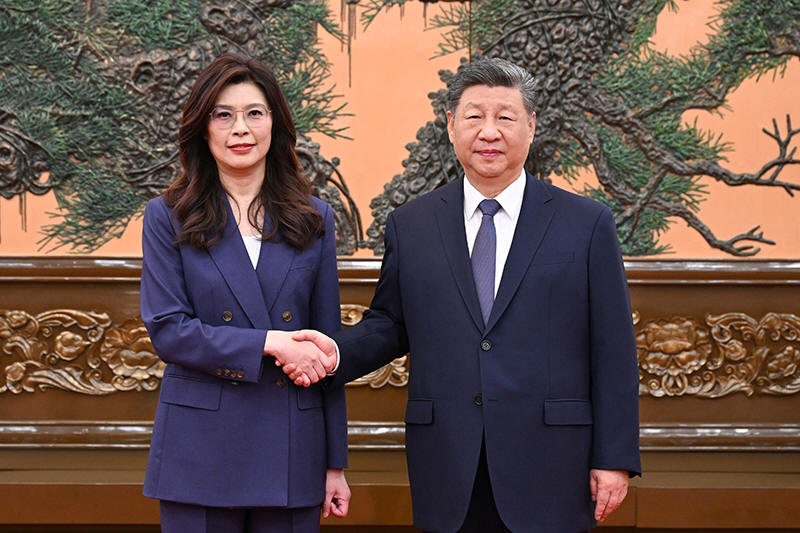
In this photo released by Xinhua News Agency, Chinese President Xi
Jinping, right shakes hands with Kuomintang (KMT) party leader Cheng
Li-wun in Beijing on Friday, April 10, 2026. (Xie Huanchi/Xinhua via
AP)

Cheng said both parties will work to make sure “the Taiwan Strait
will no longer be a flash point with the possibility of conflict,
and will not become a chess piece played by the outside world.”
“Her speech is not like that of a Taiwanese politician,” said Weihao
Huang, a professor of political science at National Sun Yat-sen
University in Taiwan, saying she didn't mention the public. “You
can't see the public's mindset from her words. It's either her words
are being restricted by China or that she was willing for China to
restrict it.”
Both Xi and Cheng said they would uphold the 1992 Consensus and
opposed Taiwan's independence.
The 1992 Consensus is a tacit agreement, never formally enshrined as
a document, that Taiwan and China all belong to one China. However,
while the KMT said the 1992 Consensus means they belong to “One
China” with separate interpretations of what China means, the
Communist Party has never acknowledged that.
“This visit is more significant to Xi than to Cheng," said Ma Chun-wei,
an expert in China-Taiwan relations at Taiwan's Tamkang University.
”At the local level, the KMT's grassroots members didn't really want
Cheng to visit China at this time" ahead of local elections later
this year.
But for Xi, this visit is a chance to have a grip on China-Taiwan
relations with Cheng, Ma said, as there's been no official contact
between the governments since the Democratic Progressive Party came
into power. Further, Xi can tell the U.S. to not interfere as “he
has a channel and the ability to deal with the Taiwan issue.”
___
Wu reported from Bangkok.
All contents © copyright 2026 Associated Press. All rights reserved
 |