Hungarian Prime Minister Orbán is ejected after 16 years in a European
electoral earthquake
[April 13, 2026]
By JUSTIN SPIKE and SAM McNEIL
BUDAPEST, Hungary (AP) — Hungarian voters on Sunday ousted long-serving
Prime Minister Viktor Orbán after 16 years in power, rejecting the
authoritarian policies and global far-right movement that he embodied in
favor of a pro-European challenger in a bombshell election result with
global repercussions.
It was a stunning blow for Orbán — a close ally of both U.S. President
Donald Trump and Russian President Vladimir Putin — who quickly conceded
defeat after what he called a ″painful″ election result. U.S. Vice
President JD Vance had made a visit to Hungary just days earlier, meant
to help push Orbán over the finish line.
Election victor Péter Magyar, a former Orbán loyalist who campaigned
against corruption and on everyday issues like health care and public
transport, has pledged to rebuild Hungary's relationships with the
European Union and NATO — ties that frayed under Orbán. European leaders
quickly congratulated Magyar.
His victory was expected to transform political dynamics within the EU,
where Orbán had upended the bloc by frequently vetoing key decisions,
prompting concerns he sought to break it up from the inside.
It will also reverberate among far-right movements around the world,
which have viewed Orbán as a beacon for how nationalist populism can be
used to wage culture wars and leverage state power to undermine
opponents.
It's not yet clear whether Magyar’s Tisza party will have the two-thirds
majority in parliament, which would give it the numbers needed for major
changes in legislation. With 93% of the vote counted, it had more than
53% support to 37% for Orbán’s governing Fidesz party and looked set to
win 94 of Hungary's 106 voting districts.
“I congratulated the victorious party,″ Orban told followers. “We are
going to serve the Hungarian nation and our homeland from opposition.″

Jubilation erupted along the Danube
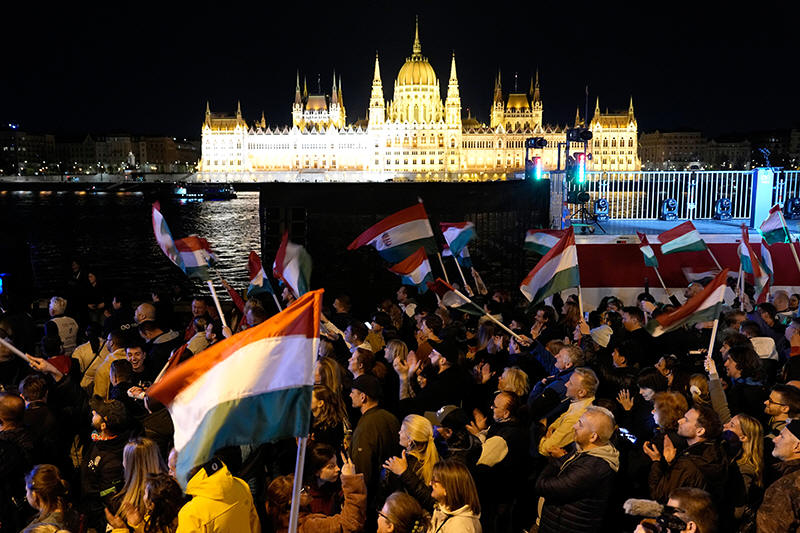
In a speech to tens of thousands of jubilant supporters at a victory
party along the Danube River, Magyar said his voters had rewritten
Hungarian history.
“Tonight, truth prevailed over lies. Today, we won because Hungarians
didn’t ask what their homeland could do for them — they asked what they
could do for their homeland. You found the answer. And you followed
through,” he said.
On the streets of Budapest, drivers blared car horns and cranked up
anti-government songs while people marching in the streets chanted and
screamed.
Many revelers chanted “Ruszkik haza!” or “Russians go home!” — a phrase
used widely during Hungary’s 1956 anti-Soviet revolution, and which had
gained increasing currency amid Orbán’s drift toward Moscow.
Turnout in the election was nearly 80%, according to the National
Election Office, a record number in any vote in Hungary’s post-Communist
history.
‘Choice between East or West’
Orbán, the EU’s longest-serving leader and one of its biggest
antagonists, traveled a long road from his early days as a liberal,
anti-Soviet firebrand to the Russia-friendly nationalist admired today
by the global far-right.
The EU will be waiting to see how Magyar changes Hungary's approach to
Ukraine. Orbán repeatedly frustrated EU efforts to support the
neighboring country in its war against Russia’s full-scale invasion,
while cultivating close ties to Putin and refusing to end Hungary’s
dependence on Russian energy imports.
Recent revelations have shown a top member of Orbán's government
frequently shared the contents of EU discussions with Moscow, raising
accusations that Hungary was acting on Russia’s behalf within the bloc.
Members of Trump's “Make America Great Again” movement are among those
who see Orbán's government and his Fidesz political party as shining
examples of conservative, anti-globalist politics in action, while he is
reviled by advocates of liberal democracy and the rule of law.

[to top of second column]
|
Supporters of Peter Magyar, the leader of the opposition Tisza party
celebrates after a parliamentary election in Budapest, Hungary,
Sunday, April 12, 2026. (AP Photo/Darko Bandic)

In Budapest, Marcell Mehringer, 21, said he was voting “primarily so
that Hungary will finally be a so-called European country, and so
that young people, and really everyone, will do their fundamental
civic duty to unite this nation a bit and to breakdown these
boundaries borne of hatred.”
Strained relationship with the EU
During his 16 years as prime minister, Orbán launched harsh
crackdowns on minority rights and media freedoms, subverted many of
Hungary's institutions and been accused of siphoning large sums of
money into the coffers of his allied business elite, an allegation
he denies.
He also heavily strained Hungary's relationship with the EU.
Although Hungary is one of the smaller EU countries, with a
population of 9.5 million, Orbán has repeatedly used his veto to
block decisions that require unanimity.
Most recently, he blocked a 90-billion euro ($104 billion) EU loan
to Ukraine, prompting his partners to accuse him of hijacking the
critical aid.
His challenger came from the inside
Magyar, 45, rapidly rose to become Orbán's most serious challenger.
A former insider within Orbán's Fidesz, Magyar broke with the party
in 2024 and quickly formed Tisza. Since then, he has toured Hungary
relentlessly, holding rallies in settlements big and small in a
campaign blitz that recently had him visiting up to six towns daily.
In an interview with The Associated Press earlier this month, Magyar
said the election will be a “referendum” on whether Hungary
continues on its drift toward Russia under Orbán, or can retake its
place among the democratic societies of Europe.
Tisza is a member of the European People's Party, the mainstream,
center-right political family with leaders governing 12 of the EU's
27 nations.
Uphill election battle
Magyar faced a tough fight. Orbán's control of Hungary's public
media, which he has transformed into a mouthpiece for his party, and
vast swaths of the private media market give him an advantage in
spreading his message.
The unilateral transformation of Hungary's electoral system and
gerrymandering of its 106 voting districts by Fidesz also required
Tisza to gain an estimated 5% more votes than Orbán’s party to
achieve a simple majority.
Additionally, hundreds of thousands of ethnic Hungarians in
neighboring countries had the right to vote in Hungarian elections
and traditionally have voted overwhelmingly for Orbán's party.

Russian secret services have plotted to interfere and tip the
election in Orbán's favor, according to numerous media reports
including by The Washington Post. The prime minister, however,
accused neighboring Ukraine, as well as Hungary's allies in the EU,
of seeking to interfere in the vote to install a “pro-Ukraine”
government.
___
Associated Press journalists Béla Szandelszky, Marko Drobnjakovic,
Ivan L. Nagy, Florent Bajrami in Budapest, Hungary, and Angela
Charlton in Paris contributed to this report.
All contents © copyright 2026 Associated Press. All rights reserved |