Election loss for Hungarian Prime Minister Orbán has ripple effects for
Trump, US conservatives
[April 13, 2026]
By NICHOLAS RICCARDI and MATT BROWN
WASHINGTON (AP) — The big election over the weekend was in a small
European country nearly half a world away from Washington, but the
defeat of Hungarian Prime Minister Viktor Orbán has significant
reverberations in the United States.
That's because President Donald Trump and many U.S. conservatives have
long embraced Orbán, who has become an icon among the global right for
his anti-immigrant stance. The American president's agenda has striking
parallels with the way the Hungarian leader used the levers of
government to tilt the media, judiciary and electoral system to keep his
party in power for 16 years.
Trump supported Orbán’s reelection bid and even dispatched Vice
President JD Vance to Budapest last week — in the midst of the Iran war
— to stump for the incumbent.
Orbán's loss was a reminder of how the war has diminished Trump's
ability to help allied politicians overseas, as well as of the limited
ability of leaders to use their power to tilt voting in their direction
in an age of worldwide discontent over incumbents of all ideological
stripes.
“Oppositions can win despite a tilted playing field,” said Steven
Levitsky, a politics professor at Harvard and coauthor of the book “How
Democracies Die.” “Democracies are facing many challenges in many parts
of the world, but so are autocracies.”
Orbán’s defeat has immediate global implications because he was the
European leader closest to Russian President Vladimir Putin and had
blocked European Union aid to Ukraine, which is defending itself after
Russian's 2022 invasion.
His fall was celebrated on Sunday by both Democrats and Republicans,
some of whom criticized their own administration for such overt support
for the Hungarian leader.

“Don’t fiddle-paddle in other democracies’ elections,” Republican Rep.
Don Bacon of Nebraska said on the social media site X.
“The freedom-loving people of Hungary have voted decisively in favor of
democracy and the rule of law,” posted Republican Sen. Roger Wicker of
Mississippi.
Matt Schlapp, chairman of the American Conservative Union, is part of
the wing of the American right that embraced Orbán. The Conservative
Political Action Conference, which Schlapp's group hosts, held its first
European session in Budapest and has made Hungary a regular destination.
Orban was a featured speaker at the group's conference in Dallas in
2022.
Schlapp said there's an easy explanation for Orbán's loss.
“Eventually, democracies just want change,” he said. “In democracies,
you don't have kings, and the people in the end speak.”
"The people of Hungary were saying, 'We're having a difficult time with
inflation, the economy and the war. Let's try the new guy,'” Schlapp
said, noting that he backs Trump's Iran war but the turmoil it's
created, especially in European energy markets, hurt Orbán.
Diana Sosoaca, a far-right member of the European Parliament from
Romania, on Sunday called Vance's Hungarian visit “a big mistake” given
widespread revulsion at the Iran war on the continent.
“You invite a representative of the United States of America, who
created the big disorder in this world?” Sosoaca said in an interview
posted by the Kremlin-controlled network RT, formerly known as Russia
Today. “It was the biggest mistake he could do before the elections.”

[to top of second column]
|
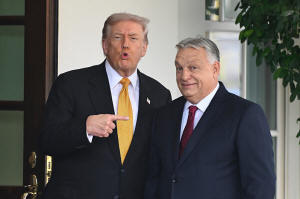
President Donald Trump, left, greets Hungary's Prime Minister Viktor
Orban at the White House, Friday, Nov. 7, 2025, in Washington. (AP
Photo/John McDonnell,File)

How Orbán consolidated power
An anti-communist activist in his youth, Orbán was initially elected
prime minister in 1998 but took a turn to the right after being
voted out in 2002. Upon returning to office in 2010, Orbán and his
Fidesz party implemented a legal framework to consolidate authority
that he and his allies developed while he was out of power.
Orbán embraced what he dubbed “illiberal democracy,” building a
barrier on Hungary's southern border to block migrants from Africa
and Asia who were moving northward through Europe. He and his party
stifled LGBTQ+ rights, cracked down on freedom of the press and
undermined judicial independence.
Orbán cemented his power when his Fidesz party won enough seats in
Parliament during the 2010 global recession to rewrite the country's
constitution. They restructured the judiciary to funnel appointments
to the bench through party loyalists, redrew legislative districts
to make it much harder for Fidesz members to lose elections and
helped push Hungary's media companies to be sold to tycoons allied
with Orban.
The European Union has declared Hungary an “electoral autocracy.”
Orbán backers have scoffed at suggestions that the Hungarian leader
is an enemy of democracy, and on Sunday he quickly conceded his
loss. Democrats have worried that Trump will try to use his own
executive power to tilt November's midterm elections or the 2028
presidential vote to his party, much as Trump tried to use his
official powers to overturn Democrat Joe Biden's win in the 2020
presidential election.
“Most importantly for American voters, even a guy who rigs the
system can be defeated when the people unite and turn out against
him,” said Ian Bassin of Protect Democracy, a nonpartisan group that
says it combats authoritarianism.
Democrats weigh in
Democratic Rep. Ro Khanna of California took the opportunity to jab
at Vance: “Your ally Orban conceded. In 2028, will you @JDVance
follow suit if you lose?” he posted on X.

Levitsky said defenders of democracy shouldn’t take too much comfort
from Orbán’s loss, noting that in some ways Trump has been more
oppressive. He cited Trump’s use of the Justice Department to
investigate political opponents and the shooting deaths of
protesters by immigration officers -- steps that Orban’s government
never took, Levitsky said.
But Sen. Chris Van Hollen, a Maryland Democrat, said he sees
parallels between Trump's and Orban’s political projects, as well as
the potential fate of their parties at the polls.
“He was essentially doing what Donald Trump is trying to do here in
the United States,” Van Hollen said of Orban. “My read of the
election is that the people of Hungary rejected that, just like
people in the United States are rejecting that here at home.”
Trump made no public comments Sunday about the election results in
Hungary.
___
Riccardi reported from Denver.
All contents © copyright 2026 Associated Press. All rights reserved |