Mississippi reveals its full history for America's anniversary year, a
contrast to federal efforts
[April 13, 2026]
By GARY FIELDS and SOPHIE BATES
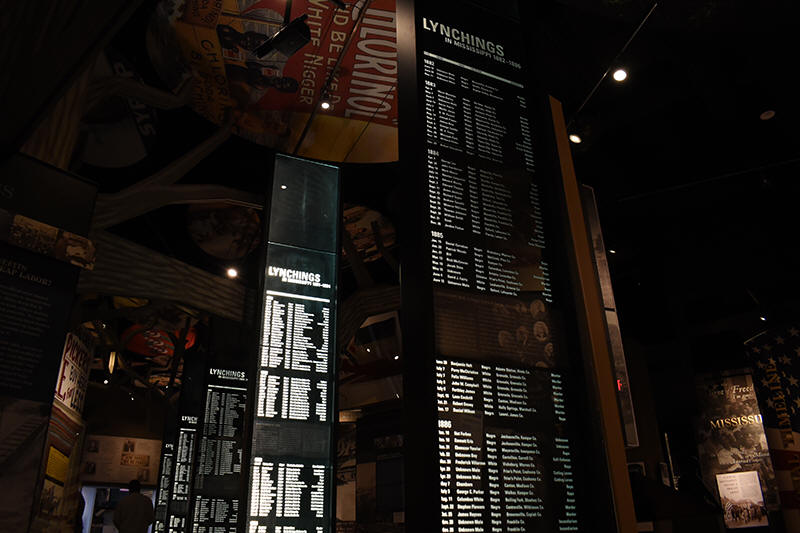
JACKSON, Miss. (AP) — The glass panels of the Lynching Victims Monolith
are simple, etched with the names of more than 600 victims of documented
racial killings in Mississippi, along with the attackers' motives.
One man, Malcolm Wright, was beaten to death in front of his family in
1949. His offense? “Hogging the road.” Further research revealed that
his mule-drawn wagon was, to his killers, moving too slowly.
The panels are among thousands of exhibits and artifacts inside the
Mississippi Civil Rights Museum and the adjoining Museum of Mississippi
History. Called the Two Mississippi Museums, the massive complex in
sight of the state Capitol is a central part of the state’s America 250
celebration.
“That’s just the people that we know about," Kiama Johnson, who was
visiting from Monroe, Louisiana, said of the victim panels as she sat
beyond the display and fought back tears. "Just imagine the ones that we
don’t. Imagine the ones that’s never going to be written in history
books.”
Mississippi’s warts-and-all approach to reflecting its history as part
of the state’s official commemoration of the nation’s 250th anniversary
is a stark contrast with what has taken place at the national level
since President Donald Trump returned to the White House in January
2025.
Easing the discomfort of a sometimes brutal American history has been a
central theme of Trump’s administration. He signed an executive order
his first day back in office eliminating diversity, equity and inclusion
efforts in the federal government. That, along with a March 2025
executive order, ” Restoring Truth and Sanity to American History,” have
led to signs being changed at federal parks, exhibits being altered or
in some cases removed, and military bases being renamed.
Part of the Republican administration's preparations to celebrate the
250th anniversary have included putting pressure on federal
institutions, including the Smithsonian, to tell a version of history
that is less focused on discrimination and episodes of racial violence.

In Mississippi, a temporary exhibit created specifically for the
commemoration — Mississippi Made -- fills a space that is routinely
changed to entice visitors to return. But it is housed in a space where
achievement is intertwined with the state’s dark past involving Native
Americans, enslaved people and the Civil Rights era.
Nan Prince, director of collections for the Mississippi Department of
Archives & History, said the instructions were simple from scholars,
politicians, staff members, and civic and civil rights groups when the
museums were being conceived and built.
“Don’t brush over anything, don’t whitewash anything," she said. "Just
tell the absolute truth.”
‘We weren’t going to hide anything'
Jackson Mayor John Horhn was a state senator when he began pushing for
the Civil Rights Museum in 1999. His efforts finally got a boost when
Haley Barbour, a former Republican National Committee chairman, became
governor.
Plans for the museum eventually were combined with a parallel effort to
move the state history museum from the Capitol grounds, with the complex
opening in 2017.
The approach to creating a state history museum was the same — tell the
full story, beginning with how Native Americans were removed from the
land.
“We said at the beginning we weren’t going to hide anything," Barbour
said in an interview, noting that he grew up in an era of segregation.
"We weren’t gonna try to justify what was done. That’s what the people
wanted — to say, ‘Look, we’re not proud of this, but we’re not going to
deny it.’”
Other states have made sure to highlight their diversity in their
presentations for the 250th anniversary. The America 250 description for
neighboring Alabama includes milestones in the Civil Rights Movement.
Mississippi takes its history head-on. Its “America 250 MS” platform
says the state’s history mirrors the American story, with the removal of
Native Americans making way for slavery and slavery leading to the Civil
War, followed by Reconstruction and the Jim Crow era.
Horhn praised the willingness of Mississippi leaders to use the museums
to tell the state's full story.
“We still have issues, we still have a lot of challenges," he said. "But
it’s a demonstration that progress has been made.”

[to top of second column]
|
Lynching monoliths at the Mississippi Civil Rights Museum display
the names of more than 600 victims of documented racial killings,
March 26, 2026, in Jackson, Miss. (AP Photo/Sophie Bates)

‘It just made me want to weep’
The History Museum opens into a gallery that explores Mississippi’s
first people, the Native Americans. The entrance is dominated by a
500-year-old canoe, a vivid reminder that Native Americans were here
thousands of years before settlers arrived and forced them out,
taking the land to begin growing cotton, which was tended by
enslaved people.
Across the lobby sits the Civil Rights Museum. The first audio
exhibit is abrupt: “We don’t serve your kind,” a menacing voice
tells visitors, triggered when they cross the museum threshold.
It is one of several phrases once commonplace in the nation’s
segregated past that bombard visitors at the opening to the gallery.
The museum also does not shy away from presenting one of the state's
most infamous racial killings, that of Emmett Till. The 14-year-old
was kidnapped, tortured and killed in 1955 after being accused of
whistling at a white woman in a rural Mississippi grocery store.
Till’s murder was a pivotal moment in the Civil Rights Movement.
Thousands came to his funeral in Chicago, and his mother, Mamie Till
Mobley, insisted on an open casket so the country could see the
gruesome state of her son’s body.
At the end of the narrative, by Oprah Winfrey, visitors can see the
.45-caliber pistol used to kill the teenager.
Lindsay Ward, 49, cried in the lobby after touring the Civil Rights
Museum. Raised in what she described as a sheltered world in Salt
Lake City, she said she had not had any exposure to the topics she
encountered during her visit — "this heaviness," as she put it.
Ward, now living in Denver, said she was troubled by how recent some
events were.
“We’re not talking about hundreds and hundreds of years ago. We’re
talking 60 years. It just made me want to weep," she said. "It
doesn’t feel great, but it’s important we understand what happened
in the past.”
Connor Lynch, a history teacher and social justice advocate from
Chicago, said deciding how history will be told has always been a
struggle.
“All we have is human narrative” and that comes with bias, he said.
"I do believe that no matter what sort of erasure the country might
be doing, we know the stories. We know the truth."
‘A very difficult history,’ on full display
For the America 250 celebration, the museums created ”Mississippi
Made," which highlights the state's products and achievements.

There is the common household cleaner Pine-Sol, a Nissan Frontier
and a Toyota Corolla, a section citing the state's involvement in
the U.S. space program and medical advances such as the first human
lung transplant.
There is something else — a display by renowned Mississippi quilter
Hystercine Rankin. It is a quilt telling the story of her father
being killed in 1939.
Jessica Walzer, the exhibit curator, said she included it because it
is one of the few story quilts in the museums’ collection and
because it tells part of Mississippi's history.
“I think it’s important to have something kind of striking like that
to kind of remind us that Mississippi also has this very difficult
history that a lot of people have been through,” she said.
Prince, the state director of collections, said such truth had long
been denied. Visitors to antebellum homes, for instance, heard about
the families who lived there, but “they would never once tell you
about the people that lived behind the house or the people that
built the house or the people that worked the fields,” she said.
“For so long," she said, "we just tried to gloss over that because
it was uncomfortable.”
All contents © copyright 2026 Associated Press. All rights reserved |