China’s exports grew 2.5% in March in a sharp slowdown as Iran war
raises uncertainty
[April 14, 2026] By
CHAN HO-HIM
HONG KONG (AP) — China’s exports grew 2.5% in March from a year ago,
significantly slowing from the previous two months as uncertainties rose
from the Iran war and its impact on energy prices and global demand.
The March export data released by China’s customs agency Tuesday missed
analysts’ estimates and was sharply down from the 21.8% export growth
recorded for January and February.
Imports last month surged 27.8%, up from the 19.8% year-on-year increase
in the first two months of this year.
Technology-related exports including a jump in shipments of
semiconductors from China on the global artificial intelligence boom
have powered its robust exports in early 2026, but economists say
impacts from the prolonged Iran war could affect overall global demand
for Chinese exports this year.
“China’s exports have decelerated as the Iran war starts to affect
global demand and supply chains,” said Gary Ng, a senior economist for
Asia Pacific at French bank Natixis.
Despite the significant rebound in China's export growth in January and
February, external demand is likely to weaken due to the war's energy
shock, Bank of America economists led by Helen Qiao wrote in a recent
research note. The risks will "arise from a persistent global slowdown
in overall demand if the conflict lasts longer than currently expected,”
they wrote.

But economists, including those from Bank of America, also noted that
the energy supply disruptions could further strengthen global demand for
China’s renewable energy technologies such as solar cells, wind turbines
and electric vehicles, while enduring semiconductor demand on the AI
frenzy is expected to help export momentum.
“Despite the energy price shock, exports should stay solid in the coming
quarters, thanks to strong demand for semiconductors and green
technologies,” wrote Zichun Huang, a China economist at Capital
Economics in a note Tuesday.
The late timing of the Lunar New Year, which fell in mid-February,
probably also negatively impacted China's export data last month with
some holiday-related disruptions spilling over, Huang added.
[to top of second column] |
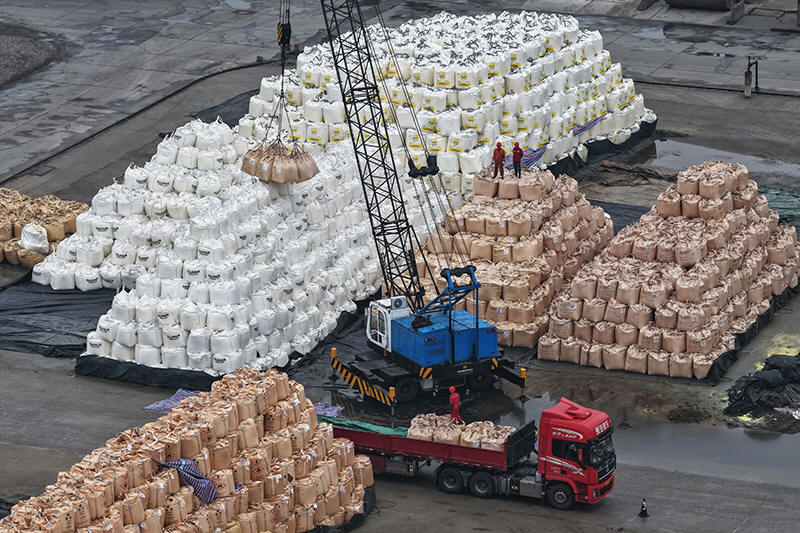
Workers transfer bags of imported solid sulfur onto a truck in a
port in Nanjing in eastern China's Jiangsu province, Tuesday, April
14, 2026. (Chinatopix Via AP)
 U.S. President Donald Trump’s
elevated tariffs on Chinese exports and tensions between Washington
and Beijing have also been straining China’s shipments to the U.S.
over the past months, with China stepping up its exports to other
regions including Europe, Southeast Asia and Latin America.
Analysts are also closely watching Trump’s planned visit to Beijing
in May to meet with Chinese leader Xi Jinping following a delay due
to the Iran war.
China's exports to the U.S. fell 26.5% year-on-year in March,
widening from a 11% drop in January and February, while those to the
European Union and Southeast Asia rose 8.6% and 6.9%, respectively.
Chinese leaders have set an annual economic growth target for 2026
of 4.5% to 5%, the lowest since 1991. China met its “around 5%”
economic growth target for 2025 on strong exports — with a record
high $1.2 trillion trade surplus — and analysts say exports likely
will continue to be a key driver for maintaining economic expansion
this year as a prolonged property sector slump in China weighed on
domestic demand and investments.
Some economists believe China has so far been relatively
well-positioned in shielding itself from the impacts from the Iran
war, which has sent fuel prices surging and is threatening worsening
global inflation. China’s vast oil reserves and diversified energy
sources mean it’s less affected by the fallout from the war,
including shipping disruptions in the Strait of Hormuz, a key
waterway for energy transport, they said.
All contents © copyright 2026 Associated Press. All rights reserved
 |