Hosting solar can be a lifeline for farmers. But overcoming local
opposition is tough
[April 14, 2026] By
JOSHUA A. BICKEL
CANFIELD, Ohio (AP) — Through the window of his combine, Wayne Greier
watches his teenage son Blake drive a tractor across an empty field,
towing a plow into position for another uncertain season of spring
planting.
Greier would be worrying less if the solar farm he wanted on his land
had come to pass. But local officials blocked it in 2023 under an Ohio
state law, and Greier — facing a heavy medical debt — had to sell part
of his land to stay afloat. The deal that was killed would have brought
him about $540,000 in lease payments every year.
“It was our saving grace,” he said. “It wasn’t a scary picture that
everybody likes to paint about solar and the loss of farmland.”
Local opposition to solar has long been an obstacle for green energy
developers. But some communities are working to reverse local
restrictions, citing the tax benefits and jobs the projects bring and
the lease payments from energy companies that can provide stable income
to farmers in a volatile industry.
When a solar company approached him wanting to build panels on part of
his land, Greier, 42, and a sixth-generation farmer, hesitated. But
facing $1 million in medical debt from a long battle with COVID and
related complications, he saw a chance to save his farm.
Some in the community thought differently.
Greier said he and his family were ostracized as debate over the project
played out in public meetings. His mental health plummeted. And the
project was eventually blocked under a state law that allows counties to
block construction of wind and solar farms on land they deem
“restricted.”
“I was the one that was going to lose the sixth-generation farm. I was
the one that couldn’t provide for my family,” he said.

A tough time for renewables
President Donald Trump's hostility to green energy has battered the
industry by wiping away subsidies, loans and tax incentives. But even
before his return to the White House, local bans on renewable energy
were becoming more common. A 2025 study from Columbia University found
that from 2023 to 2024, there was a 16% increase in local laws across 44
states that restricted such projects.
“Many communities want to decarbonize and probably theoretically support
renewable energy,” said Juniper Katz, an assistant professor at the
University of Massachusetts who focuses on environmental policy. But,
she added, “When it’s your community and your backyard, balancing these
processes so people feel like they’ve had a say without creating so many
veto points that nothing can get done, I think is the trick. And it’s
not easy to do.”
In February, Dearborn County, Indiana, officials paused solar
development for a year after concern from residents over the proximity
of solar panels near homes and potential environmental impact of panel
materials.
Bobby Rauen, who lives near part of a proposed 1,200-acre (486-hectare)
solar project in that county, is among residents who petitioned for the
pause. He said he hopes officials use this time to create better
protections for residents living near potential solar projects. He said
he was also concerned that farmland may not go back into production if
solar panels are eventually removed.
After officials in Mahoning County, Ohio, halted Greier's planned
675-acre (273-hectare), 150-megawatt project, he decided to help others
who wanted solar on their land, saying he “didn’t want to be a victim.”
As a member of the Renewable Energy Farmers of America, Greier, who
primarily farms corn and soybeans, has shared his experience with
lawmakers, advocacy groups and in communities debating green energy
development.
[to top of second column] |
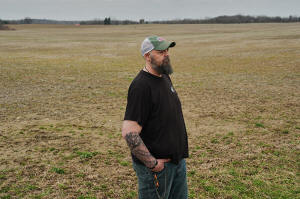
Wayne Greier poses for a portrait Tuesday, March 10, 2026, in
Canfield, Ohio. (AP Photo/Joshua A. Bickel)
 He recently spoke to government
officials at a public meeting in Richland County, Ohio, about 100
miles (161 kilometers) from his home. Advocates there got a
referendum on the ballot this May to reverse the county’s ban on
wind and solar projects.
Morgan Carroll, a lifelong county resident, has been working since
last summer to rally support to drop the ban. Though she is not a
farmer or landowner, Carroll said she supports the jobs and tax
revenue these projects can bring and thinks the ban takes the
decision away from residents — and may someday affect her two young
children.
“I want them to be in a county that can provide jobs, can provide a
good school for them,” she said. “I don’t want to have to move.”
Federal policy influencing local laws
Congressional Republicans and the Trump administration moved up
deadlines for utility-scale solar projects to qualify for tax
incentives after the passage of a big tax breaks and spending cuts
bill last July. Now, utility-scale solar projects have to be in
service by the end of 2027 to qualify.
Last year, Lita Leavell and her husband, Joe, who operate a
1,000-acre (405-hectare) cattle farm in Lancaster, Kentucky, had
hoped to host a utility-scale solar project on about half their land
that would have brought them an estimated $60,000 per year. Like
Greier, the lease payments would have ensured the land could stay in
their family.
But after a Garrard County ordinance was passed in 2023 restricting
the development of solar, the energy company Leavell was working
with decided to end the project.
Part of her county's rationale for the ordinance was the federal
government's opposition to solar energy and the Trump
administration's desire to stop utility-scale projects on farmland,
county leaders said during an August 2025 meeting. Leavell, who said
she is a Republican, questioned why lack of federal support for
green energy projects should affect her ability to pursue these
projects on her own land. She and a group of six other landowners
are suing to overturn the ordinance.
“The thing I guess that perplexed me so much is that there’s so many
more worse things that could be next to you,” she said.

A property rights issue
Carroll, who helped gather signatures for the referendum in Richland
County, Ohio, found that when the debate over solar projects was
framed as a property rights issue, people in the community were more
receptive.
Greier also focuses on property rights when speaking on the issue.
His farm is his retirement plan, and he should have the right to use
it to support his family, he said.
“There’s families that are relying on this and looking for this,” he
said. “And it’s been taken away, this opportunity.”
All contents © copyright 2026 Associated Press. All rights reserved |