US home sales fall in March, marking a slow start to the spring
homebuying season
[April 14, 2026] By
ALEX VEIGA
Sales of previously occupied U.S. homes fell in March to their slowest
pace nine months, as easing mortgage rates failed to motivate home
shoppers during what’s traditionally been the busiest time of the year
for the housing market.
Existing home sales fell 3.6% last month from February to a seasonally
adjusted annual rate of 3.98 million units, the National Association of
Realtors said Monday.
Sales also fell 1% compared with March last year, weighed down by
declines in the Northeast and Midwest. The latest sales figure fell
short of the roughly 4.06 million pace economists were expecting,
according to FactSet.
“Lower consumer confidence and softer job growth continue to hold back
buyers,” Lawrence Yun, NAR’s chief economist, said in a statement.
A measure of Americans’ short-term expectations for their income,
business conditions and the job market fell 1.7 points to 70.9,
remaining well below 80, a marker that can signal a recession ahead.
It’s the 14th consecutive month that reading has come in under 80.
Sales have been hovering close to a 4-million annual pace now going back
to 2023. That’s well short of the 5.2-million annual pace that’s
historically been the norm.
Despite the pullback in sales, home prices continued to rise last month.
The national median sales price increased 1.4% in March from a year
earlier to $408,800, an all-time high for any March on data going back
to 1999, NAR said. Home prices have risen on an annual basis for 33
months in a row.

The U.S. housing market has been in a slump dating back to 2022, when
mortgage rates began to climb from pandemic-era lows. Sales of
previously occupied U.S. homes remained stuck last year at 30-year lows.
They have remained sluggish so far this year, declining in January and
February versus a year earlier.
The pace of home price growth has slowed or fallen in many metro areas
and there are more homes on the market than a year ago, largely because
they're taking longer to sell.
And until recently, mortgage rates were easing, lowering borrowing costs
for homebuyers. Homes purchased last month likely went under contract in
January and February, when the average rate on a 30-year mortgage ranged
from 5.98% — its lowest level in three and a half years — to 6.16%,
according to mortgage buyer Freddie Mac.
Mortgage rates started ticking higher in March as the war with Iran sent
energy prices surging, heightening worries about higher inflation.
That’s pushed up the yield on U.S. 10-year Treasury bonds, which lenders
use as a guide to pricing home loans. The average rate on a 30-year
mortgage was at 6.37% last week, according to Freddie Mac. That's still
down compared to a year ago.
[to top of second column] |
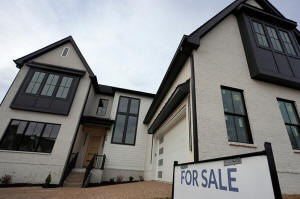
A for sale sign is posted outside a home, Feb. 10, 2026, in
Nashville, Tenn. (AP Photo/George Walker IV, file)
 Still, the rise in mortgage rates
led Yun to lower his 2026 existing U.S. home sales forecast. He now
projects sales will rise 4% this year, down from his previous
forecast of a 14% increase.
The latest home sales snapshot and uncertainty over the trajectory
of mortgage rates is clouding the outlook for the spring homebuying
season.
A sharp run-up in home prices, especially in the early years of this
decade, and a chronic shortage of homes nationally worsened by years
of below-average home construction have kept many aspiring
homeowners priced out of the market, especially first-time buyers
who don’t have equity from an existing home to put toward a new home
purchase. Fewer first-time buyers bought homes in March than in
February, NAR said.
Those who can afford to buy are benefiting from more properties on
the market, although home inventory levels remain well below
historical norms.
There were 1.36 million unsold homes at the end of March, up 3% from
February and up 2.3% from March last year, NAR said. That’s still
well short of the roughly 2 million homes for sale that was typical
before the COVID-19 pandemic.
March’s month-end inventory translates to a 4.1-month supply at the
current sales pace. Traditionally, a 5- to 6-month supply is
considered a balanced market between buyers and sellers.
A dearth of homes for sale in the Northeast is driving competition
among buyers, with some homes drawing multiple offers — something
relatively rare these days elsewhere in the country, Yun said.
That helped push the region’s median home sales price nearly 6%
higher in March from a year earlier, even as sales slowed to their
slowest pace on record.
“We simply don’t have enough supply in the marketplace,” Yun said.
All contents © copyright 2026 Associated Press. All rights reserved
 |