Faculty strike at University of Illinois Springfield continues into
second week
[April 14, 2026]
By Ben Szalinski
SPRINGFIELD — A strike by faculty members at the University of Illinois
Springfield has entered its second week as the union and administration
remained divided over salary increases.
The two sides have been unable to reach an agreement over salary
increases despite the help of a federal mediator and eight bargaining
sessions having taken place between tenured and tenure-track faculty
since the strike began on April 3.
“From our perspective, the university is not dealing with us in good
faith when it comes to the demands around compensation,” union president
Dathan Powell, an associate theater professor at UIS, told Capitol News
Illinois. “We can see the salaries that our highest paid administrators
are getting and what we’re asking for is well within the reason of what
inflationary costs are demand of people who are paid a lot less.”
The UIS United Faculty union is seeking a 2.6% increase in the current
fiscal year and 6% over the next two years, according to the
university’s bargaining update. UIS has offered three options for
increases, two of which begin with 1% raises that could increase under
the University of Illinois system’s University Salary Program.
The university said it believes sticking with the program is more
financially feasible and told students in an email last month that the
institution was running a $19 million deficit. Powell countered that
union contracts at UIS and the other U of I universities show UIS can
offer raises that are better than what is set annually by the Board of
Trustees for the program. He added the union is also seeking to
guarantee raises will be higher than 1%.

“The current median salary for bargaining unit members with a nine-month
contract (approximately 20 workdays per month) is approximately $86,000,
not including summer stipends or service-in-excess agreements, which can
substantially increase an individual’s earnings,” the university said in
an email to students on Sunday. “Approximately 1/3 of the faculty
members in this union earn over $100,000 annually.”
Powell responded that the union is fighting for the interests of its
members who fall below those numbers.
[to top of second column]
|
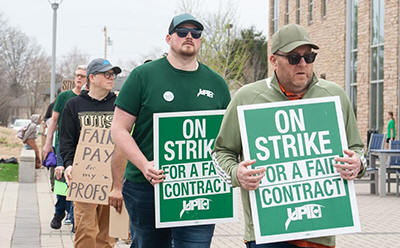
Faculty members at the University of Illinois Springfield hold a
picket in front of the university’s student union on April 3, 2026.
(Capitol News Illinois photo by Jenna Schweikert)

“They are struggling right now in this economy,” Powell said. “And if we
want to keep them here because they are high quality teachers and
attract new teachers down the road who bring the same energy, they have
to be paid a wage that they can afford to raise their families.”
Some progress made
Not all faculty members in the union are participating in the strike.
Some professors are covered under a different collective bargaining
agreement, meaning classes are continuing for many students.
More negotiations were scheduled for Monday afternoon.
The two sides have reached a tentative agreement on parking and
professional development. It would keep a cap on parking fees in place
and allow faculty members to roll over funds to future years that are
made available to them each year to attend conferences.
Union members also brought their picket to the Statehouse last week to
meet with legislators.
“We just let them know that there is a failure of the leadership on our
campus to prioritize the teaching and learning the faculty and students
here engage in,” Powell said. “They were really receptive to what we had
to say.”
UIS accounts for 2% of all of the university system’s spending in the
current fiscal year, according to the system’s budget documents. The
university also receives only 3% of state funds allocated to the system.
A staff union at UIS is also negotiating a new contract and has
authorized a strike but have so far not instituted a work stoppage.
Capitol News Illinois is
a nonprofit, nonpartisan news service that distributes state government
coverage to hundreds of news outlets statewide. It is funded primarily
by the Illinois Press Foundation and the Robert R. McCormick Foundation. |