High energy prices, federal dollars turn nuke subsidies into ratepayer
relief in northern Illinois
[April 14, 2026]
By Maggie Dougherty
CHICAGO — A law originally enacted to keep the state’s nuclear fleet
profitable is instead giving relief to energy customers due to rising
power costs and increased federal subsidies for nuclear generators.
ComEd customers in Illinois will see an average $19 monthly reduction to
their electricity bills over the coming months, thanks to a policy in
the state’s landmark climate bill.
At the time negotiations were underway for the 2021 Climate and
Equitable Jobs Act, then-nuclear operator Exelon Corporation informed
policymakers that it could not continue operating three of the state’s
six nuclear stations profitably amid low energy prices. Rather than
operate at a loss, Exelon would have opted to close the plants.
Closure would have been a major roadblock to Gov. JB Pritzker’s goals
for a carbon-free future and could have resulted in significant energy
shortfalls, creating reliability concerns and higher prices.
To avoid a crisis, lawmakers struck a deal.
Ratepayer bills were to include a small monthly surcharge to support the
purchase of Carbon Mitigation Credits, or CMCs, to subsidize nuclear
plants. The deal offered Exelon, now Constellation, the security of
reliable income to meet its costs, while ensuring reliable carbon-free
energy delivery for northern Illinoisians.
But it also imposed a ceiling. When the company’s revenues exceed a set
threshold, either via federal subsidies or due to higher market prices,
the excess flows back to ComEd customers.

And as energy market prices have surged over the past few years, it
turns out northern Illinois’ nuke plants haven’t needed the state’s
help.
Instead, the program has provided a net benefit to ratepayers exceeding
$1.8 billion since 2022, as ratepayers contributed $795 million to keep
nuclear plants running but saw over $2.6 billion flow back to them.
The initiative has saved ComEd’s 3.8 million residential customers an
average of $177 since it commenced, according to the Illinois Power
Agency, which oversees procurement of the credits.
The deal was not about giving a “free lunch” to the nuclear plant
operators, according to Rep. Ann Williams, D-Chicago, but about
supporting the grid in a “responsible and equitable” way.
“And the end result proved that it was the right call on our part to
include that kind of backstop so that, as we make investments in our
generation supply, we make sure that it’s not a giveaway, and that
consumers are made whole and kept whole,” Williams said.
‘Affordability being prioritized’
IPA Director Brian Granahan described the credits as the outcome of
successful public policy, thanks to lawmakers working with nuclear plant
operators.
ComEd customers receive electricity from the PJM Interconnection, the
largest regional transmission organization in the nation. But as data
center demand drives up energy rates for customers across the PJM
region, it increases the price of energy. The price per megawatt-day at
the December PJM capacity auction, for example, hit a record of $333.44
for 2027-28, 11.5 times higher than just three years prior.
While customer bills still rise, the CMC initiative partially offsets
that cost for Illinois customers.
“We’re seeing something in Illinois that other states in the PJM region
may not be seeing, in affordability being prioritized through this
crediting coming through,” Granahan said. “Formed out of CEJA, the
program has meaningfully supported clean energy in Illinois while
insulating ratepayers from price spikes.”
[to top of second column]
|
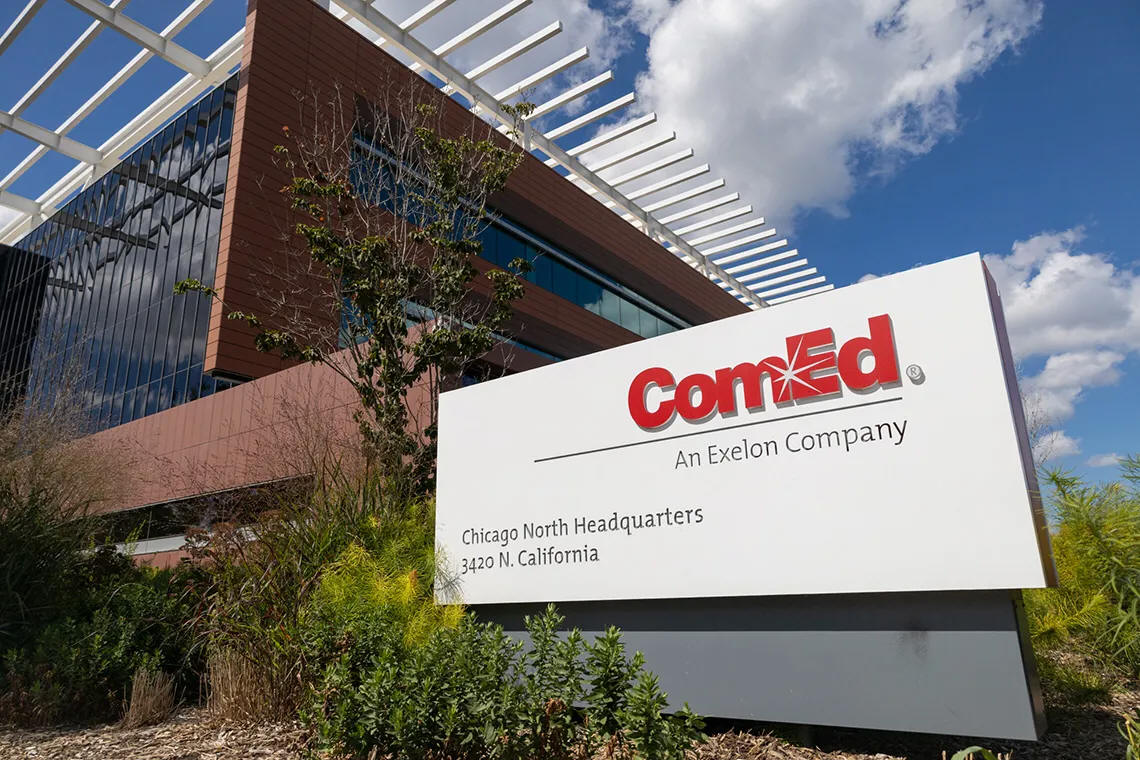
ComEd’s Chicago headquarters. (Capitol news Illinois file photo by
Andrew Adams)

ComEd customers have already seen higher than usual benefits this year,
with over $580 million credited back on energy bills in the first two
months of the year alone, according to the IPA.
The credits more than doubled between December and January, with $404
million credited to customers in January alone. That is part of an $803
million federal tax credit granted to Constellation under the Inflation
Reduction Act, signed by former President Joe Biden in 2022.
It wasn’t always certain that federal subsidies received by nuclear
plant operators would be considered revenue eligible for return to
consumers, Granahan added, but Gov. JB Pritzker’s administration sought
to ensure it would be in the CEJA provision.
“Thanks to the forward-looking policies in CEJA, Illinois is proving you
can lower costs for consumers while strengthening clean, reliable
energy,” a Pritzker spokesperson said.
Sarah Moskowitz, executive director of the Citizens Utility Board
watchdog agency, called the credits “a testament to the value of
thoughtful, pro-consumer energy legislation,” but said there is still
work to be done.
“We have to build off this success and pass more pro-consumer
legislation, including reforms that hold data centers accountable for
their costs,” Moskowitz said.
What does this mean for bills?
For the first couple months of 2026, the federal subsidy returned to
customers has translated into about a $13 monthly credit for residential
ComEd customers. The remainder will continue to show up on customer
bills through May.
And on top of the amount already coming in from the tax credits, high
energy prices from early 2026 are going to give the credits an even
bigger boost on April and May bills.
An average residential customer can expect to see around $19.40 credited
on their April bill, according to ComEd. Though the May adjustments are
not published yet, a ComEd spokesperson said they are “expected to still
be more noticeable” due to the federal subsidy and higher energy and
capacity prices.

Customers can find the credit listed as a Carbon-Free Energy Resource
Adjustment under the Taxes, Fees & Other Credits section of their bills.
Exact credit amounts will depend on energy usage.
The credits will be applied automatically, so customers don’t need to do
anything extra to sign up for them. They will be received by most ComEd
electric delivery customers, including those who purchase energy through
an alternative energy supplier.
ComEd customers can expect to continue seeing credits during periods of
high energy prices until they conclude in May 2027, as directed by
statute.
Capitol News Illinois is
a nonprofit, nonpartisan news service that distributes state government
coverage to hundreds of news outlets statewide. It is funded primarily
by the Illinois Press Foundation and the Robert R. McCormick Foundation. |