Trump says US military has blockaded Iranian ports to pressure Tehran
[April 14, 2026]
By SAMY MAGDY, JULIA FRANKEL and MIKE CORDER
CAIRO (AP) — U.S. President Donald Trump said Monday the American
military had begun a blockade of Iranian ports as part of his effort to
force Tehran to open the Strait of Hormuz and accept a deal to end the
war that has raged for more than six weeks.
Iran responded with threats on all ports in the Persian Gulf and the
Gulf of Oman, taking aim at U.S.-allied countries.
At least two tankers approaching the strait Monday turned around soon
after the U.S. blockade began, vessel tracker MarineTraffic said in a
post on X.
The U.K. Maritime Trade Operations agency said the blockade restricted
“the entirety of the Iranian coastline, including ports and energy
infrastructure.” Its notice to mariners said transit through the strait
to or from non-Iranian places was not reported to be impeded though
ships “may encounter military presence.”
The U.S. blockade and Iran's threatened retaliation set up an
extraordinary showdown that posed serious risks for the global economy
and raised the specter that the ceasefire could collapse and the
fighting could resume. Talks aimed at permanently ending the conflict —
which began Feb. 28 with U.S. and Israeli strikes on Iran — failed to
reach an agreement this past weekend.
Trump says the blockade has begun
“We can’t let a country blackmail or extort the world because that’s
what they’re doing,” Trump said of Iran at the White House, where he
announced the blockade had started.
He suggested the U.S. remains willing to engage with Iran.
“I can tell you that we’ve been called by the other side,” Trump said,
adding that "they want to work a deal.”

Discussions between the U.S. and Iran about a second round of in-person
negotiations are underway, two U.S. officials and a person familiar with
the development said Monday. A diplomat from one of the mediating
countries said Tehran and Washington have agreed to more talks.
All four spoke on condition of anonymity to discuss sensitive diplomatic
negotiations.
Iran’s effective closure of the strait, through which a fifth of global
oil transits in peacetime, has sent oil prices skyrocketing, pushing up
the cost of gasoline, food and other basic goods far beyond the Middle
East.
Before the U.S. blockade, Tehran had allowed some ships perceived as
friendly to pass while charging considerable fees, leading to
accusations it is holding the global economy hostage.
Some analysts are doubtful that the United States can restore normal
shipping through force alone. And it’s not clear how the blockade will
work or what the dangers might be to U.S. forces.
The question is essentially who can endure the most pain: Could a
blockade make Iran’s economic situation untenable and force it to
concede? Or will it drive global oil and other prices so high that Trump
is forced to back down?
The blockade could have far-reaching effects
The U.S. military's Central Command announced the blockade would be
enforced “against vessels of all nations entering or departing Iranian
ports and coastal areas” on the Persian Gulf and Gulf of Oman.
CENTCOM's decision to allow ships traveling between non-Iranian ports to
transit the strait was a step down from Trump’s earlier threat to
blockade the waterway.
In a social media message, Trump said Iran’s navy had been "completely
obliterated” but still had “fast attack ships.” Trump warned that “if
any of these ships come anywhere close to our BLOCKADE, they will be
immediately ELIMINATED."

Iran issued threats of its own.
“Security in the Persian Gulf and the Sea of Oman is either for everyone
or for NO ONE,” the Islamic Republic of Iran Broadcasting reported
Monday. “An Iranian military statement said: “NO PORT in the region will
be safe.”
The threats halted the limited ship traffic that resumed in the strait
since the ceasefire, according to a report from Lloyd’s List
Intelligence. Marine trackers say over 40 commercial ships have crossed
since the start of the ceasefire last week, down from 100 or more vessel
passages per day before the war.
The blockade is intended to pressure Iran, which has exported millions
of barrels of oil since the war began, much of it likely carried by
so-called dark transits that evade Western sanctions and oversight.
[to top of second column]
|
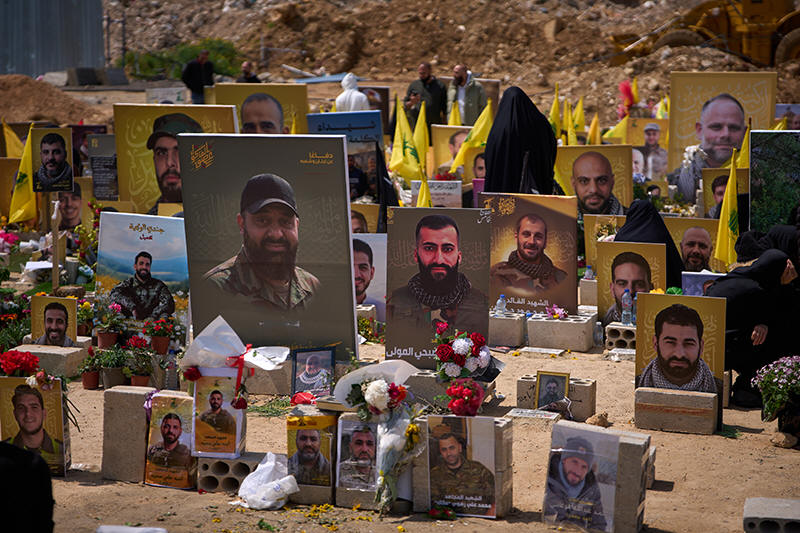
Graves bearing photos of Hezbollah fighters killed in Israeli
strikes are seen in a cemetery in Choueifat, Lebanon, Monday, April
13, 2026. (AP Photo/Emilio Morenatti)

But the effects will be felt far beyond Iran. The price of Brent
crude oil, the international standard, hovered Monday just under
$100 per barrel. It cost roughly $70 per barrel before the war.
Iran says ‘if you fight, we will fight'
Top-ranking Iranian officials threatened retaliation.
Ebrahim Rezaei, a spokesperson for the Iranian parliament’s National
Security Commission, dismissed U.S. the threat of a U.S. blockade as
“more bluffing than reality.”
“It will make the current situation (Trump) is in more complicated
and makes the market — which he is angry about — more turbulent,” he
said in a post on X.
The Iranian parliament speaker, Mohammad Bagher Qalibaf, addressed
Trump in a statement: “If you fight, we will fight.”
Meanwhile, Iran’s representative to the United Nations, Amir-Saeid
Iravani, demanded compensation from five Middle Eastern countries —
Bahrain, Saudi Arabia, Qatar, Jordan and the United Arab Emirates —
that Iran says violated international law by aiding the war effort
against it, the Islamic Republic’s state-run media reported.
Legal experts are watching
U.S. military officials have offered few details about how the
blockade will actually work.
The U.S. Navy has 16 warships, including the aircraft carrier USS
Abraham Lincoln, in the Middle East, a defense official said. A
second defense official said no American warships are in the Persian
Gulf, which forms most of Iran’s coastline. Both spoke on condition
of anonymity to discuss sensitive military operations.
Under international law, the blockade must be impartially enforced.
Legal experts will also be watching to see if the U.S. allows
humanitarian aid to reach Iran.
“How it is carried out will determine whether it is lawful or not,”
said Todd Huntley, a retired Navy captain and director of Georgetown
University’s national security law program.

Ceasefire holds after talks end without agreement
The blockade threat came after marathon U.S.-Iran ceasefire talks in
Pakistan ended without an agreement on Saturday.
U.S. Vice President JD Vance said the talks stalled after Iran
refused to accept American terms on refraining from developing a
nuclear weapon. Vance told FOX News Channel's “Special Report” that
some progress was made on nuclear issues, but he felt Iran's
negotiators couldn't make a deal without approval from Tehran.
Iran has insisted its nuclear program is peaceful. However, it has
pushed forward with steps that could give it the ability to build a
nuclear weapon, including enriching uranium to near weapons-grade
levels and developing long-range missiles potentially capable of
delivering a bomb.
Iran’s ambassador to India, Mohammad Fathali, said the main sticking
points for Tehran were its nuclear program, war reparations and
sanctions relief.
The ceasefire expires April 22. The fighting has killed at least
3,000 people in Iran, 2,089 in Lebanon, 23 in Israel and more than a
dozen in Gulf Arab states. Thirteen U.S. service members have been
killed.
___
Corder reported from The Hague, Netherlands, Frankel from New York.
Associated Press writers Melanie Lidman in Tel Aviv, Israel;
Farnoush Amiri at the United Nations; Aamer Madhani, Matthew Lee,
Konstantin Toropin, Collin Binkley, Ben Finley and David Klepper in
Washington; Kareem Chehayeb in Beirut; Sheikh Saaliq in New Delhi;
Jill Lawless in London; Ghaya Ben MBarek in Tunis, Tunisia; and Russ
Bynum in Savannah, Georgia, contributed to this report.
All contents © copyright 2026 Associated Press. All rights reserved
 |