Bodycam video contradicts St. Louis police's earlier account in fatal
shooting of 17-year-old
[April 14, 2026]
By HEATHER HOLLINGSWORTH
Body camera video released Monday shows a St. Louis police officer
fatally shooting a 17-year-old in the back of the head as he fled,
contradicting an earlier police statement that the teen pointed a gun at
officers.
Al Watkins, an attorney for the family of Emeshyon Wilkins, obtained the
video as part of the discovery process in a federal lawsuit against the
police department. Watkins said his office tried and failed to get the
video through a records request.
“They fought that video issue for over a year,” Watkins told The
Associated Press. “We had to file a federal lawsuit to get it. That’s
not transparent. That’s not integrity. Indeed, it’s irresponsible.”
Wilkins was shot and killed in June 2024, just two weeks after he turned
17. He had no prior criminal history, Watkins said. Wilkins was Black.
Police said it all started when detectives attempted to stop an SUV that
was reported stolen. Police said there was a brief pursuit; Watkins
described it as a slow-speed chase. He said the SUV was only going
around 10 mph.
The pursuit ended with Wilkins fleeing the vehicle on foot, with two
officers in pursuit. One officer held a taser; another a firearm, the
suit says.
The video shows the officer armed with a gun yelling at the teen to get
on the ground as he raises the firearm. The officer can be heard telling
the teen to drop a gun. The teen keeps running, and then the officer
fires.

One of the four bullets struck the teen in the back of the head, killing
him, the suit says. In the teen's pocket was a firearm, but it was
disassembled, in multiple pieces, and incapable of being fired, the suit
says.
The video didn't show the teen holding the firearm in his hand or
pointing it at the officer.
“There was no threat to the public, and you look at the video, and there
were no furtive movements,” Watkins said.
Police acknowledged Monday, following the release of the video, that
“information provided by a third-party to investigators in the immediate
aftermath of the incident was not consistent with the actual events or
what was initially shared with the community.”
[to top of second column]
|
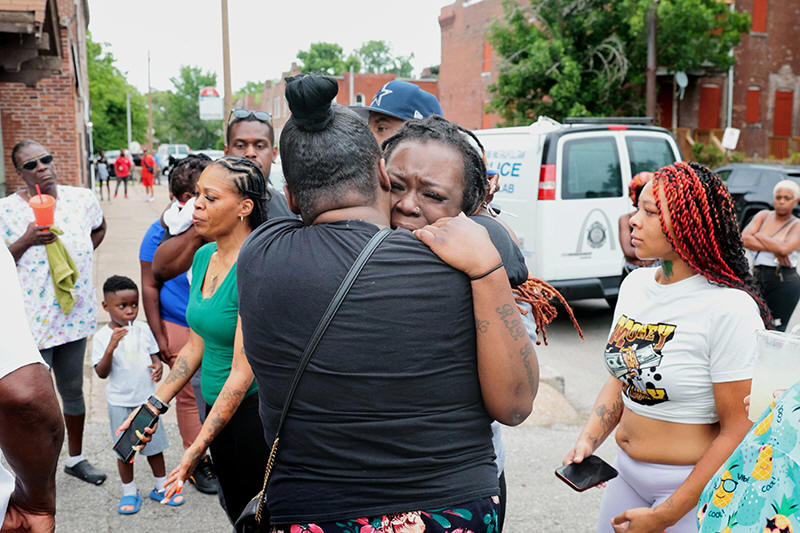
Shaina Wilkins, the mother of Emeshyon Wilkins, grieves on June 18,
2024, in St. Louis, after a St. Louis police officer shot and killed
her son. (Christian Gooden/St. Louis Post-Dispatch via AP)

The department said it now sends a member of the department’s
body-worn camera unit to such scenes so that footage can be reviewed
by investigating commanders before detailed public accounts are
provided.
“In this case, an earlier review of body-worn camera footage would
have provided greater clarity than what was available in the initial
moments following the incident,” the statement says.
St. Louis still bears the scars from the 2014 fatal shooting by a
white police officer of 18-year-old Michael Brown — who was Black
and unarmed — in the St. Louis suburb of Ferguson. Some witnesses
said Brown had his hands up in surrender. The Ferguson officer was
cleared of wrongdoing and resigned, and Brown’s death led to months
of protests.
Watkins said the public was assured change would happen. But now he
said the police officer who killed Wilkins was placed on desk duty,
with pay. He questioned why the process is taking so long.
“The family needs answers, and the only way answers can be given is
if there is justice that is open and transparent,” Watkins said.
The St. Louis Circuit Attorney's Office said it received the police
investigative report in October. But the statement says the office
also completes its own “review of the evidence and law to determine
whether there is a basis for criminal liability.”
“The CAO is committed to reviewing each matter as expeditiously as
possible while ensuring that all available evidence and legal
considerations are carefully and thoroughly evaluated,” the
statement says.
All contents © copyright 2026 Associated Press. All rights reserved
 |