Consecutive Israeli strikes kill 4 Lebanese medics as Israel-Hezbollah
war grinds on
[April 16, 2026]
By MALAK HARB and ISABEL DEBRE
TYRE, Lebanon (AP) — The Israeli military killed four Lebanese rescue
workers and wounded six others in three consecutive, targeted strikes
Wednesday, paramedic groups said, a stark illustration of the human cost
of the Israeli military campaign against Hezbollah in southern Lebanon a
day after the two countries held historic talks in Washington.
The back-to-back Israeli attacks on the southern village of Mayfadoun,
near the bigger town of Nabatiyeh, hit the first group of medics
responding to a distress call from wounded civilians, a second group
trying to assist their wounded colleagues and a third group rushing to
aid the first two teams that had been targeted.
The Israeli military did not respond to a request for comment on the
strikes beyond saying it was “looking into” what happened. It has
previously accused the Iran-backed Hezbollah militant group of using
ambulances as cover for militant activities, without offering evidence.
The Lebanese Health Ministry condemned the attacks as a “blatant
violation” of international law.
Abou Haidar Hayya, an official with the Islamic Health Committee
involved in the rescue operation, said he feared such direct targeting
of medics meant that “there are no more red lines in this war."
“Ambulances are protected under all international laws and conventions.
It is forbidden to target them. And when those prohibitions collapse, we
have nothing left,” he said by phone from the health center in Nabitiyeh.

Since the Israel-Hezbollah war began on March 2, at least 91 Lebanese
medical workers have been killed by Israel, the ministry said,
underscoring the intensity of the ongoing strikes and strain on
Lebanon's health system. The overall death toll from the war in Lebanon
jumped to 2,167 on Wednesday.
A succession of Israeli attacks on medics
Israel first struck a team from Lebanon’s Islamic Health Committee, a
major healthcare provider that is affiliated with Hezbollah’s political
movement, killing two paramedics, the group said. A second team from the
committee headed to the site and was struck in another Israeli attack
that wounded three medical workers, the ministry reported.
The Nabatiyeh Emergency Services as well as the Islamic Risala Scout
Association, a paramedic group affiliated with the Amal movement, a
Hezbollah ally, mounted a third rescue attempt. They were hit by a
strike that killed two more medics.
Most of the wounded medics remain in moderate condition except for one
medic in serious condition after being hit in the chest by shrapnel, the
Islamic Health Committee said.
Footage captured by the Nabatiyeh Emergency Services and shared with The
Associated Press shows the second team of medics wearing their uniforms
and riding in clearly marked emergency vehicles struggling to pull their
bloodied colleagues out of wrecked ambulances that had veered onto the
side of the road.
Rescue workers are seen administering aid to two wounded colleagues on
stretchers in the back of an ambulance when an Israeli strike smashes
into the vehicle, blowing out its windows and sending glass shattering
everywhere. The camera shakes, and the medic who was treating his
colleagues screams in pain. The video then shows a third team arriving
to help the others before being attacked.
Hayya, from the Islamic Health Committee, said he doesn't regret
dispatching one team after another into the line of fire.
“We went in three times because we refuse to leave our paramedics
behind, even if it costs all of us our lives," he said.

[to top of second column]
|
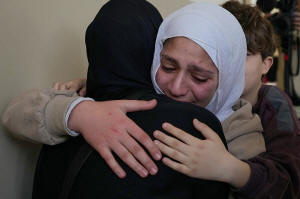
Relatives of Ghadir Baalbaki, 19, who was killed on Tuesday in an
Israeli airstrike, mourn during her funeral in the southern port
city of Tyre, Lebanon, Wednesday, April 15, 2026. (AP Photo/Hussein
Malla)

He promised that the Islamic Health Committee and other paramedic
groups would continue to carry out their duties in southern Lebanon
despite the increasingly impossible conditions.
Israel presses its ground invasion
Across southern Lebanon, Israeli forces said they had struck more
than 200 Hezbollah targets over the past 24 hours. Hezbollah claimed
rocket attacks on military targets in northern Israel.
Israeli Prime Minister Benjamin Netanyahu said in a video address
late Wednesday that he had ordered the military to expand its
so-called “buffer zone” in southern Lebanon toward the east. He said
that Israel is pursuing negotiations with the Lebanese government
alongside its military campaign against Hezbollah in hopes of
disarming the militant group and achieving a “sustainable peace"
with its northern neighbor.
In Lebanon, those negotiations have drawn backlash from Hezbollah
and its supporters. Al Akhbar, a Lebanese newspaper that is closely
allied with Hezbollah, declared the government to be a “regime of
shame” in its front-page report about Tuesday's talks in Washington.
Hezbollah lawmaker Hassan Fadlallah castigated Lebanese authorities
for what he called the “disgraceful image” of direct negotiations
with Israel “at a time when it is killing Lebanese people and
committing massacres."
He urged the government, which has long sought the disarmament of
Hezbollah to no avail, to hold a popular referendum on the future of
Hezbollah's arsenal rather than decide its fate in talks with
Israel.
“We are ready for a referendum on these choices,” Fadlallah told
reporters, saying he expected the results of any such vote to show
that a majority of Lebanese people support Hezbollah's militant
activities.

On the streets of Beirut, Lebanese were divided. Some agreed with
Hezbollah that Israel can only be stopped through military force.
Others welcomed the talks in Washington as a possible step toward
ending the war.
“The negotiations are more in our interest than in Israel’s interest
because we are the ones whose country is being destroyed, we are the
ones suffering losses,” said Mohamed Saad, a Beirut resident.
A refuge of last resort
The Israeli military has issued evacuation warnings for wide swaths
of southern Lebanon. But tens of thousands of people have stayed —
either because they don’t want to leave their homes or because they
have nowhere to go.
Many displaced families see the coastal city of Tyre as the last
remaining refuge in southern Lebanon, removed from the heaviest
clashes closer to the border.
Increasingly, though, residents say nowhere feels safe. Across the
normally bustling beach town, the war is visible in shattered
buildings, mounds of rubble and debris-strewn streets.
___
DeBre reported from Beirut. Associated Press writer Fadi Tawil
contributed to this report.
All contents © copyright 2026 Associated Press. All rights reserved |