Iran war energy shock drives nuclear power plans in hard-hit Asia and
Africa
[April 17, 2026] By
ALLAN OLINGO and ANTON L. DELGADO
NAIROBI, Kenya (AP) — The Iran war's global energy shock is causing some
nations in Asia and Africa to boost nuclear power generation and
spurring atomic energy plans in non-nuclear countries on both
continents.
Asia, where most of the Middle Eastern oil and natural gas was headed,
was hit first and hardest by disruptions to shipping routes carrying
those fuels — swiftly followed by Africa. The U.S. and Europe are also
feeling the pinch as the conflict drives up energy costs.
African and Asian nations with nuclear plants are increasing their
output as they scramble for short-term energy supplies, while
non-nuclear countries are accelerating long-term nuclear plans to
safeguard against future fossil fuel shocks.
Nuclear power isn't a quick fix for the current energy crisis.
Developing atomic energy can take decades, especially for nuclear
newcomers. But long-term commitments to nuclear power made now will
likely lock it in to countries' future energy mixes, said Joshua
Kurlantzick of the Council on Foreign Relations.
In Asia, the Iran war is pushing South Korea to increase nuclear power
generation, while Taiwan is debating restarting mothballed reactors. In
Africa, future plans to build reactors have taken on urgency, with
Kenya, Rwanda and South Africa affirming their support.
Nuclear power takes advantage of the energy released when the nucleus of
an atom, such as uranium, splits in a process called fission. Unlike
fossil fuels, this doesn't release climate change-causing carbon
dioxide. But it creates potentially dangerous radioactive waste, one
reason many countries are cautious about nuclear power.

The war has accelerated a global “nuclear renaissance,” said Rachel
Bronson of the Bulletin of the Atomic Scientists, as countries seek an
out from the risks of fossil fuel markets.
There are 31 countries that use nuclear power, which provides about 10%
of global electricity, according to the International Atomic Energy
Agency, which says another 40 nations are either considering the
technology or preparing to build a plant.
Hard-hit Asia advances on nuclear
In Asia, where energy triage efforts range from increased coal use to
purchases of Russian crude oil, countries with nuclear plants are
seeking to get more out of their existing reactors.
South Korea is increasing generation at its nuclear plants and speeding
up maintenance at five offline reactors, with restarts planned in May.
Taiwan and Japan are reversing policies that shuttered nuclear sites
following the 2011 Fukushima nuclear meltdown, triggered when an
earthquake and tsunami disabled the power supply that cooled the
reactors.
Taiwan is considering the years-long process of restarting two reactors
because of the current crisis, which will require meticulous
inspections, safety checks and control system verifications.
In Japan, since the start of the war, Prime Minister Takaichi Sanae has
signed a $40 billion reactor deal with the U.S., a nuclear fuel
recycling agreement with France and promised Indonesia nuclear
cooperation. Japan restarted the world’s largest nuclear plant, the
Kashiwazaki-Kariwa site, in January.
Renewables, like solar and wind, make more sense than nuclear for energy
affordability and security, according to Michiyo Miyamoto of the
U.S.-based Institute for Energy Economics and Financial Analysis.
While the Iran war is also driving consumer and government interest in
renewable energy globally and in Japan, historically high electricity
costs combined with the current crisis is swinging Japanese public
opinion toward acceptance of nuclear power, she said.

In South Asia, Bangladesh is racing to turn on new reactors built by
Russia’s state-owned nuclear corporation Rosatom. Dhaka hopes they will
supply the national grid with 300 megawatts by this summer, relieving
some pressure from current gas shortfalls.
Meanwhile, Vietnam signed a deal with Moscow in March for two
Russian-designed reactors.
The Philippines, which recently declared a national energy emergency, is
also considering reviving a nuclear plant built in the aftermath of the
1973 oil crisis but was never turned on.
“I hope we learned our lesson,” said Alvie Asuncion-Astronomo of the
Philippine Nuclear Research Institute. The Iran war is “providing a
needed push for nuclear.”
Africa voices atomic aims
Soaring energy prices and power shortages in Africa, triggered by the
Iran war, is leading to public calls for nuclear cooperation and
re-invigorated interest in long-term nuclear energy plans, which are
underway in more than 20 of the 54 African countries.
[to top of second column] |
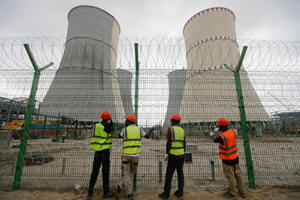
Workers fix barbed wire on the fence of the Rooppur Nuclear Power
Plant at Ishwardi in Pabna, Bangladesh, Oct.4, 2023. (AP
Photo/Mahmud Hossain Opu)
 With Africa seen as an atomic energy
growth market, nuclear nations — including the U.S., Russia, China,
France and South Korea — are pitching advanced technology such as
small modular reactors, or SMRs, as a solution to energy shortages.
These modular reactors are a cheaper, more compact alternative to
large-scale plants.
Proponents tout them as a faster option, but projects can still take
years. Kenya, for instance, plans to bring a small modular reactor
online in 2034 after starting the first phase in 2009.
Last month, Justus Wabuyabo of Kenya’s Nuclear Power and Energy
Agency, said “nuclear energy is no longer a distant aspiration for
African countries; it is a strategic necessity.”
During a March summit convened by the U.N.'s nuclear watchdog
agency, Rwandan President Paul Kagame said Africa will be “one of
the most important global markets” for the smaller reactors in the
years ahead.
Smaller reactors, which can offer scalable, low-emitting base load
power, are considered a solution to Africa's rising electricity
demand, weak grids and over reliance on imported diesel.
Similarly, Loyiso Tyabashe of the South African Nuclear Energy
Corporation, said SMRs could "fulfill our strategic objective of
positioning South Africa at the forefront of advanced nuclear
technologies.”
South Africa, which has the continent’s only existing nuclear
plants, wants nuclear to go from making around 5% of its energy mix
now to 16% by 2040.
US and Russia vie for role as a nuclear provider
The energy disruptions come as competition for influence in Africa
intensifies between Washington and Moscow.
Russia's Rosatom is building Egypt’s first reactor and has
cooperation agreements with Ethiopia, Burkina Faso, Ghana, Tanzania
and Niger, spanning major projects, research centers, uranium
processing facilities and training programs.

While only Kenya and Ghana have joined an American-led modular
reactor initiative, Washington is trying to catch up.
The U.S. and South Korea sponsored a nuclear conference in Nairobi
last month. Ryan Taugher of the U.S. State Department said
Washington is working with African nations to rapidly develop secure
and safe civil nuclear reactors.
Ghana, which aims to begin building a nuclear plant in 2027, is in
the market for foreign suppliers.
Considering the risks of nuclear energy
Risks like meltdowns and mismanaged waste remain, even as interest
builds. Nuclear energy could also be a step toward building nuclear
bombs.
Ayumi Fukakusa, of the advocacy group Friends of the Earth Japan,
said “nuclear is very risky" and will keep countries reliant on
imported fuels such as enriched uranium.
Given that nuclear sectors take years to develop, governments should
stay focused on building out renewables for long-term energy
security, said Rex Amancio of the Global Renewables Alliance.
Bronson, with the atomic scientists group, also said nuclear plants
are vulnerable during conflicts, citing recent instances where
reactors were specifically targeted during the Iran war and the
Russia-Ukraine War.
“All of this comes into the mix of how we think about energy
security,” she said. “Countries are now weighing those kinds of
risks against the other risks, which Asia and Africa are seeing
first and foremost, about what happens when gas and oil stops."
___
Delgado reported from Bangkok. Associated Press writers Kim Tong-hyung
in Seoul, South Korea, Mari Yamaguchi in Tokyo, Japan and Aniruddha
Ghosal in Hanoi, Vietnam contributed to this report.
All contents © copyright 2026 Associated Press. All rights reserved
 |