Pope blasts 'tyrants' ravaging the planet during his visit to Cameroon
[April 17, 2026]
By NICOLE WINFIELD and NALOVA AKUA
BAMENDA, Cameroon (AP) — Pope Leo XIV blasted the “handful of tyrants”
who are ravaging Earth with war and exploitation, as he preached a
message of peace Thursday in the epicenter of a separatist conflict in
central Africa considered one of the world’s most neglected crises.
Leo traveled to the western Cameroon city of Bamenda, where jubilant
crowds clogged the roads, blowing horns and dancing. They were overjoyed
that a pope had come so far to see them and put a global spotlight on
the violence that has traumatized this region for nearly a decade.
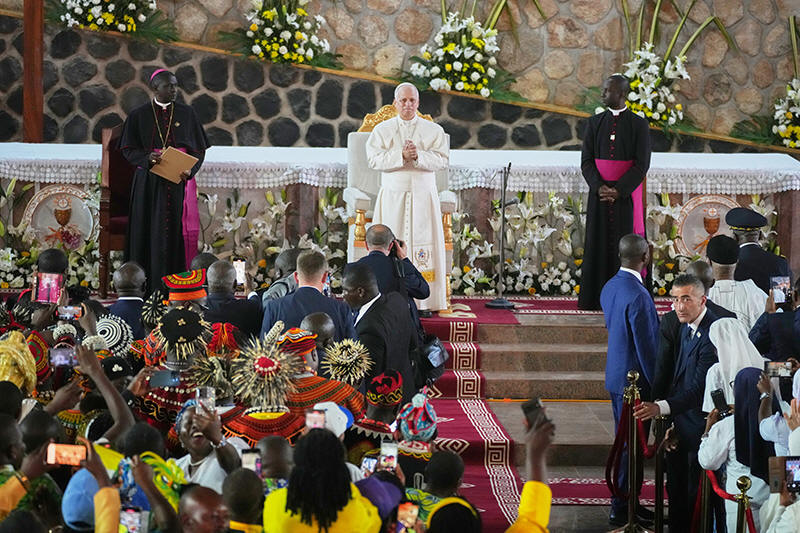
Leo presided over a peace meeting involving a Mankon traditional chief,
a Presbyterian moderator, an imam and a Catholic nun. The aim was to
highlight the interfaith movement that has been seeking to end the
conflict and care for its many victims.
In his remarks in the St. Joseph Cathedral, on land donated by the
Mankon, Leo praised the peace movement and warned against allowing
religion to enter conflicts. It's a theme he has been echoing amid the
U.S.-Israeli war in Iran and the religious justifications for it by U.S.
officials.
“Blessed are the peacemakers!” he said. “But woe to those who manipulate
religion and the very name of God for their own military, economic and
political gain, dragging that which is sacred into darkness and filth.”
He called for a “decisive change of course” that leads away from
conflict and the exploitation of the land for military or economic gain.
“The world is being ravaged by a handful of tyrants, yet it is held
together by a multitude of supportive brothers and sisters!” he said.

Leo's comments were directed at Cameroon's separatist conflict. But
Vatican officials have made clear that on this trip, he is preaching the
Gospel message of peace that surpasses borders and continents, and is
meant for all those responsible for the wars and exploitation ravaging
Earth.
Leo said Bamenda was a model for the rest of the world. “Bamenda, today
you are the city on the hill, resplendent in the eyes of all!” Leo said
in English, using a phrase often understood as referring to American
exceptionalism.
It wasn’t immediately clear if any of Cameroon's separatist fighters,
who announced a three-day pause in fighting to allow the pope safe
passage to Bamenda, attended.
A conflict rooted in colonial history
The conflict in Cameroon’s two Anglophone regions is rooted in
Cameroon’s colonial history, when the country was divided between France
and Britain after World War I. English-speaking regions later joined
French Cameroon in a 1961 U.N.-backed vote, but separatists say they
have since been politically and economically marginalized.
In 2017, English-speaking separatists launched a rebellion with the
stated goal of breaking away from the French-speaking majority and
establishing an independent state. The conflict has killed more than
6,000 people and displaced over 600,000 others, according to the
International Crisis Group.
Leo arrived to a raucous welcome in Bamenda, where blasting music from
loudspeakers gave the event a concert-like vibe.
“We are so overjoyed, so overwhelmed,” said Felicity Cali, a Catholic
student. “Say thank you, God, for this extraordinary day and for making
us be alive to see this day.”
Leo kept up the theme in his homily before an estimated 20,000 people
who gathered for his afternoon Mass at Bamenda’s airfield, where they
went wild when he looped around the crowd in his covered popemobile. Leo
pointed to the “moral, social and political corruption,” that afflicts
Cameroon, stifling its development.
Added to these internal problems of conflict and corruption “is the
damage caused from outside, by those who, in the name of profit,
continue to lay their hands on the African continent to exploit and
plunder it,” he said.
[to top of second column]
|
Pope Leo XIV, with the Archbishop of Bamenda, Andrew Nkea Fuanya,
left, leads a meeting for peace at Saint Joseph's Cathedral in
Bamenda, Cameroon, with the local community Thursday, April 16,
2026, on the fourth day of his 11-day pastoral visit to Africa. (AP
Photo/Andrew Medichini)

It was a cry that echoed the words of Pope Francis when he traveled
to Congo in 2023. “Hands off Africa!” he exhorted the foreign
interests plundering the continent.
Cameroon's separatist movement is believed to be backed by several
actors abroad. In December, a federal jury in U.S. convicted two
individuals for conspiracy to provide funds and equipment to the
separatist fighters. Belgian authorities in March also announced
they had arrested four people as part of investigations into Belgian
residents suspected of being among the separatist leaders and
raising money for them there.
“Those who rob your land of its resources generally invest much of
the profit in weapons, thus perpetuating an endless cycle of
destabilization and death,” Leo said. “It is a world turned upside
down, an exploitation of God’s creation that must be denounced and
rejected by every honest conscience.”
Cameroon sits atop significant reserves of oil, natural gas, cobalt,
bauxite, iron ore, gold and diamonds, making resource extraction one
of the pillars of its economy.
While French and English companies have long dominated the
extraction industry in Cameroon, Chinese companies have established
a significant presence in recent years, particularly in the gold
mining regions of the east.
Though the number of deadly attacks by separatists has decreased in
recent years, the conflict shows no sign of resolution. Peace talks
with international mediators have stalled, with both sides accusing
each other of acting in bad faith.
Morine Ngum, a mother of three whose husband was shot dead in 2022
by Cameroonian soldiers while fighting as a separatist, expressed
doubt that the pope’s visit and peace meeting would lead to
meaningful change. She said any real progress must begin with those
in power.
“Nothing is going to change,” said Ngum, 30. “This conflict has
turned my children into orphans and me into a widow. Many families
have been rendered homeless.”
Testimony to pope about the toll of the conflict
The archbishop of Bamenda, Andrew Nkea Fuanya, told Leo that the
people there had suffered from “a situation they did not create,”
losing their livelihoods, homes and education: Children were not
allowed to go to school for years.

“Most Holy Father, today that your feet are standing on the soil of
Bamenda that has drunk the blood of many of our children,” he said.
The Right Rev. Fonki Samuel Forba, emeritus moderator of the
Presbyterian church in Cameroon, said the Vatican had joined other
faith groups in trying to bring the separatists to the negotiating
table with the government, and meeting with their supporters abroad.
Biya’s government has been accused of shunning dialogue with the
separatists.
“There is a proverb in Africa that ‘When two elephants fight, it is
the grass that suffers,’” Forba said.
___
Akua reported from Yaounde, Cameroon. Associated Press writer
Chinedu Asadu in Abuja, Nigeria, contributed to this report.
All contents © copyright 2026 Associated Press. All rights reserved |