Northeast flower and fruit farmers grapple with whiplash weather
[April 21, 2026] By
HOLLY RAMER and AMANDA SWINHART
BRIDPORT, Vt. (AP) — An abrupt swing from hot weather to cold across the
Northeast is frustrating some flower and fruit farmers who have had to
either harvest blooms extra early or fear they could lose some crops
altogether.
Frosty nights aren't unusual this time of year. Across the region, the
average date of the last frost ranges from mid-April to early June,
according to the Northeast Regional Climate Center at Cornell
University. But the first half of April was unusually warm for much of
the region, and that, coupled with the quick drop in temperature, could
cause some problems.
Some parts of New England saw temperatures climb into the 80s (around 27
Celsius) last week followed by snow a few days later. And the cold
continued into this week: The National Weather Service issued a freeze
warning for Monday night and Tuesday morning for parts of Ohio,
Pennsylvania, Virginia, Maryland and North Carolina.
In Ohio, the warm weather pushed peach and apple trees to start budding
early at Apple Hill Orchards, which includes about 80 acres (32
hectares) in Mansfield and 110 acres (45 hectares) in Fredericktown. But
the temperature then dropped into the low 20s (around minus 5 Celsius),
ruining one variety of peach, said owner Anne Joudrey.

“Farming is farming, and you never know what you’re gonna get, but we
had a pretty good bloom, so we were expecting a pretty good crop,” she
said Monday.
The apples were doing OK, she said, and it helps that the trees are
planted on high ground so cold air drains away.
“We should fare pretty well, hopefully,” she said. “But you never know.”
[to top of second column] |
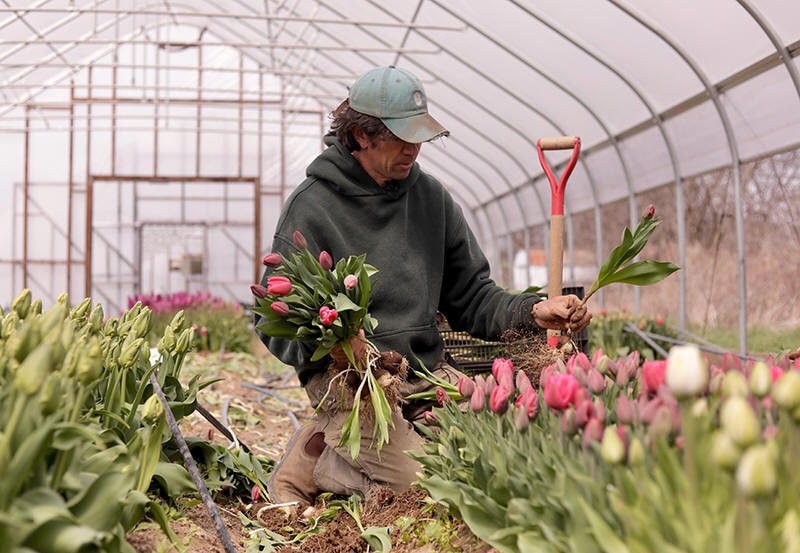
Gregory Witscher, owner of Understory Farm, harvests tulips, Monday,
April 20, 2026, in Bridport, Vt. (AP Photo/Amanda Swinhart)
 In Vermont, the temperature swing
affected operations at Understory Farm in Bridport, which grows cut
flowers. Tulips that were supposed to be ready for Mother's Day in
mid-May have already bloomed in the farm's greenhouses, said owner
Gregory Witscher.
“That just means that we have to harvest them all at the same time,”
he said. “We have to harvest them and store them with the bulbs on
in creates in a walk-in cooler for longer.”
Witscher grows about 50 varieties of flowers for wholesale markets.
Weather fluctuations require flexibility, he said, and it's become
more common for small vegetable and flower farms to have row covers
or heaters to protect plants from cold or shade cloth for extreme
heat.
“With the hot weather and then the cold weather, I think its
intense, and it makes things challenging,” he said. “The longer I do
this, the more I want to have as many options as possible and have a
lot of tools and resources available to be extremely nimble.”
All contents © copyright 2026 Associated Press. All rights reserved |