|
At the April 2026 Logan County
Genealogical and Historical Society, Bill Donath spoke about the
history of Temple Beth-El and Jewish families in Logan County from
around 1842 to 1927. He has done extensive research on this topic.
Donath said 1842, 1884, 1904, 1910
and 1927 were significant transition dates for the Jewish population
in Logan County. 1842 was the earliest documented person of Jewish
faith in Logan County. The man was living in Postville.
By 1884, eight or nine families in Lincoln and Logan County came
together for religious services and organized Temple Beth-El.
The numbers dwindled for a while, but Donath said in 1904 the temple
was reorganized with twenty families. Rabbi Abraham Messing helped
organize the temple.
Rabbi Charles Levi from Peoria put Rabbi Messing in charge of the
Lincoln temple.
Donath said by 1910, the families had pooled enough money to build
the temple.
By 1927, several men who were leaders at the temple had passed away
and the women were left to try to keep it going. That year they had
to close the temple and dispose of the building.
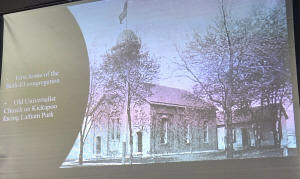
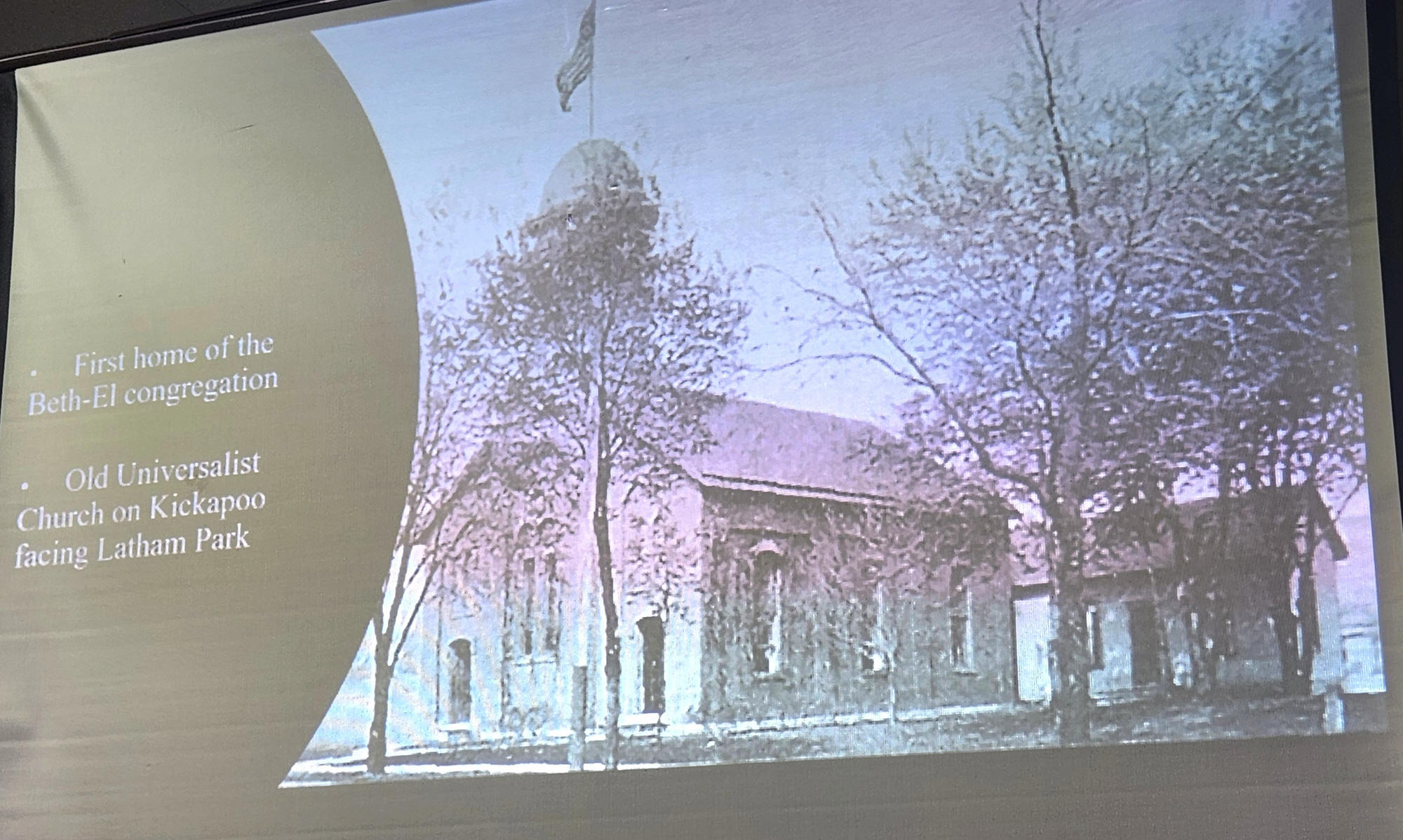
When they started in 1884, the
Beth-El congregation leased the old Universalist Church on Kickapoo
facing Latham Park where Mel-O-Cream Donuts is now located. Donath
said the building housed the library from 1870 to 1884 and was the
library's second location.

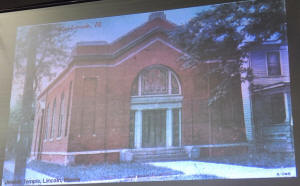
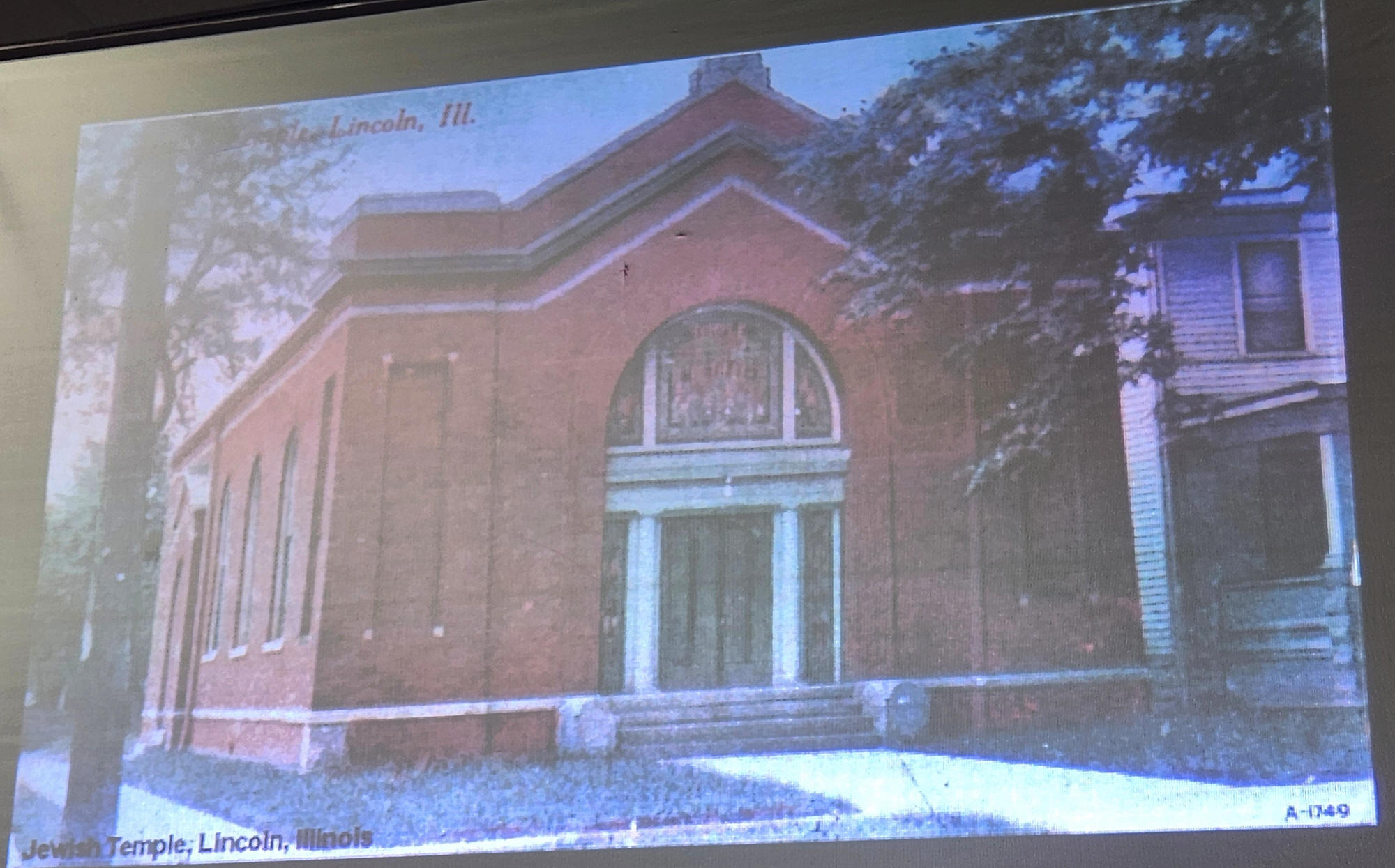
In 1910, the temple’s permanent
home was built on McLean Street facing Latham Park. Donath said the
Star of David on the top is still there today.
Margaret E. Maxwell purchased the property for $1100. The temple was
designed by architect J.M. Deal, who also designed the Logan County
Courthouse, library and several other churches in Lincoln.
The contractor was Crowell and the cost for building the temple was
$7000. Donath said they had no debt when the building was completed.
The temple was approximately 36 feet wide and 70 feet long and
follows the modernized Roman style. The interior of the temple was
done by Schaumbacher of Springfield who had decorated many churches
in Lincoln built around the time.
Construction of the temple started in June 1910, and it was
dedicated November 5, 1910. Donath found information for his
presentation in articles by Nancy Gelbach and Mary Ellen Martin.
Gelbach’s article on the Star of David was in a 1997 Our Times
article and Martin’s article was about the Jewish temple being
dedicated. Both articles can be found in the church files at the
LCGHS building.
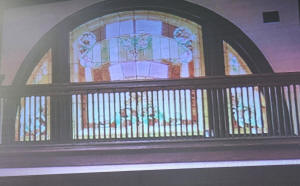
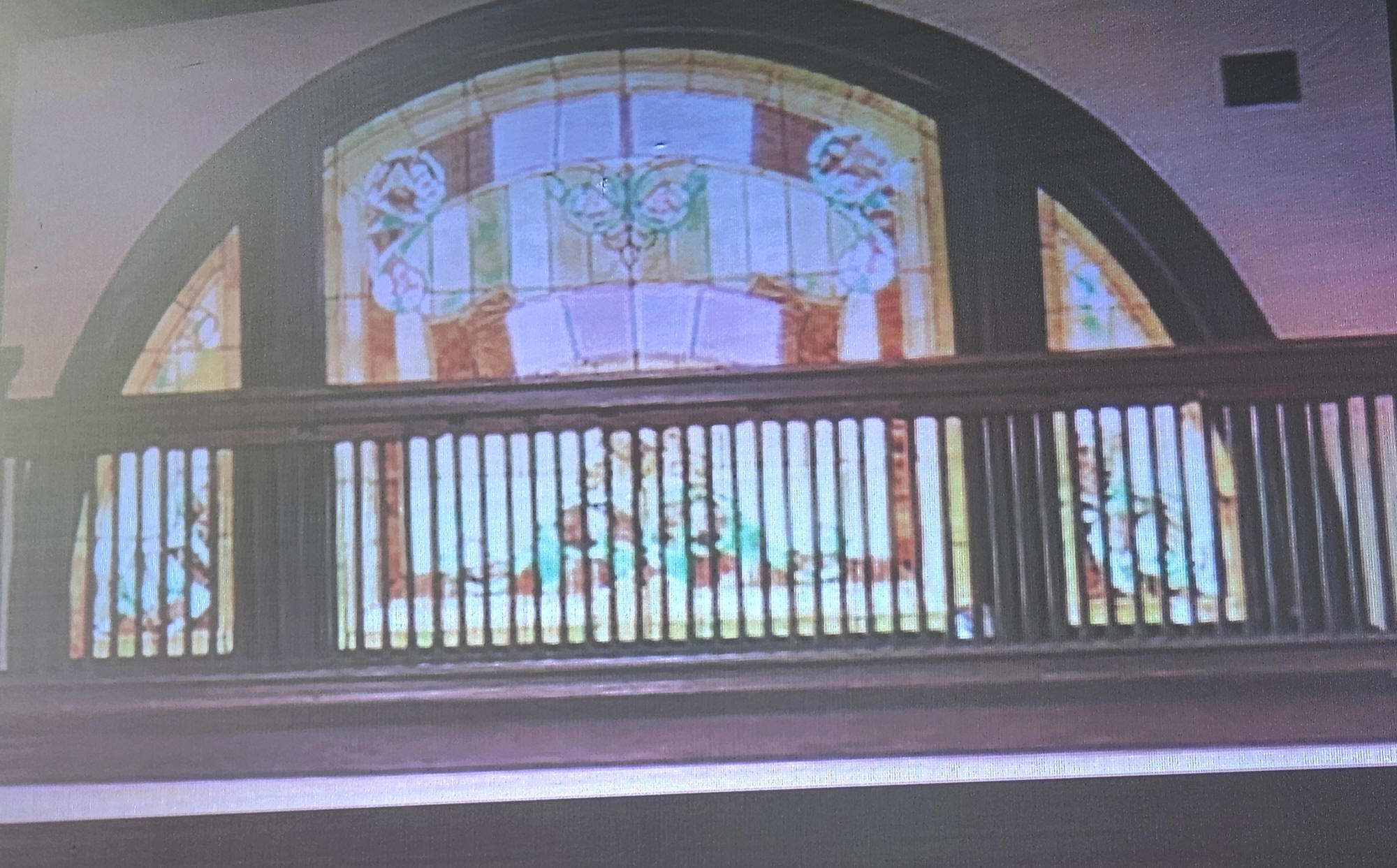
The temple had several glass
windows, but Donath said only one window is still in the building
today. Several windows and the pulpit were donated by families who
were part of the temple.
In 1920, Donath said several men in
leadership positions at the temple had passed away. The women tried
to keep the temple going, but they disbanded in 1927.
A Methodist Church in Cornland which had been destroyed by a tornado
bought the pews, pulpit, chairs and some stained-glass windows from
the temple for their new church.
The temple was purchased by the
Lincoln Woman’s Club in 1927. Donath said the Woman’s Club had the
interior renovated for their use at a cost of $9000 and are still
using the building today.
Donath heard there were a Jewish cemetery in Old Union Cemetery.
This cemetery has had two additions, and the Jewish families were
buried in the newest section. There are diagrams for each of the six
lots in this section and most are big enough for eight burials. Lots
one, two and three have members of the Rosenthal family, who were
part of the temple.

[to top of second column] |

A list of the
various families who were part of the temple and are buried
there was created by Donath. Jewish kids who died and had no
family were buried in donated plots.
Notable families
The Kahns and the Rosenthals were two notable families who were
part of the temple.
Solomon Kahn bought the Postville Courthouse in 1848 and lived
upstairs before he married Yete Aaron, with whom he had eleven
children. Just down the street from Postville Courthouse, he ran
a store with his brothers Felix and Moses Kahn. He later sold
the store to his brothers.
In 1884, Donath said Solomon Kahn was Vice-President of Beth-El.
Kahn served as Lincoln’s first city treasurer from 1865 to 1885.
Lewis Rosenthal and Francis Aaron got married at the Postville
Courthouse in 1856 and Donath said it was the earliest known
Jewish marriage performed there. Over the years, the couple had
nine children, though some did not live to adulthood. Rosenthal
was a merchant and horse dealer who sold racehorses in Mexico,
Missouri.
When Rosenthal served as a Deputy Marshall, Donath said he got
to know Abraham Lincoln. One day when Lincoln was in the
courthouse for court, he saw a shed sitting on his lot that was
supposed to be empty. Lincoln asked Rosenthal if he knew whose
shed it was and thought maybe the person who owned it could pay
the taxes since Lincoln was not getting any use out of it.
Lincoln asked who the guy was and Rosenthal said he knew who the
guy was and he would not pay any taxes on it. It turns out
Rosenthal was the one who had the shed there. Lincoln ended up
paying those taxes.
Rosenthal was also a Civil War veteran in the 106th regiment who
was a sutler or storekeeper for soldiers. Donath said sutlers
sold goods like toothpaste, toothbrushes, writing paper and
stamps.
From 1862 to 1865, Rosenthal served as the President of Beth-El.
From around 1880 to 1916, Rosenthal served as a Police
Magistrate in the county, sorting out who needed to go to the
county court. Donath said Rosenthal was known to be an honest
and reputable man.
Jewish Merchants in Logan County
Most of the Jewish people in town were merchants who sold men’s
apparel or dry goods. Donath pulled several newspaper
advertisements from the Shew collection.
One ad shows a merchant named Frank Atlass bought and sold hens,
springs, young turkeys, old turkeys and eggs plus rags and other
items that could be reused.
Donath said two of Rosenthal’s sons built a radio station in the
attic of a house on Logan Street. They would have people come in
and talk, sing or play music. Later the brothers moved to
Chicago and ran the radio station WBBN, which still exists
today.
The Cork Faced Collar Company sold products like horse collars
and mule collars that mostly went to the military.
The Landauer family had a store and invested in various
industries in Lincoln.
H.F. Friend was a jeweler. Donath said he rented part of the
store to someone who sold sewing machines.
Meyer Gresham was a men’s clothing store.
Julius Jacobs & Company sold overalls, topcoats and other men’s
clothing.
John A. Lutz Company was a dry goods store. Donath said the
store was open for over 50 years.
Chicago Novelty Cloak Company sold women’s clothing like
dusters, which Donath said were coats that protected their
clothes from dust as they travelled.
Kahn Brothers sold Dawson’s Hog and Poultry Cholera remedy.
Donath said the remedy was made in Mt. Pulaski

Steifel & Company sold women’s
clothing. He had someone in the shop who did millinery and
dressmaking. Steifel had a dry goods store with carpets and menswear
as well.
Those were just some of the shops during the early years of Lincoln.
As Donath researches families who are buried in the Union cemetery,
he makes a file folder for each family. When Donath runs across
articles on the families, he puts them in the files. He hopes to
have a nice collection on each family so people will know what they
did here in the city and elsewhere.
The next Logan County Genealogical and Historical Society meeting
will be Monday, May 18 at 6:30 in the LCGHS building located at 114
N. Chicago Street in Lincoln. Casey Claypool will speak on Route 66
scenic byways.
Temple of Beth-El photo slideshow
[Angela Reiners] |