Republicans launch a new effort to fund the Department of Homeland
Security
[April 22, 2026]
By MARY CLARE JALONICK
WASHINGTON (AP) — The Senate voted on Tuesday to launch a new effort to
reopen the Department of Homeland Security and end the longest partial
government shutdown in history.
The 52-46 vote was the first step in a budget process that Republicans
hope will unlock the funding for Immigration and Customs Enforcement and
Border Patrol. Senate Democrats have blocked money for those agencies
since mid-February, demanding policy changes after the fatal shootings
of two protesters by federal agents.
Republicans are now trying to fund the two agencies through a
complicated, time-consuming process called budget reconciliation, a
maneuver that they also used to pass President Donald Trump’s package of
tax and spending cuts last year with no Democratic votes. The Senate has
already voted on a bipartisan basis to reopen the rest of the
department, but Republican leaders in the House say they won't take that
bill up until the Senate shows progress toward funding ICE and Border
Patrol, as well.
The budget process only requires a simple majority in the Senate,
bypassing filibuster rules that require Republicans to find 60 votes on
most bills when they only hold 53 seats. But it also comes with
increased scrutiny from the Senate parliamentarian and an open-ended
series of amendment votes that could potentially alter the bill.
“It’s not my preference, but it is reality,” Thune said.
Senate Minority Leader Chuck Schumer, D-N.Y., called the budget
workaround a “partisan sideshow” and said the resolution will pour money
into immigration enforcement “without putting any restraints on these
rogue agencies’ rampant violence in our streets.”

Senate leaders try to keep bill focused on ICE, border patrol
The Senate Budget Committee on Tuesday released the estimated $70
billion resolution to fund ICE and Border Patrol for three years,
through the rest of Trump’s term. Thune and other GOP leaders say they
hope to keep the bill narrowly focused and pass it by the end of the
month.
But that could prove difficult as many in the party see it as the last
real chance this year to enact their priorities. Republicans in both the
Senate and House have pushed to add other items, including money for
farmers and Trump’s proof of citizenship voting bill, called the SAVE
America Act.
Republican leaders say they would try to do a second partisan budget
reconciliation bill to deal with some of those issues. But many of their
colleagues are skeptical, especially with thin GOP margins in both
chambers of Congress and an election approaching.
Senators who have been pushing for more to be included in the original
resolution say they are preparing amendments to try and add them on the
Senate floor. Sen. John Kennedy, R-La., said he’ll try to add parts of
the SAVE America Act and proposals related to the economy.
“A lot of Americans are very worried about the cost of living and we
need to address it,” Kennedy said Monday.
But at a lunch meeting on Tuesday, Republican senators were mostly
united around Thune's plan.
“I think people recognize that we have to act quickly,” said Sen. Ron
Johnson, R-Wis. “The more you add the more that slows the process down.”
[to top of second column]
|

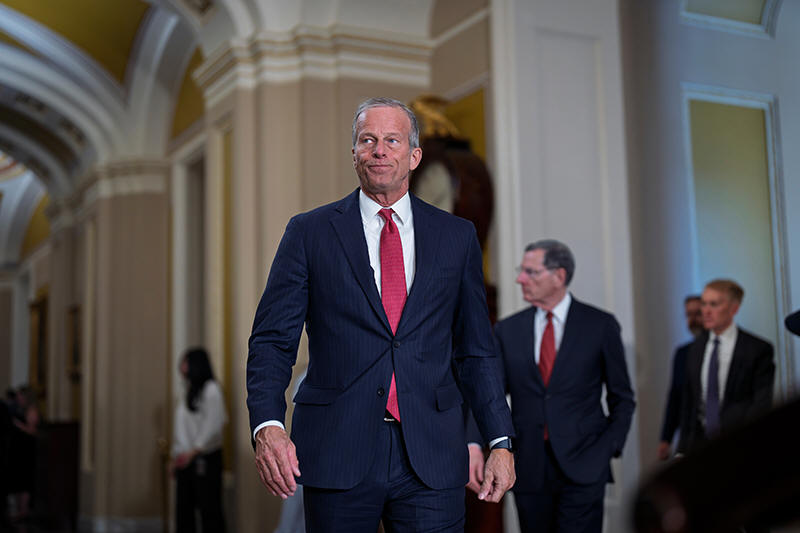
Senate Majority Leader John Thune, R-S.D., emerges from a
closed-door party meeting to speaks with reporters, at the Capitol
in Washington, Tuesday, April 21, 2026. (AP Photo/J. Scott
Applewhite)

Democrats say reforms still needed at ICE
Democrats say any funding bill should place restraints on federal
immigration authorities, including better identification for federal
officers and more use of judicial warrants, among other asks.
“After the killings of Renee Good and Alex Pretti, people across the
country demanded ICE be reined in," said Washington Sen. Patty
Murray, the top Democrat on the Senate Appropriations Committee.
“But instead of working with Democrats to enact real reform,
Republicans rejected the most basic accountability measures, and now
they’re rushing to give ICE billions of dollars more.”
After federal agents shot Renee Good and Alex Pretti in Minneapolis
in January, Trump agreed to a Democratic request that the Homeland
Security bill be separated from a larger spending measure that
became law. But bipartisan negotiations went nowhere, and the DHS
funding lapsed with no agreement on changes to the Trump
administration’s immigration enforcement tactics.
In March, the Senate passed legislation by voice vote that would
separate out ICE and Border Patrol and fund the rest of the
department, including the Transportation Security Administration as
security lines grew long at some airports. But Republicans in the
House refused to vote for it, saying they wouldn’t support any bill
that didn’t include money for immigration enforcement.
Congress then left town for a two-week recess, leaving the issue
unresolved. Trump has used executive orders to pay some department
salaries in the meantime, but the future of those paychecks is
uncertain.
During the recess, Thune and House Speaker Mike Johnson announced
that they would pursue a two-track approach — pass the Senate bill
that includes most of the department’s funding through regular order
and use the party-line bill to pass ICE and CBP funding.
Weeks later, though, Johnson has still not said when the House will
take up the Senate's legislation funding the rest of the department.
And it is unclear if members of his GOP conference will unite behind
the narrowed budget bill.
“We’ll figure this out,” Johnson said ahead of the Senate vote on
Tuesday. “We’ve got lots of discussion today and in the coming days
to make sure we can get that through and I think we will.”
___
Associated Press writers Steven Sloan and Kevin Freking contributed
to this report.
All contents © copyright 2026 Associated Press. All rights reserved
 |