Nearly 500 alleged MS-13 members are on a mass trial in El Salvador
[April 22, 2026]
By MARCOS ALEMAN and ANNA-CATHERINE BRIGIDA
SAN SALVADOR (AP) — Prosecutors in El Salvador opened a massive, joint
trial of nearly 500 alleged members of the MS-13 gang on charges that
include homicide, extortion and arms trafficking.
The trial, which opened Monday in San Salvador, is the latest in a
practice that has been criticized by human rights groups as an
infringement on the right of the accused to defend themselves. Such
trials form part of President Nayib Bukele's iron-fist approach against
criminal groups in El Salvador, which has been under a state of
emergency for four years to fight organized crime.
“These mass trials lack basic guarantees of due process and thus they
increase the risk of convicting innocent people who have nothing to do
with the gangs that have terrorized the country for decades,” Juan
Pappier, Americas deputy director for Human Rights Watch, told The
Associated Press.
The 486 defendants are accused of being members of MS-13, or Mara
Salvatrucha, and accused of ordering more than 47,000 crimes from 2012
to 2022, according to the Salvadoran government. The charges also
include femicide and enforced disappearances.
"For years, this structure has operated systematically, causing fear and
mourning among Salvadoran families,” Attorney General Rodolfo Delgado
said on social media.

El Salvador once had one of the highest homicide rates in the world,
with 103 killings per 100,000 inhabitants in 2015. Since Bukele took
office in 2019, government statistics show a drastic drop in that
number. But human rights groups say Bukele's approach has violated due
process.
Mass trials “raise serious questions about compliance with due process
guarantees, including the right to an individualized defense, the
presumption of innocence and access to adequate legal representation,”
Irene Cuéllar, researcher for Central America at Amnesty International,
said Tuesday in a statement.
The gang leaders are being tried in an open hearing at an Organized
Crime Court under a 2023 reform of El Salvador’s penal code.
The country's “state of exception" since March 2022 has suspended
fundamental rights, including the right to be informed of the reasons
for detention and the right to legal counsel. Security forces can also
intercept telecommunications without a court order, and detention
without a preliminary hearing is extended from 72 hours to 15 days.
In a statement Tuesday, the Inter-American Commission on Human Rights
said it “maintains serious worries about the impact on human rights by
the unjustified and excessive prolongation of the state of exception in
El Salvador” and called on the government to end the measure.
[to top of second column]
|

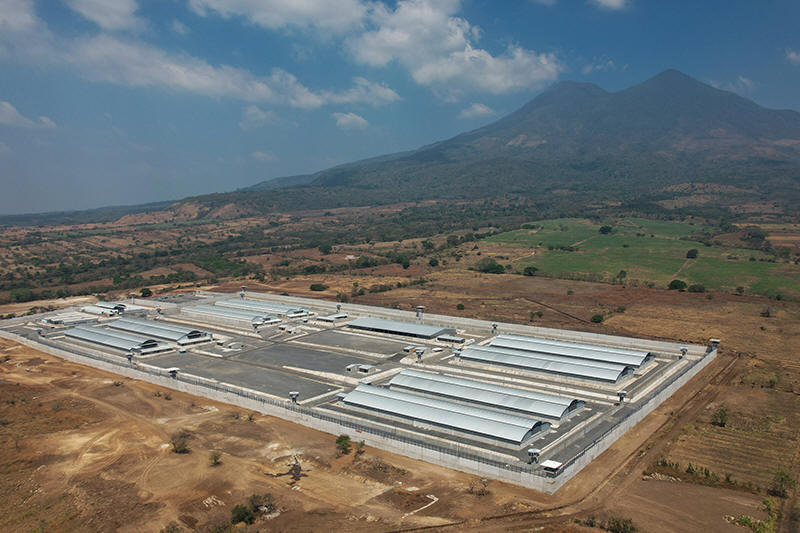
The Terrorism Confinement Center (CECOT) stands in Tecoluca, El
Salvador, March 5, 2023. (AP Photo/Salvador Melendez, File)

Of the defendants, 413 are being held at the Terrorism Confinement
Center, a maximum-security prison that Bukele ordered built that has
become a symbol of his controversial security policies. Many defendants
watched the proceedings virtually from the prison.
Another 73 alleged gang members are being prosecuted in absentia,
according to the Attorney General's office.
In March 2025, in the first such collective trial, 52 members of the
Barrio 18 gang were sentenced to prison, with the longest sentence
amounting to 245 years.
In another collective trial in November 2025, a court found 45 members
of a rival faction, Barrio 18 Sureños, guilty of several crimes and
handed down a 397-year prison sentence to one leader.
Since the state of emergency began, authorities say they have arrested
91,300 people allegedly belonging or tied to gangs.
Human rights organizations say thousands have been arbitrarily detained
and that they have registered more than 6,000 complaints filed by
victims under the state of emergency. At least 500 people have died in
state custody.
Bukele has acknowledged that at least 8,000 innocent people were
arrested under the measure and have since been released.
"Justice is not only about punishing those responsible," said Cuéllar of
Amnesty International. “It is also about protecting innocent people from
being wrongly accused or convicted.”
___
Associated Press reporter Anna-Catherine Brigida reported from Mexico
City.
All contents © copyright 2026 Associated Press. All rights reserved
 |