|
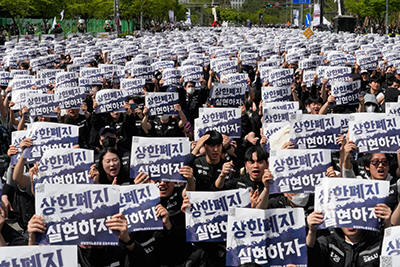
Holding signs and waving banners, the workers gathered at a
factory compound amid a heavy police presence, shouting “make
compensation transparent and remove maximum limits on bonuses!”
Union officials said about 40,000 members participated in the
protest. Police did not immediately provide a crowd estimate.
The rally came hours after Samsung’s cross-town rival, SK Hynix,
posted an all time high in quarterly revenue and operating
profit for the January-March quarter, a jump it attributed to
expanding global investments in data centers and other AI
infrastructure that drove up the demands for its memory chips.
Samsung, which together with SK Hynix produces about two-thirds
of global memory chips, forecast earlier this month that its
first-quarter operating profit would reach a record 57.2
trillion won ($38.6 billion). That would be higher than the 37.6
trillion won ($25.4 billion) posted by SK Hynix on Thursday,
although Samsung has a more diverse lineup of businesses,
including smartphones and consumer electronics.
Samsung’s union, which represents about 74,000 workers, says the
company has failed to offer adequate compensation despite its
strong performance. It has rejected the management’s proposal
for bonuses of restricted stock and calling for removing caps on
bonuses.
The union has threatened to stage an 18-day walkout starting May
21 if negotiations with management fail and claims that such
action would cost the company more than 1 trillion won ($676
million) a day.
“We won’t stop this fight until our fair demands are met,” Choi
Seung-ho, a union leader, said through a loudspeaker from atop a
crane-mounted structure.
While semiconductor makers have benefited from the AI boom, the
war in the Middle East has clouded the future outlook,
disrupting supplies of key materials such as helium that are
crucial to chipmaking and pushing up energy costs.
In a conference call Thursday, Woo Hyun Kim, SK Hynix’s chief
financial officer, said the company is closely monitoring the
conflict but does not expect a meaningful impact on production,
saying it has been diversifying its sourcing of helium and
bromine beyond the Middle East and has sufficient inventory.
__
Kim Tong-hyung reported from Seoul, South Korea. AP writer
Hyung-jin Kim contributed to the report from Seoul.
All contents © copyright 2026 Associated Press. All rights reserved

|
|