Transportation providers, schools, state officials ease school bus
driver shortage
[April 23, 2026]
By Jenna Schweikert
A nationwide school bus driver shortage, driven by the COVID-19
pandemic, persists in some parts of the country. But in Illinois,
efforts to attract new demographics of bus drivers and make hiring
easier have paid off.
Illinois school districts and transportation providers partnered with
the secretary of state’s office to increase hiring and retention in the
school bus driver workforce.
First Student, the largest nationwide school transportation provider,
initiated the connection with Secretary of State Alexi Giannoulias.
The shortage, the worst in decades, began in 2020 as a significant part
of the bus driver workforce — elderly retirees — were among the
most-affected by the virus, according to Leslie Norgren, vice president
of consulting at First Student.
In a nationwide survey conducted in 2025 by the Associated Press-NORC
Center for Public Affairs Research, a nonpartisan research organization,
and HopSkipDrive, a school rideshare company, 80% of school
administrators said school bus driver shortages were a problem in their
district.
Eighty-three percent of respondents said staff in their districts had to
take time away from their core duties to drive school buses or manage
car lines at least a few times a year. Fifty-four percent did so weekly
over the period.
And 90% said they faced a growing number of students who qualify for
free school transportation amid a diminishing workforce and strict
financial constraints.
According to its website, First Student is hiring for about 40 part-time
driver positions across the state, from Chicago and its suburbs down to
Carbondale.

But Norgren said that for now, the market has stabilized and there is no
longer a shortage of bus drivers in Illinois.
“A lot of districts in Illinois outsource their transportation, and
that’s always been a model in Illinois, because that’s what we do,
right? That’s our core business and our expertise,” Norgren said. “We
tend to be much stronger on the recruiting and retention side than at
school districts whose core business is educating students.”
In Chicago’s public school district, only about 5.5% of 315,000 students
are eligible for bus service under state law, according to a
spokesperson for the district. To be eligible for bus service under
Illinois law, kids must live more than 1.5 miles from their school or be
in danger on their school route.
But that number is growing: An increase in the district’s “most
vulnerable” students, those with disabilities and those in temporary
living situations, is contributing to an ongoing labor shortage in the
district, according to the spokesperson.
But CPS has addressed the shortage by raising driver wages, coordinating
with vendors including First Student, assisting with access to public
transportation, adjusting school transportation schedules and advocating
for adjustments to state tests and certifications, according to the
district’s spokesperson.
Spokespersons for the Decatur and Peoria public school districts
declined to comment on their efforts to address the shortage.
Springfield Public Schools did not respond to a request for comment.
Removing hiring barriers
Giannoulias has worked with companies like First Student and school
districts across the state to reduce legislative and administrative
barriers to hiring.

[to top of second column]
|
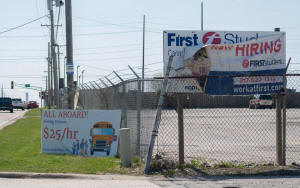
A hiring sign at First Student’s bus depot in Springfield has been
posted for months. (Capitol News Illinois photo by Jenna Schweikert)

“We’re focused on removing unnecessary barriers while keeping safety at
the center of everything we do,” Giannoulias said in a statement. “Our
children who depend on bus services in urban, small-town and rural
communities must have bus drivers who are not only reliable, but have
passed required testing that will keep them as safe as possible on their
way to and from school.
“By ensuring the process is accessible and aligned with our core safety
values, Illinois will have more reliable and qualified school bus
drivers,” Giannoulias said.
In one major change, Giannoulias adjusted training requirements to
better reflect which type of vehicle drivers operate and petitioned the
federal government to waive the requirement of an under-the-hood exam.
In the exam, drivers had to identify the engine components, which
doesn’t make sense today because school bus depots have mechanics and
techs to do that work, Norgren said.
“They (state officials) were critical in getting that exemption in
Illinois for drivers, so that helped a lot (to) open up the workforce,”
Norgren said. “They helped us streamline our training, so that training
was more pertinent based on the vehicle you drive.”
Giannoulias also expanded access to the commercial driver’s licensing
process by adding exams administered in Spanish and allowing certain
farm truck licensees to also operate school buses.
Throughout the process, safety remained a top priority, Giannoulias and
Norgren said.
“We do believe that it’s important that the safety standards are met for
all drivers transporting students regardless of the vehicle type,”
Norgren said. “All of that is very important to the standards that we’re
offering and that we believe all student transportation should meet.”
Changing the workforce
While working with Giannoulias to ease hiring requirements, First
Student also worked to attract and retain drivers and build a more
diverse workforce in terms of age, and added sign-on bonuses to attract
a larger workforce, Norgren said.

“We’ve raised pay and benefits. We offer more flexible schedules,”
Norgren said of First Student. “The last thing I would say is more
education and training for our drivers as they come into the workforce.
So, right, you’re creating that culture of value and care for the
students.”
In Illinois, First Student operates over 6,000 buses that provide
specialized and standard home-to-school transportation to hundreds of
districts including Elgin, Urbana, Springfield and Rockford. In some
districts, like Galesburg and Westville, the company partnered with the
school district to upgrade equipment by providing electric school buses.
These changes are expected to stay in place to continue increasing and
diversifying the workforce, Norgren said.
“We see these as structural changes that are long term and help the
industry and directly address the challenges … as the labor market
changes,” Norgren said.
Capitol News Illinois is
a nonprofit, nonpartisan news service that distributes state government
coverage to hundreds of news outlets statewide. It is funded primarily
by the Illinois Press Foundation and the Robert R. McCormick Foundation. |