Millionaire tax amendment fails to gain enough support from House
Democrats
[April 24, 2026]
By Ben Szalinski
SPRINGFIELD — A “millionaire tax” proposal floated in the Illinois House
failed to gain enough traction in Springfield this week, making it
increasingly unlikely that voters will be asked to approve the measure
in November.
House Speaker Emanuel “Chris” Welch, D-Hillside, confirmed to reporters
on Wednesday night that the constitutional amendment proposed by Rep. La
Shawn Ford, D-Chicago, was not going to be called for a vote this week.
The House is not scheduled to be in after Thursday before the May 3
deadline to put constitutional amendments on the November ballot.
“Everyone knows it needs a lot more work,” Welch said. “There were a lot
of questions that people had and they deserve to have those answers to
those questions.”
Increasing taxes on millionaires was a priority for Welch and many
progressives in Springfield, but the speaker said it didn’t have the
votes to pass the House. Constitutional amendments require a 71-vote
super majority in the chamber and the proposal was deeply unpopular with
Republicans, meaning at least 71 of the House’s 78 Democrats would need
to push it out to the Senate.
“We were very close, very close,” Welch said. “But close is not enough
and we’re committed to getting it right. We’re going to continue to work
towards it.”
It could be a few years before lawmakers revisit the concept. The next
deadline for approving constitutional amendments is early May 2028, six
months ahead of the presidential election.

How it would work
Illinois’ constitution mandates a flat tax rate regardless of income.
Voters would have to approve an amendment changing that to tax
millionaires more.
Under the amendment being floated in Springfield, income over $1 million
would be taxed at 3%. It would be the first time under the current
constitution that a specific tax rate on income would be included in the
guiding document, which has led some people to question if that’s a
smart choice given that the value of money changes over time and the
constitution cannot be easily changed.
The state’s current 4.95% tax rate is dictated by lawmakers.
The amendment also called for splitting revenue from the millionaire tax
equally between a property tax relief fund and K-12 education. There was
also disagreement among lawmakers about exactly where the revenue should
go.
A study published by researchers at the Illinois Economic Policy
Institute and the University of Illinois at Urbana-Champaign last month
found the tax would generate $3.8 billion in its first full year and
$4.2 billion by 2030 — revenue estimates the researchers labeled as
“conservative.”
The nonpartisan Commission on Government Forecasting and Accountability
pegged the number at $2.1 billion annually but cautioned that it could
fluctuate greatly by year. About 1% of people in Illinois would pay the
tax.
[to top of second column]
|

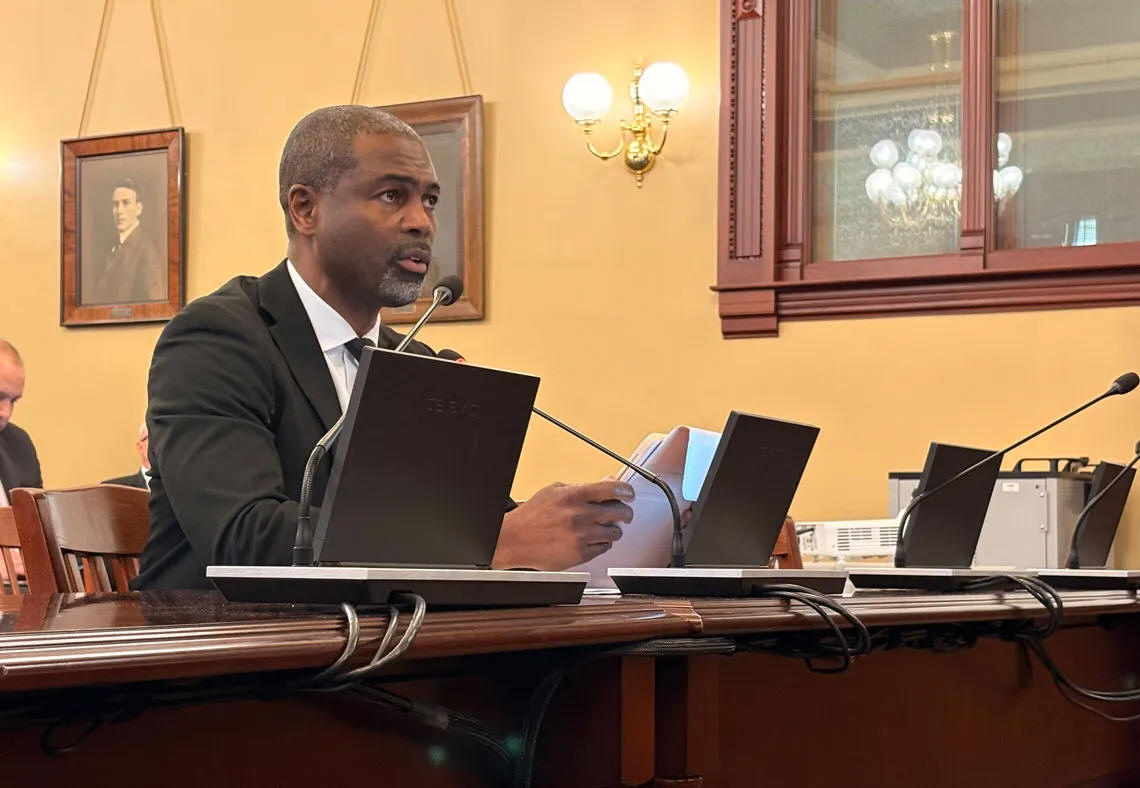
Rep. La Shawn Ford, D-Chicago, presents a proposed constitutional
amendment to implement a tax on millionaires to the House Revenue
and Finance Committee on April 21, 2026. (Capitol News Illinois
photo by Jerry Nowicki)

Political will
The proposal was more specific than a proposed amendment in 2020 that
would’ve allowed a graduated tax structure in the state. But that was
rejected by voters, and even though 61% of voters signaled support for
the millionaire tax in 2024 in a nonbinding referendum, some lawmakers
were still skeptical a binding amendment would get voters’ blessing.
“The message that was very clear to me after the last effort was the
voters weren’t quite ready for that,” Senate President Don Harmon, D-Oak
Park, told reporters last week. “So we’re going to have to do some
serious evaluation here before advancing anything right now.”
The bill passed out of a House committee on Tuesday on a party line
vote.
“They do not trust Illinois government with more money,” Rep. Amy Elik,
R-Godfrey, said in the committee. “They don’t trust that it’s really
doing to go to these things and there’s nothing in this language that’s
going to guarantee that.”
Even Gov. JB Pritzker, who was the cheerleader of the 2020 amendment and
spent millions of dollars supporting it, wasn’t pressuring lawmakers to
approve a new amendment this year. He had said he continues to support
the concept but it will be up to the legislature if they want to place
it on the ballot. Amendments don’t require the governor’s signature
after passing the legislature.
Welch also told reporters he hopes to get support from business groups
for the amendment in the future. Multiple business groups, who also
opposed the 2020 amendment, registered their opposition to this year’s
proposal.
Voters may still see an amendment on redistricting in November, however,
after the House approved one on Wednesday. The Senate must still approve
it by the end of next week for it to appear on the ballot.
Capitol News Illinois is
a nonprofit, nonpartisan news service that distributes state government
coverage to hundreds of news outlets statewide. It is funded primarily
by the Illinois Press Foundation and the Robert R. McCormick Foundation.
 |