Pritzker’s affordable housing plan gets Senate hearing as municipalities
remain opposed
[April 25, 2026]
By Aidan Klineman and Medill Illinois News Bureau
SPRINGFIELD — Illinois lawmakers questioned affordable housing
advocates, municipal leaders and members of the public Thursday on Gov.
JB Pritzker’s Building Up Illinois Developments plan.
The plan, known as BUILD, was announced by Pritzker during his budget
address in February. It hasn’t moved in the legislature despite the
passage of House and Senate deadlines for moving bills, though several
of its components were the subject of a nonvoting Senate Executive
Committee hearing this week.
It aims to overhaul the state’s residential zoning laws to address a
statewide housing shortage of roughly 142,000 units and meet a demand of
225,000 units over the next five years, according to data from the
governor’s office.
Oral testimony and questioning from lawmakers on the six BUILD bills
lasted nearly three hours. Proponents of BUILD argued that the primary
driver of the current housing affordability crisis is a lack of supply
caused by regulatory hurdles and inconsistencies across municipalities.
Opponents of the package — primarily municipal leaders — argued that
BUILD infringes on local home rule authority and imposes a
“one-size-fits-all” approach to residential zoning. Some also complained
that it would impose unfunded mandates on municipalities and did not go
far enough to address affordability concerns.
Members of the Senate Executive Committee said the meeting would not
lead to a vote on the bills under consideration but was aimed at
focusing on feedback and best practices. Despite the passage of bill
movement deadlines, the legislature has ways of moving bills quickly
late in the legislative session, which is scheduled to conclude on May
31.

Senators began the hearing by introducing the six pieces of legislation
in question — Senate Bills 4060, 4061, 4062, 4063, 4064 and 4071 —
before handing it off to Olivia Ortega, the governor’s director of
housing solutions, to provide testimony.
“Our current rules make it very difficult to build the homes people
need, and that is what BUILD is designed to address,” Ortega said.
Trying to deflect claims by opponents that the bills would amount to
changing the character of Illinois neighborhoods, Ortega said BUILD
would spark only “incremental increases in housing supply.”
Supporters make their case
Supporters of the initiatives see it as a market-driven solution to
Illinois’ growing affordability problem. Increasing supply by cutting
regulatory red tape would temper exorbitant housing and living costs
across the state, proponents argued.
Among the most ambitious of the BUILD provisions is the ability of
property owners to construct “middle housing,” or multi-dwelling units
such as duplexes, triplexes and fourplexes, on lots restricted to
single-family homes under current zoning codes.
The six bills would allow for the construction of middle housing, permit
multi-family dwellings to be constructed with a single stairwell,
establish a statewide formula for calculating impact fees, expedite
timelines by allowing third-party inspectors, do away with parking
requirements based on number of tenants and allow property owners to
lease accessory dwelling units to outside renters.
Emily Bloom-Carlin, director of housing and community development at the
Metropolitan Planning Council, a Chicago-based nonprofit that researches
and advocates for affordable housing initiatives, testified that the
impact of this legislation could be far-reaching.
Constructing additional units in certain neighborhoods, along with a
proposed $250 million capital grant to assist first-time and low- and
middle-income homebuyers, may increase school district revenues and
improve local infrastructure, Bloom-Carlin argued.
“When the rules make room for smaller, more varied homes, more of them
get built and affordability improves,” Bloom-Carlin said. “BUILD is a
careful, tested, common-sense response to a problem that has been
decades in the making.”

[to top of second column]
|
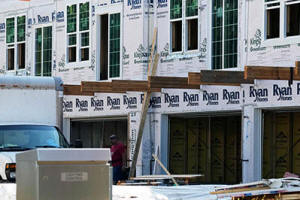
New homes are shown under construction in Wheeling, Illinois,
Monday, Aug. 26, 2024. (AP Photo/Nam Y. Huh)

Illinois REALTORS CEO Jeff Baker framed it in the context of economic
opportunity.
“This package of legislation represents one of the most meaningful and
impactful policy shifts our state has made toward making the American
Dream realistic to everyone in our state that desires it,” Baker said.
Concerns over local control, gentrification
Opponents were less flowery. Illinois Municipal League CEO and former
Carbondale Mayor Brad Cole said the league’s objections to the bill
stemmed from the state going over the heads of local authorities to
impose new statewide zoning regulations.
“The core issue for us is the preemption of local authority, and that
also means the preemption of local input,” Cole said.
Cole referenced earlier testimony from a proponent of the legislation,
establishing a mantra that other BUILD opponents repeated throughout the
remainder of the hearing.
“Somebody earlier indicated that a one-size-fits-all approach does not
work,” Cole said. “And we agree!”
Concerns about the state undermining local authority were not the only
ones voiced by BUILD opponents. Isabel Cabrera, a Mexican immigrant and
Chicago resident who had to relocate from the Logan Square neighborhood
due to affordability concerns, argued that simply building more housing
units will not result in lower costs. Instead, Cabrera feared that more
people in her community would be displaced.
“Density without affordability is not justice,” Cabrera said, “It’s
gentrification.”
Many opponents indicated they were not opposed to the entire BUILD
proposal, but that key aspects needed refinement to more directly
address affordability concerns.
Daniel Lauber, an attorney from Chicago’s west suburbs, echoed this and
lamented the legislative product before the committee, arguing that
rezoning, as described in SB4060, will change the “character” of
neighborhoods across the state.

“I love the goals of SB4060,” Lauber said of the particular BUILD bill
that would rezone areas for middle housing. “But the devil is in the
details, and sadly, SB4060 is not ready for primetime.”
Sen. Omar Aquino, D-Chicago, inquired about protections against market
pressures that may arise from the construction of additional units in
neighborhoods. Aquino said he and his wife recently sold their home and
moved into a multigenerational home due to affordability concerns.
Similarly, Sen. Donald DeWitte, R-St. Charles, raised concerns about
changing land values that could negatively affect current homeowners.
Ortega indicated that the land value component will be addressed by the
$250 million capital investment but stated that market protections had
not been included in the introduced legislation.
Aidan Klineman is an undergraduate student in
journalism with Northwestern University’s Medill School of
Journalism, Media and Integrated Marketing Communications, and is a
fellow in its Medill Illinois News Bureau working in partnership
with Capitol News Illinois.
Capitol News Illinois is
a nonprofit, nonpartisan news service that distributes state
government coverage to hundreds of news outlets statewide. It is
funded primarily by the Illinois Press Foundation and the Robert R.
McCormick Foundation. |