Mid-May ruling set for special prosecutor demand to investigate alleged
‘Operation Midway Blitz’ abuses
[April 25, 2026]
By Hannah Meisel
CHICAGO — A Cook County judge will rule next month on a petition to
appoint a special prosecutor to investigate — and possibly charge —
alleged abuses by federal immigration agents during the Trump
administration’s “Operation Midway Blitz” mass deportation campaign last
fall.
Judge Erica Reddick’s decision, scheduled to be handed down on May 11,
will take into account more than 1½ hours of arguments in her courtroom
Friday. Following weeks of legal back-and-forth, lawyers for more than
400 Cook County residents, including elected officials and community
leaders, again accused Cook County State’s Attorney Eileen O’Neill Burke
of “abdicating her duty” to constituents for not having opened any
investigations into alleged wrongdoing by federal agents.
“There are multiple conflicts preventing the state’s attorney from doing
her job for the people of Cook County,” Meg Gould, an attorney with
Chicago-based civil rights law firm Loevy & Loevy, argued Friday. She
said the “first and most straightforward conflict” for O’Neill Burke was
that her refusal to lead investigations was tantamount to “abdicating
her duty.”
“This is a standalone reason to grant the petition,” Gould said.
Under Illinois law, special prosecutors can be appointed to oversee a
particular case when a state’s attorney has a conflict of interest. The
action is rare but is most often associated with high-profile cases.
For months, even before a political pressure campaign on O’Neill Burke
to go after federal agents morphed into the present court battle, the
state’s attorney has maintained that her office only has limited ability
to open investigations without a request from law enforcement and to
charge federal agents.

Lawyers for the petitioners said their Freedom of Information Act
requests indicate there have been no immigration agent-related
complaints forwarded from the Chicago Police Department to the state’s
attorney’s office for investigation.
In court Friday, Cook County Assistant State’s Attorney Yvette Loizon
told the judge all of the petitioners’ arguments for appointing a
special prosecutor fall short of the legal standard for granting the
extraordinary request.
“Judge, what we have here is a group of influential political leaders,
community members from a cross-section of our city who are outraged. And
they should be; we’re outraged,” she said. “But that outrage doesn’t
translate to what the law requires to appoint a special prosecutor.”
Gould said federal agents’ alleged behavior was “textbook law
enforcement misconduct,” which any state’s attorney has a responsibility
to look into when a law enforcement agency is refusing to investigate
itself.
“These are not just brutal acts,” Gould said. “They are crimes.”
She pointed to the Sept. 12 fatal shooting of Silverio Villegas González,
an undocumented immigrant, in suburban Franklin Park, and the Oct. 4
shooting of Marimar Martínez in Chicago’s Brighton Park neighborhood as
two of the most violent examples of agents’ unexamined crimes.
Beyond those, Gould said agents committed “aggravated batteries,
assaults, kidnapping, conspiracy and acts of perjury,” all of which she
said O’Neill Burke “has the duty to investigate.”
‘No confidence at all’
In addition to O’Neill Burke’s non-action on investigating federal
agents’ alleged crimes, petitioners’ attorneys argued that the state’s
attorney has a “political alliance” with federal law enforcement, which
also constitutes a conflict of interest.
Attorneys for the petitioners pointed to an August email, obtained via a
Freedom of Information Act request, in which a former top staffer for
O’Neill Burke declined a request for the state’s attorney to sign on to
a letter condemning President Donald Trump for his threats to deploy
National Guard troops to Chicago. Trump eventually followed through on
the threat in early October, but mobilization of guardsmen was
ultimately blocked by a federal judge.

[to top of second column]
|
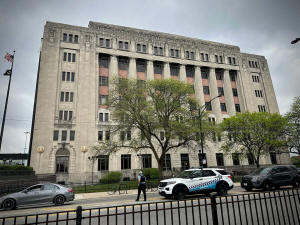
The Cook County Criminal Courthouse in Chicago. (Capitol News
Illinois photo by Hannah Meisel)

The Aug. 11 email, dated nearly a month before Operation Midway Blitz
began, explained why O’Neill Burke would not sign onto the joint letter.
“We obviously share concerns about Trump’s actions, rhetoric and
bluster,” then-state’s attorney spokesman Matt McGrath wrote. “At the
same time, the State’s Attorney’s top priority remains combating illegal
guns, and to continue doing that effectively we need to maintain our
excellent working relationships with the local ATF and other federal
partners.”
Loevy & Loevy attorney Locke Bowman said the email was further evidence
that O’Neill Burke has a conflict of interest necessitating the
appointment of a special prosecutor.
“If she was unwilling to criticize the invasion of Cook County as it was
about to happen, what confidence can the citizens of Cook County have
that now — in the aftermath, when violence has been perpetrated, when
crimes have been committed — that she will be the person to step up and
investigate those who have committed crimes?” he told the judge. “I
submit that the answer is no confidence at all.”
‘We want to do it right’
Loizon cited a pair of Illinois Supreme Court rulings dealing with
special prosecutors, saying they ultimately instructed caution so as to
not risk prosecutions getting overturned on appeal.
She said O’Neill Burke didn’t sign onto “political statements” like the
August letter to mitigate that risk. Further, Loizon pointed to February
guidelines the state’s attorney published for her office to follow for
handling any future investigations of federal agents.
“The state’s attorney made it clear in her protocol, and we’re making it
clear here today, that if ICE agents get investigated … we want to do it
right,” Loizon said. “That we can actually hold them accountable without
impediment.”
In a brief filed last month, the state’s attorney’s office wrote that
“investigating and charging a case simply to have it dismissed before
trial … would bring no accountability for any criminal acts arising out
of Operation Midway Blitz and does nothing to advance the public
interest.”

In a news conference after Friday’s hearing, Loevy & Loevy attorney
Steve Art responded to that claim, saying there’s always inherent risk
in bringing charges: “That there will be a successful defense to the
charges, that a witness won’t show up to testify, that something will go
wrong in the case.”
“For any of those things to happen, however, we need to get to the
starting line,” Art said. “And the starting line is somebody who will
not prosecute no matter what, but somebody who will look at the evidence
and exercise some kind of prosecutorial power to say there needs to be
accountability and justice in this case.”
He also dismissed O’Neill Burke’s perpetual concern about the federal
Supremacy Clause and qualified immunity for federal agents, saying
“we’re never going to know” what effect they have legally “unless
someone comes in and actually prosecutes and investigates these crimes
in the first place.”
“So what the Supremacy Clause really says in this context is if somebody
is doing something reasonable related to their job, they’re going to
have a defense in an ultimate prosecution of the case, which is a
reasonable doctrine to have,” he said. “I don’t think that anybody who
takes a fair look at the evidence of these serious crimes could possibly
say that they are related to a federal law enforcement prerogative, or
that they’re reasonable.”
Capitol News Illinois is
a nonprofit, nonpartisan news service that distributes state government
coverage to hundreds of news outlets statewide. It is funded primarily
by the Illinois Press Foundation and the Robert R. McCormick Foundation. |