Trump to send envoys to Islamabad as Iran rules out direct talks
[April 25, 2026]
By MUNIR AHMED, SAMY MAGDY, and JON GAMBRELL
ISLAMABAD (AP) — U.S. envoys are expected to travel to Pakistan on
Saturday in a new bid to salvage ceasefire talks with Tehran, even as
Iran ruled out direct negotiations with U.S. representatives as its top
diplomat arrived in Islamabad.
The latest effort to broker a deal comes as an indefinite ceasefire has
paused most fighting, but the economic fallout is still mounting with
global energy shipments disrupted by the closure of the Strait of
Hormuz.
On Saturday, Iran resumed commercial flights from Tehran’s international
airport for the first time since the conflict with the U.S. and Israel
began about two months ago. Iran’s state-run television reported that
flights were scheduled to depart for Istanbul, Oman’s capital of Muscat
and the Saudi city of Medina. Iran partly reopened its airspace earlier
this month amid a ceasefire with the U.S. which halted fighting between
the two countries.
The airport opening comes as Iran’s Foreign Minister Abbas Araghchi met
twice with Pakistan's top military and political leaders since arriving
in Islamabad on Friday night, officials said.
According to Pakistan's Foreign Ministry, the Iranian delegation will
hold talks with Pakistan’s senior leadership as the U.S. envoys were
expected to travel to Islamabad on Saturday. Officials have not
specified when Steve Witkoff and Jared Kushner are due to arrive.

Pakistan works to get US and Iran back to the negotiating table
Pakistan’s capital of Islamabad was in a near-lockdown early Saturday
ahead of the talks, where the weeklong security restrictions have
disrupted daily life across the capital. Residents struggle to commute
even short distances as checkpoints, road closures, and diversions have
become a routine sight, particularly around sensitive zones.
The usually busy arteries leading to the airport and the heavily
fortified Red Zone were largely deserted early Saturday, with movement
tightly restricted. Security forces, including troops, paramilitary
commandos, and police, maintained a strong presence at key
intersections, especially near the airport, while helicopters circled
overhead throughout the morning.
Pakistan has been trying to get U.S. and Iranian officials back to the
table after Trump this week announced an indefinite extension of the
ceasefire with Iran, honoring Islamabad’s request for more time for
diplomatic outreach.
The White House said Friday that President Donald Trump would send Steve
Witkoff and Jared Kushner to meet with Iran's Foreign Minister Abbas
Araghchi. But shortly after Araghchi arrived in Islamabad, his ministry
said any talks would be indirect, with messages conveyed between the two
sides by Pakistani officials.
Araghchi and the two Trump envoys held hours of indirect talks in Geneva
on Feb. 27 over Tehran’s nuclear program, but walked away without a
deal. The next day, Israel and the United States started the war against
Iran.
White House press secretary Karoline Leavitt told Fox News that the
president had decided to send Witkoff and Kushner to Pakistan “to hear
the Iranians out.”
“We’ve certainly seen some progress from the Iranian side in the last
couple of days,” Leavitt said. She did not offer any details about what
U.S. officials were hearing.
Trump extends the Jones Act waiver for 90 days
Separately Friday, the White House said Trump issued a 90-day extension
to the Jones Act waiver, making it easier for non-American vessels to
transport oil and natural gas.
He first announced a 60-day waiver in March in a move intended to
stabilize energy prices and ease oil and gas shipments to the U.S.
following the effective closure of the Strait of Hormuz, a strategic
waterway through which a fifth of the world's oil passes in peacetime.
[to top of second column]
|
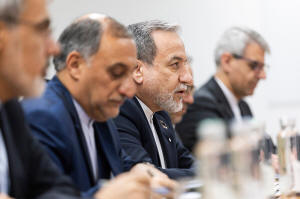
Iranian Foreign Minister Abbas Araghchi, speaks during a
bilateral meeting between Switzerland and Iran, in Geneva,
Switzerland, Feb. 17, 2026 (Cyril Zingaro/Keystone via AP, File)

Iran has kept its stranglehold on traffic through the strait,
attacking three ships earlier this week, while the U.S. is
maintaining a blockade on Iranian ports and Trump has ordered the
military to “shoot and kill” small boats that could be placing
mines.
The price of Brent crude oil, the international standard, retreated
on the news, vacillating between $103 a barrel and more than $107 —
still nearly 50% higher than where it was on Feb. 28, when the war
began.
The squeeze on shipments through the strait has rippled through
global maritime trade flows, including through the Panama Canal
nearly halfway around the world.
Also on Saturday, Germany's Defense Minister Boris Pistorius
announced that the country will send minesweeper ships to the
Mediterranean so they are in place to remove mines Iran has placed
in the Strait of Hormuz once the hostilities end.
A growing toll even as ceasefires hold
Since the war began, at least 3,375 people have been killed in Iran,
and more than 2,490 people in Lebanon, where new fighting between
Israel and the Iran-backed militant group Hezbollah broke out two
days after the war started, according to authorities.
Additionally, 23 people were killed in Israel and more than a dozen
in Gulf Arab states. Fifteen Israeli soldiers in Lebanon and 13 U.S.
service members throughout the region have been killed.
The U.N. peacekeeping force in southern Lebanon has also sustained
casualties. UNIFIL said Friday that an Indonesian peacekeeper died
of wounds sustained in an attack on his base on March 29, raising to
six — four Indonesians and two French — the number of force members
killed since the war erupted.
Tensions linger in Lebanon despite extended truce
The situation in Lebanon remained tense after Trump on Thursday
announced that Israel and Lebanon had agreed to extend a ceasefire
between Israel and Hezbollah by three weeks. Hezbollah has not
participated in the diplomacy brokered by Washington.
Israeli Prime Minister Benjamin Netanyahu, in a video statement
released by his office on Friday, hailed “a process to achieve a
historic peace between Israel and Lebanon.”

Earlier, the Israeli army asked residents of the southern Lebanese
village of Deir Aames to evacuate, saying Hezbollah was using the
village to launch attacks against Israel.
Israel's military said it had downed a drone over Lebanon following
the launch of a small surface-to-air missile by Hezbollah. The
militant group, meanwhile, said it shot down an Israeli drone with a
surface-to-air missile over the outskirts of the southern port city
of Tyre.
___
Ahmed reported from Islamabad and Gambrell reported from Dubai,
United Arab Emirates. Associated Press writer Melanie Lidman
contributed from Tel Aviv, Israel.
All contents © copyright 2026 Associated Press. All rights reserved |