United Airlines CEO confirms he approached American about potential
merger, but was rebuffed
[April 28, 2026] By
MATT OTT and RIO YAMAT
United Airlines' CEO confirmed Monday that he approached rival American
Airlines about a potential merger — his first public acknowledgment of
his proposal — saying it would benefit travelers despite American’s
refusal to engage in talks.
“I was confident that this combination, which would have been about
adding and not subtracting, creating a truly great airline that
customers love, could get regulatory approval,” Scott Kirby wrote in a
statement released Monday. “I was hoping to pitch that story to
American, but they declined to engage and instead responded by publicly
closing the door.”
Kirby's confirmation comes after weeks of public speculation about a
potential merger between two of the biggest U.S. airlines, amid rising
jet fuel prices tied to the Iran war and reports that he had approached
the White House about the idea. Kirby said Monday that he had approached
American directly about a tie-up, but it's unclear whether that was
before or after his White House meeting.
American publicly shot down the idea of a merger, saying in an April 17
statement that it “is not engaged with or interested in any discussions
regarding a merger with United Airlines.” Additionally, a combination of
the two carriers “would be negative for competition and for consumers”
and possibly raise antitrust concerns, the company said.
Fort Worth, Texas-based American Airlines is itself the product of a
2013 merger with US Airways Group.
President Donald Trump also said last week that he was against a merger
of the airlines.
In his statement Monday, Kirby, who previously served as president of
American Airlines, argued that merging the carriers would expand
service, create a more globally competitive airline and boost the U.S.
economy by creating jobs and strengthening the aircraft manufacturing
sector.

[to top of second column] |

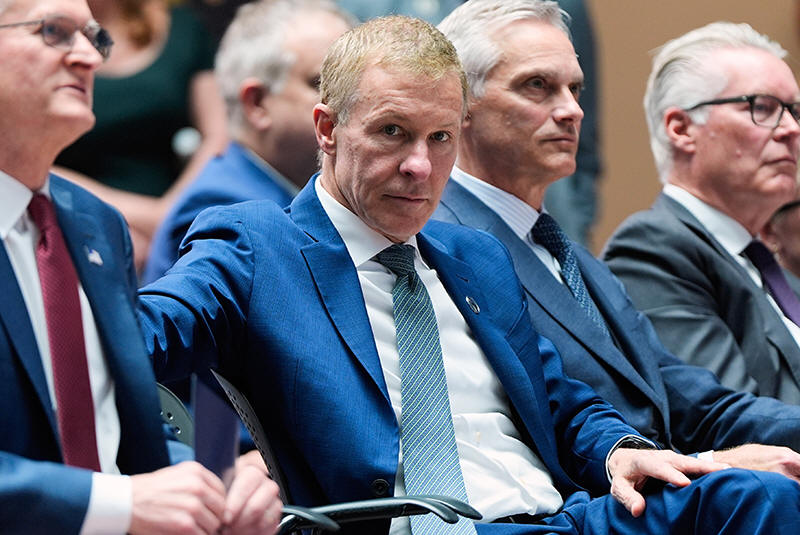
Scott Kirby, second left, CEO of United Airlines, and Robert Isom,
second right, CEO of American Airlines, listen as Transportation
Secretary Sean Duffy announces a new air traffic control
infrastructure plan, Thursday, May 8, 2025, in Washington. (AP
Photo/Julia Demaree Nikhinson, File)
 The rivalry between United and
American has played out for years in pricing battles and disputes
over gate access at major hubs like Chicago’s O’Hare International
Airport, where both airlines have fought to expand their footprint.
Amid that competition, the Federal Aviation Administration this
month ordered about 300 daily flights cut from peak summer schedules
at O'Hare, saying planned increases by both carriers risked
overwhelming an airport already plagued by severe delays.
The order will take effect June 2, later than initially planned,
after the FAA said last week it wanted to give airlines additional
time to adjust their schedules.
Shares of Chicago-based United fell 1.2% on Monday, to $91.90. They
are down about 18% this year amid the Iran war, which began in late
February and has driven fuel prices sharply higher. American shares
were down about 3.5% on Monday, to $11.68. American is down nearly
24% for the year.
Jet fuel is typically one of the largest expenses for airlines,
leaving them especially vulnerable to price spikes and supply
shocks.
In some markets, the price of jet fuel has more than doubled as
fighting near the Strait of Hormuz squeezes global supplies, raising
operating costs for airlines. In response, carriers around the world
have raised fares and fees, with both United and American among the
major U.S. airlines that have raised checked baggage fees.
All contents © copyright 2026 Associated Press. All rights reserved |