Federal agency casts further uncertainty on Illinois’ credit card ‘swipe
fee’ law
[April 28, 2026]
By Jerry Nowicki
A federal agency says Illinois can’t limit credit card swipe fees for
federally chartered banks, even though a federal judge earlier this year
ruled that it could.
Two interim filings posted last week by the Office of the Comptroller of
the Currency, an independent subsection of the U.S. Treasury Department,
represent the latest twist in a two-year legislative fight between banks
and retailers.
One of the filings specifically preempts the state’s first-of-its-kind
Interchange Fee Prohibition Act, throwing the policy into further
uncertainty by creating a second legal front and added pressure on state
lawmakers amid an ongoing appellate court case.
Interchange or “swipe fees” are automatically applied to debit and
credit card transactions, redirecting about 1-2% or more of a
transaction’s cost from the merchant to the banks, credit unions and
card companies. The fees include both a set amount and a percentage of
the transaction, but the credit card companies, namely Visa and
Mastercard, control how they’re calculated.
Illinois lawmakers passed the Interchange Fee Prohibition Act as part of
the state budget in May 2024 to prohibit financial institutions from
charging such fees on the tax and tip portion of credit and debit card
transactions.

At stake is more than $100 million annually between retailers and banks,
as exempting tax and tips from interchange fees would reduce the banks’
cut of swipe fees by 10% or more.
Banks have since warned of impending “credit card chaos.” They say the
current system only asks for the total amount of a transaction, meaning
consumers might have to do multiple swipes or pay cash to cover the tax
and tip portion of transactions. Retailers say they’re bluffing and can
implement the changes with mere software upgrades.
Given the pending court case and a hard push from financial
institutions, lawmakers are considering pushing back the state law
beyond its July 1 effective date that was already delayed by a year.
Reaction to the filings
The financial institutions praised the OCC’s filings but warned they
create a piecemeal legal landscape by only applying to banks that are
federally chartered. Smaller state-chartered institutions would still be
subject to the law.
A joint statement from the Illinois Bankers Association, Illinois Credit
Union League, American Bankers Association and America’s Credit Unions
urged similar application to national credit unions.
“They (the filings) reinforce the firm legal foundation of our ongoing
appeal and underscore that Illinois’ misguided law is unlawful and
should not be implemented,” the statement read. “The OCC’s actions
should also send a strong signal to other states to follow the law and
not repeat Illinois’ mistake.”
Rob Karr of the Illinois Retail Merchants Association accused the Trump
administration of trying “to evade the law, undermine the legal system
and threaten the very consumers they purport to serve.”
IRMA was heavily involved in the Illinois law’s passage, which was a
concession to retailers after the state capped a tax exemption merchants
claim for serving as the state’s de facto sale tax collectors.
“We are confident the courts will make the final decision in this matter
— not an agency operating at the behest of big banks and credit card
companies,” Karr said in a statement.
[to top of second column]
|
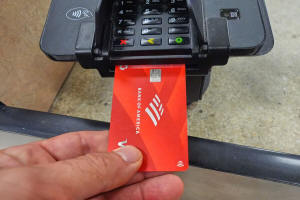
A credit card is used to complete a purchase at a grocery store. (AP
Photo/LM Otero)

The case has been tied up in court for two years. The law was initially
set to take effect in July 2025, but lawmakers pushed it back a year to
allow time for implementation and to allow the court challenge to play
out.
A U.S. district judge sided with the retailers and the state in
February. Judge Virgina Kendall ruled that the National Banking Act
prohibits states from regulating fees charged by banks — but swipe fees
are set by third parties, namely card companies. Because of that, the
state has the authority to regulate, she ruled.
But the banks quickly appealed to the 7th Circuit Court of Appeals, and
arguments are slated for May 13. Some believe the matter could even come
before the U.S. Supreme Court.
The latest filings
This is not the first time the Office of the Comptroller of the Currency
weighed in on the issue. It did so under President Joe Biden as well in
a 2024 legal filing, referring to the Illinois law as “bad policy” and
“unworkable.”
Addressing that point, Kendall wrote: “That may well be true. But even
the Office of the Comptroller does not meaningfully contest that the
third parties set the fees.”
She also warned that national banks “could shield a vast amount of their
otherwise regulatable activities from State regulation by hiding behind
third-party entities like the credit card companies.”
The OCC rebutted that line in one of the two recent filings that applied
to the National Banking Act more broadly.

The interim final rule explicitly states “national banks may charge
non-interest charges or fees, even when such charges and fees are set by
or in consultation with third parties.”
Doug Kantor, of the National Association of Convenience Stores, said the
ruling goes far beyond interchange fees.
“The OCC rules endorse price fixing of fees banks charge, including not
just swipe fees but a wide range of consumer fees,” he said in a
statement.
The OCC issued “interim final” filings, meaning they can go into effect
June 30 and bypass the standard process for proposed rules. The public
can submit comments, but ultimately it would require a vote of Congress
or an act of a court to repeal the final rule and order.
Capitol News Illinois is
a nonprofit, nonpartisan news service that distributes state government
coverage to hundreds of news outlets statewide. It is funded primarily
by the Illinois Press Foundation and the Robert R. McCormick Foundation.
 |