Drought causing ongoing concerns, legislative hearings about Illinois
water supply
[April 28, 2026]
by Nikoel Hytrek and UIS Public Affairs Reporting (PAR)
Drought and hot temperatures have burdened Illinois since last summer,
and despite rain improving conditions this spring, the long-term lack of
precipitation and high temperatures have impacted water supplies across
the state.
For example, Sullivan, a small city southwest of Decatur, declared a
water emergency in February that’s expected to last until June.
Bloomington recently ended its severe drought proclamation and eased
restrictions on water use, but residents are encouraged to continue
being judicious. The Illinois Department of Natural Resources has
delayed opening Heidecke Lake near Morris to boating because of low
water levels.
As local governments confront water challenges, regional droughts have
called attention to lax or nonexistent water management policies in
Illinois. State lawmakers have caught on, too, especially as they
consider how to regulate data centers, a new type of high-end water user
that’s been spreading across the state.
Trent Ford, the Illinois state climatologist, said water monitoring and
management can be tricky.
“It is definitely a really, really complex thing with water systems in
Illinois,” Ford said. “You know, there’s always this overarching kind of
perception of water abundance, in some cases overabundance. But that’s
definitely not the case. That’s only a perception. It’s a mirage of
abundance.”

He said rain in 2026 has improved topsoil moisture, but months of
drought mean the dryness has impacted deeper layers of soil and water.
Critical rivers like the Sangamon, the Mackinaw, the Kankakee, the
Iroquois and the Mason, “are still way below where they normally are
this time of the year,” he said, though he expects those levels to
improve.
Lawmakers in Springfield, meanwhile, are only in the early phases of
considering statewide water use plans, mostly discussing the problem in
nonvoting subject matter hearings. The onset of data center development,
however, has at least brought the conversations to the forefront.
“There’s several agencies that touch on this, and then you’ve got local
control that does things,” Sen. Rachel Ventura, D-Joliet, said. “You’ve
got the multi-state and multi-country water compact of the Great Lakes.
So this is not just something that you can easily introduce and then be
done.
“The goal of course is to make sure that our state is safeguarding water
so people can have quality of life.”
Water monitoring
Illinoisans rely on lakes, rivers, shallow groundwater and deep
groundwater, but measuring water supply can be difficult because it
depends on the region of the state and the structure of the ground
beneath the surface.
“Underneath our feet gets really complicated really fast,” said Daniel
Abrams, a principal research scientist at the Illinois Water Survey.
“Being able to understand that is critical. And we’re looking at all
kinds of ways to image and improve that.”
The Water Survey is not a government agency, but it works with the
Illinois Department of Natural Resources to conduct research and monitor
water supply by using wells that measure groundwater levels and data
mapping tools that visualize Illinois’ hydrology. The Water Survey also
advises municipalities and counties about managing water.
The Water Survey does important research, but the lack of state
regulatory authority over water makes its task difficult.

Abrams said water supply modeling is a crucial tool for water
management, but it’s not perfect, and he and his team are always looking
for more data — particularly about water use.
“One of the data sources that right now we have is annual demand,” he
said. “But the more we start thinking about drought, the more we start
thinking about those peak demand conditions.”
Shallow aquifers and surface water sources are more susceptible to
drought in the short term, but they rebound quickly after rain, Abrams
explained. The opposite is true of deep aquifers like the Mahomet
Aquifer in central Illinois or the deep sandstone aquifer system in
northern Illinois. That means drought and overuse have different effects
depending on the location.
More frequent reporting from municipalities, irrigators and industries
would give the Water Survey a better idea of how seasonal demand works
and the condition of aquifer levels, he said.
“Getting information on a quarterly basis or a monthly basis would make
our models more accurate and could help us better understand things like
impacts of drought to our water supply,” said Jenna Shelton, director of
the Illinois Water Survey.
The Illinois Water Inventory Program collects reports about withdrawals,
but it doesn’t have a full picture of that demand because of missing
data.
Since 2010, the Water Use Act of 1983 requires annual water usage
reports for “all high-capacity wells or intakes pumping 70 gallons per
minute or more (100,000 gallons/day).” Systems of wells and intakes that
have a combined pumping rate of 70 gallons per minute or greater also
fall under the requirement.
Those high-capacity entities include public water suppliers like
municipalities, industrial-commercial facilities, wildlife and
recreation operations and agriculture irrigators.
Multiple sources told Capitol News Illinois that enforcement of
reporting requirements across the state is lax.

[to top of second column]
|

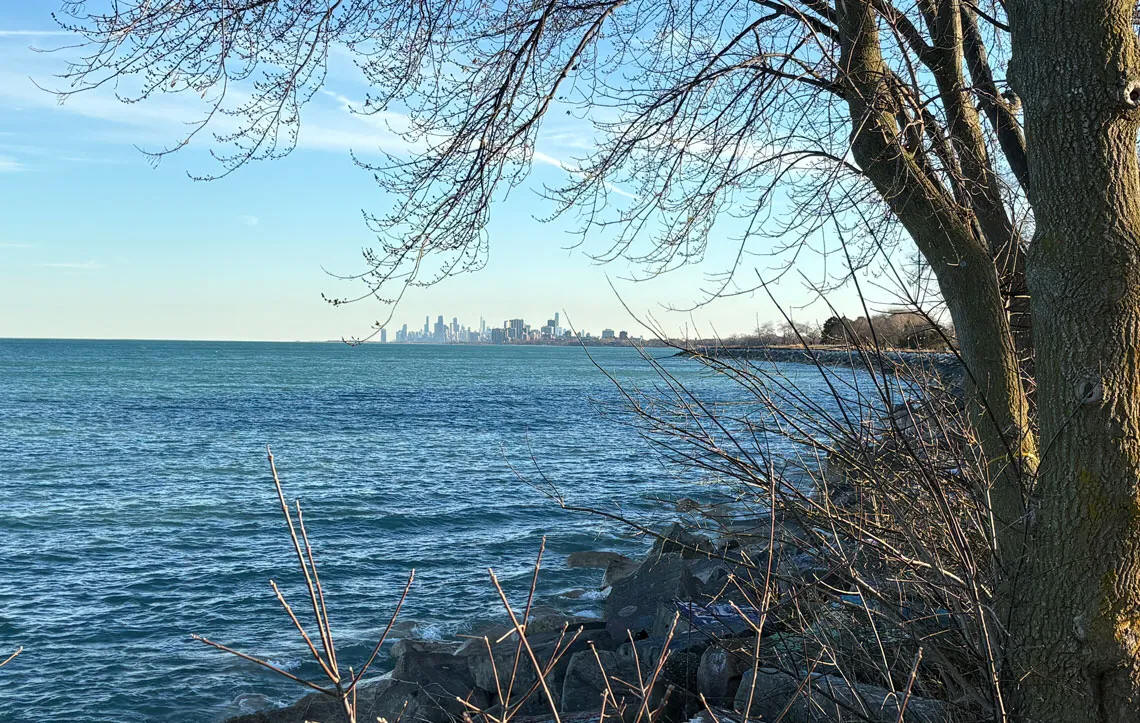
The Chicago skyline as pictured across Lake Michigan from Evanston.
(Capitol News Illinois photo by Jerry Nowicki)

“We are not a government agency, you know, we cannot really enforce the
industries, farmers to report water use every year to us,” said Zhenxing
“Jason” Zhang, a principal research scientist at the Water Survey who
leads state and regional water supply planning. “We don’t get 100%
compliance.”
Water use reporting is key to understanding what the state will need in
the future and how to plan for it, he said. Without that information,
resource planning is more difficult.
Management and planning
Nora Beck, an employee at the Chicago Metropolitan Agency for Planning,
or CMAP, said the state needs to update its rules about who’s in charge
of water resources so the state can better manage them.
“Everything legislative has been sort of piecemeal over time,” she said.
CMAP does water supply planning for northeast Illinois, where many
supply issues exist because people outside of Chicago and its immediate
suburbs rely on hard-to-replenish aquifers where water levels have
dropped dramatically.
A 2018 report from the Water Survey, for example, projected Joliet would
be unable to meet water demands by 2030 if it continued using the
aquifer, so the city is in the process of moving to Lake Michigan as a
source.
Illinois has a limit for how much water it’s allowed to draw from the
lake because of the Great Lakes–St. Lawrence River Basin Water Resources
Compact — an agreement between eight states and two Canadian provinces
concerning water quality and withdrawals from the Great Lakes. That
limit doesn’t exist for groundwater, Beck said.
Beck said approximately 80% of the people CMAP serves rely on Lake
Michigan for water, but the rest rely on groundwater sources.

“We have a water budget, basically, for the Lake Michigan properties,”
she said. “The remaining 20% are mostly on groundwater sources where
there’s not a clear budget. Any user can pump as much as they want.”
Ventura, the senator from Joliet, has been involved in water policy
since she worked as a naturalist for Georgia State Parks and Historic
Sites.
She said looking at each water region in Illinois separately and
streamlining oversight authority would be smart approaches to
management. Ventura also suggested the state should mimic the Great
Lakes Water Compact to create water use agreements across Illinois.
“Having that regional study is still really important,” Ventura said.
“And then looking at things like refilling aquifers or having a
long-term plan for access to water, I think is important for everyone in
our state.”
There’s no single agency that manages water use in Illinois, either, she
said. The IDNR, IEPA and the Illinois Department of Agriculture all
manage water to different degrees, and with different focuses.
Of the three agencies, the IDNR shoulders the most responsibility for
water supply and works with groups like CMAP, the State Water Plan Task
Force and the Water Survey to do regional planning and monitoring. But
at a February hearing on groundwater, a representative from the IDNR
said the agency faces serious staffing shortages that limit its ability
to monitor usage and enforce reporting.
Since 2024, CMAP has worked with IDNR, Illinois-Indiana Sea Grant and
the Northwest Water Planning Alliance to develop a water sustainability
plan for five counties in northeastern Illinois. Beck said a statewide
version of that could be helpful.
Beck has also discussed governance strategies with Freshwater Society, a
Minnesota initiative to better manage drinking water. Minnesota is
currently developing updated rules for groundwater governance.
“I don’t think we need to copy directly from another state,” Beck said.
“But I think it’s important to note that these other states are
recognizing that they need to upgrade their groundwater governance, and
they’re improving it in ways.”

Other solutions
Ventura has introduced or cosponsored legislation to give the Illinois
Department of Agriculture more authority over some withdrawals, and a
bill to put more restrictions on private companies buying water from
municipalities. But those measures have stalled.
She also has a data center regulation bill that would require the
facilities to file water use reports and monitor discharged water for
pollutants, a provision that could become part of a broader data center
regulatory bill.
The POWER Act, a widely debated data center regulatory bill, has several
water-related provisions, including requirements for usage, efficiency
and water quality monitoring.
“We are looking at, you know, hundreds, thousands, millions of people
who need access to water and what that looks like for the future as we
move into things like data centers and other climate concerns,” Ventura
said.
Capitol News Illinois is
a nonprofit, nonpartisan news service that distributes state government
coverage to hundreds of news outlets statewide. It is funded primarily
by the Illinois Press Foundation and the Robert R. McCormick Foundation. |