Prosecutors say suspect in missing students' killings asked ChatGPT
about disposing of a body
[April 28, 2026]
By MIKE SCHNEIDER and SARAH BRUMFIELD
ORLANDO, Fla. (AP) — The suspect in the killings of two University of
South Florida doctoral students from Bangladesh had asked ChatGPT what
would happen if a human body was put in a garbage bag and thrown in a
dumpster, days before they went missing, according to a report filed by
prosecutors over the weekend.
Hisham Abugharbieh, 26, also asked the artificial intelligence chatbot
whether the vehicle identification number on his car could be changed
and whether he could keep a gun at home without a license, according to
the pretrial detention report filed Saturday. ChatGPT responded that
Abugharbieh’s question sounded dangerous, according to the report.
An investigation that the office of Florida's attorney general launched
last week over whether ChatGPT offered advice to a gunman who killed two
people last year at Florida State University will be expanded to include
the killings of the USF students, Attorney General James Uthmeier said
Monday on social media.
The remains of Abugharbieh's roommate, Zamil Limon, were found on the
Howard Frankland bridge Friday morning, but Hillsborough County Chief
Deputy Joseph Maurer said later that day that they were still searching
for Limon's girlfriend, Nahida Bristy. On Sunday, the sheriff’s office
announced that a body had been found in a waterway near the bridge but
had not been identified.
Abugharbieh, was charged with two counts of premeditated murder in the
first degree with a weapon in the deaths of Limon and Bristy, the
sheriff’s office announced Saturday. The former USF student was ordered
held without bond. A hearing is set for Tuesday.
Limon and Bristy, both 27, were considering getting married, a relative
said. They disappeared April 16. Limon was last seen at the off-campus
apartment complex where he lived with Abugharbieh, and Bristy at a
campus science building.

Limon was studying geography, environmental science and policy, and
Bristy was studying chemical engineering. She was a graduate of Noakhali
Science and Technology University. The school said in a statement
Saturday that she was a Ph.D. candidate and described her as a talented
and promising student.
A friend contacted police April 17 about being unable to reach both
Bristy and Limon, despite repeated attempts by phone, according to the
report. Police investigators searched Bristy's campus office the next
day and found her purse, lunchbox, MacBook and iPad.
At Limon’s off-campus apartment, detectives questioned Limon’s two
roommates and noticed that Abugharbieh’s left pinky finger was bandaged.
When confronted by detectives, Abugharbieh denied any involvement with
Limon’s disappearance.
The third roommate told detectives that Abugharbieh had used a cart
overnight on April 16 and April 17 to move cardboard boxes from his room
to the trash compactor. In the trash compactor, detectives found Limon’s
wallet and campus ID badge, credit card, eyeglasses and clothes that
appeared to have blood on them.
[to top of second column]
|
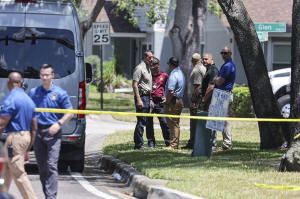
Detectives with the Hillsborough County Sheriff's Office join an
investigation inside the Lake Forest subdivision of Tampa, Fla., on
Friday, April 24, 2026, where authorities said a man was taken into
custody after barricading himself inside a home, in connection to
the search for two missing University of South Florida graduate
students. (Douglas R. Clifford/Tampa Bay Times via AP)

Detectives found blood leading from the kitchen to Abugharbieh’s bedroom
and more blood in his bedroom. In Limon’s bedroom, they found Bristy’s
campus ID and credit cards, suggesting she had been at the apartment
before she disappeared, according to the report.
Using cellphone location and license plate reader data, detectives
concluded that Abugharbieh’s car and Limon’s phone had both been on the
bridge and on Clearwater Beach, the report said. Based on location data
from Abugharbieh’s phone, detectives searched around the bridge and
found a trash bag containing Limon’s body. The medical examiner
concluded that Limon had numerous stab wounds.
Three days after Limon and Bristy's April 16 disappearance, Abugharbieh
asked Chat GPT, “Has there been someone who survived a sniper bullet to
the head" and “will my neighbors hear my gun,” according to the report.
He also asked the chatbot four days after that, on April 23, “What does
missing endangered adult mean.”
Abugharbieh, a native-born U.S. citizen, was initially arrested Friday
at his family’s home on preliminary charges that include unlawfully
moving a dead body, failure to report a death, tampering with evidence,
false imprisonment and battery. Reached by email on Monday, Jennifer
Spradley, an attorney in the public defender's office in Tampa, said the
office wouldn't comment on Abugharbieh's case.
Officers encountered Abugharbieh as they responded to a report of
domestic violence at his family’s home, just north of the campus, and
were able to move his relatives to safety. But then he barricaded
himself inside and refused to come out. A SWAT team responded — along
with a drone, a robot and crisis negotiators — before Abugharbieh came
out with his hands up, apparently wearing nothing but a blue towel.
Abugharbieh had been a USF student but was not currently enrolled.
University records showed he had attended the school from spring 2021
through spring 2023 and had pursued a BS in management, a university
spokesperson said.
___
Brumfield reported from Cockeysville, Maryland.
All contents © copyright 2026 Associated Press. All rights reserved
 |