Rare earth mining is poisoning Mekong River tributaries, threatening
'the world's kitchen'
[April 29, 2026] By
ANTON L. DELGADO and ANIRUDDHA GHOSAL
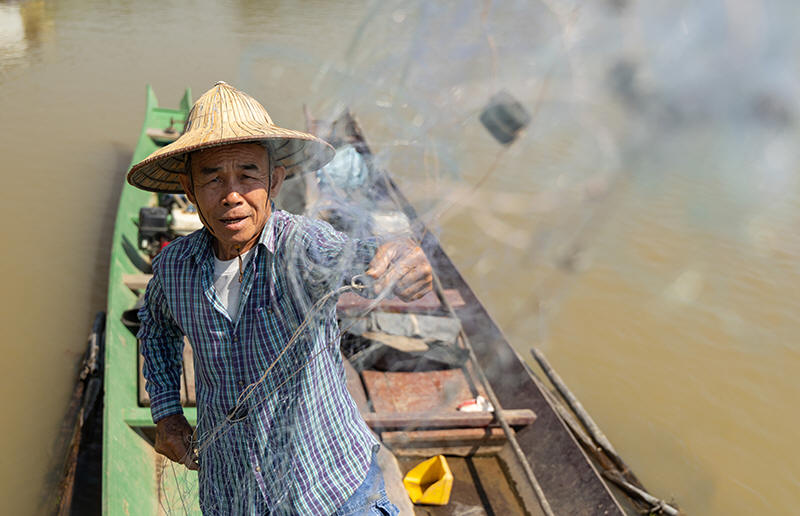
CHIANG SAEN, Thailand (AP) — Perched on the bow of his long-tail fishing
boat, 75-year-old Sukjai Yana untangled a handful of small fish from his
net, disappointed by his catch and fretting over whether he can sell
them.
Some days Yana earns nothing: demand for fish is falling due to worries
over contamination of the Mekong River and its tributaries by toxic
runoff from rare earth mines upstream that is threatening millions who
rely on those waters for farms and fisheries.
Chiang Saen, a fishing hub in northern Thailand, has been Yana's
family's home for decades. “I don’t know where else I’d go,” he said.
Yana is one of 70 million people in mainland Southeast Asia who depend
on the nearly 5,000-kilometer (3,100-mile) Mekong River. Rising demand
for rare earth materials is driving an unregulated mining boom centered
in war-torn Myanmar, to the west, that is spreading to Laos, in the
east.
The Mekong has long faced mounting pressures, from plastic pollution to
hydropower dams hemming it upstream and sand mining devouring its banks.
But experts warn that the toxic runoff from the mines could pose an
existential threat.
Exposure to heavy metals such as arsenic, mercury, lead and cadmium
raises risks of cancer, organ failure and developmental harm, especially
for children and pregnant women.
Thailand is bearing the brunt of the mining boom as such toxins imperil
its global food exports — from bags of rice in U.S. supermarkets to
edamame snacks served in Japan and garlic used in Malaysian kitchens.
Responses remain local and limited, while smuggling and Myanmar’s civil
war complicate regional fixes, raising concerns for downstream Cambodia
and Vietnam.

Agriculture is the backbone of Southeast Asia’s economies, said
Suebsakun Kidnukorn of Mae Fah Luang University in northern Thailand's
Chiang Rai, warning that rare earth mines are destroying “the world’s
kitchen.”
Toxic runoff seeps into Thailand
While cutting banana bunches on a farm in the hilly Thai village of Tha
Ton, 63-year-old Lah Boonruang taps his fingers to count the
toxin-exposed crops he harvests — rice, garlic, corn, onion, mangoes and
bananas.
He irrigates his fields with water from the Kok River, a Mekong
tributary that flows into Thailand from Myanmar and is laden with
toxins.
“Everyone is afraid of the toxins," he said. “If we can't export, a
farmer is the first to die.”
Thailand is one of the world's top rice exporters along with India and
Vietnam. It exported over $10 billion worth of rice and fruits in 2024,
according to trade figures that rank the U.S. as the top rice importer.
“Our worry is that toxins accumulate in the rice we export. This would
make our rice farming industry, which is our culture, collapse,” said
Niwat Roykaew, founder of the environmental institute The Mekong School
in northern Thailand's Chiang Khong.
Thai scientists have found elevated heavy metal pollution in other
Mekong tributaries, like the Sai and Ruak rivers.
The Mekong starts in China and flows through five Southeast Asian
nations before emptying into the sea. Millions rely on fish from the
Mekong Basin for protein.
Warnings to ethnic minorities in the hills of northern Thailand to avoid
using river water are painful for the Lahu, who are famed as fisher
people, said Sela Lipo, 56, a Lahu elder.
“The Lahu’s way of life is always with a river," he said. "The
contaminated river has cut off our lifeline.”
Solutions are local and limited
Thailand's government says it has little leverage against mining
operations across the border in strife-torn Myanmar and Laos. The Thai
response has also been constrained by limited expertise, information and
funds, said Aweera Pakkamart of Thailand's Pollution Control Department.
Instead, public universities, local governments and regional
organizations like the Mekong River Commission, have mainly focused on
monitoring levels of heavy metals and educating communities about risks.
[to top of second column] |
Fisherman Sukjai Yana untangles his net while docked on the Kok
River in Chiang Saen, Thailand, on Feb. 17, 2026. (AP Photo/Anton L.
Delgado)
 Recent water, fish and sediment
samples from Mekong tributaries had high levels of dangerous heavy
metals, such as arsenic, mercury, lead and cadmium, from rare earth
mining, said Warakorn Maneechuket, a researcher at Thailand’s
Naresuan University.
In a lab, she uses a scalpel to point out tell-tale signs of
contamination — tumor-like growths, discolored scales, and unusual
eye coloration — before dissecting a catfish caught from the Kok
River.
The accumulation of heavy metals is insidious. Arsenic can cause
organ failure. Mercury damages the nervous system. Lead impairs
cognition and cadmium harms the kidneys.
To raise awareness of health risks, Tanapon Phenrat of Naresuan
University helped develop a smartphone fish safety app, training
fishers in Chiang Saen to use it to identify and upload images of
suspicious fish. Building a citizen-science database for northern
Thailand can help quantify the scale and spread of contamination, he
said.
“Each and every sample is very important,” he said.
Rare earth demand rises
The ubiquity of rare earth elements means demand keeps rising.
Rare earths are vital to modern technology, from smartphones and
electric vehicles to missiles and jets. Despite the name, they are
common. It is the costly mining and complex refining process,
concentrated in China, that makes them scarce.
The U.S.-based Stimson Center has used satellite photo analysis to
identify nearly 800 suspected unregulated rare earth and other
mining sites along Mekong tributaries in Laos, Myanmar and Cambodia.
Many in Myanmar are in areas of active fighting. The war has driven
a "diversification of mines” geographically, according to Regan Kwan
of The Stimson Center, who has tracked expansion of mining to 26
sites along rivers in Laos.
Rare earths are mined by digging up rock or washing chemicals
through soil to extract the minerals, creating toxic waste. The
physical footprint of this process is recognizable in satellite
data, Kwan said.
Myanmar is China’s leading supplier of heavy rare earths, exporting
more than $4.2 billion worth of such materials to China between 2017
and 2024, mostly after a miliary takeover in 2021.
U.S. President Donald Trump made securing America's supply of
critical minerals and rare earths a key foreign policy objective.
Used in fighter jets like the F-35, submarines, Tomahawk missiles,
radar systems and smart bombs, according to the U.S. government, the
need for more supplies is growing as the U.S. replenishes and
expands military stockpiles drawn down by the wars in Iran and
Ukraine.
This is bad news for the river that sustains mainland Southeast
Asia.

Conflicts in last century — which include the Vietnam War and the
Khmer Rouge genocide — were the most devastating for the Mekong
region, but toxic runoff ranks a close second, said Brian Eyler of
the Stimson Center, who called it an "atomic bomb” for river basin.
It's far more damaging than other threats like large dams and "it is
not stopping.”
___
Ghosal reported from Hanoi, Vietnam. Freelance reporter Ladawan
Sondak contributed to this report.
All contents © copyright 2026 Associated Press. All rights reserved |