State commission finds agent abuses were ‘greenlit by Washington’ for
Operation Midway Blitz
[April 29, 2026]
By Maggie Dougherty
CHICAGO — The Illinois Accountability Commission has spent the last six
months reviewing incidents of alleged misconduct by federal immigration
agents in Chicago amid Operation Midway Blitz.
What it has found, commission officials said, is evidence of three major
policy directives that permitted and encouraged agent misconduct,
stemming from top Trump administration officials.
The last two commission hearings held Monday and Tuesday featured videos
and testimony from incidents in neighborhoods touched by the months-long
immigration enforcement campaign. These are a subset of 16
investigations conducted by the commission.
“Keep in mind that each … is more than just an investigation, it is a
community transformed, families destroyed in an instant, people
teargassed, shot at, beaten,” Lead Commission Counsel Ahmed Baset told
the packed room on Monday. “This collective violence was not simply
improvised on the field. It was greenlit in Washington, DC.”
The three directives identified included militarizing the streets,
suppressing speech and assembly and immunity for lawlessness.
The commission, formed through executive order by Gov. JB Pritzker last
October, was directed to specifically review the actions of eight
current and former heads of the Trump administration, including the
now-ousted Customs and Border Patrol “commander at large” Gregory Bovino,
White House “border czar” Tom Homan, former Secretary of Homeland
Security Kristi Noem, and Stephen Miller, Trump’s deputy chief of staff
for policy.
Earlier this month, commission staff sent letters inviting each of those
people to testify in the final hearings. All declined to appear,
according to commission officials.

Neighborhood terror
The commission presented evidence from some of the high-profile
incidents among their investigations.
Notably, many in the immigrant communities most directly targeted did
not offer public testimony due to a fear of retribution and the pain of
reliving trauma, according to Baset. The absence of their voices in the
room, he said, “is itself part of the harm.”
But Chicago is a city of neighborhoods, and where those targeted could
not speak up, their neighbors stood to testify on their behalf.
One commission investigation focused on Chicago’s Lakeview neighborhood,
where agents teargassed bystanders last October after they protested the
aggressive detention of a man working on a local property. Witnesses say
the agents entered a private property to arrest the man without a
warrant, ignoring express direction from the owner not to enter.
Other footage from Chicago’s Little Village and East Side neighborhoods
also featured widespread and indiscriminate use of tear gas, a chemical
weapon intended for use as a last resort when there is a direct threat
to public safety.
In the commission’s first hearing, a medical expert on chemical weapons
testified that “every single case” she’d reviewed of chemical agent use
by federal agents in Chicago constituted an excessive use of force.
Agents also used tear gas ahead of a Halloween parade in Chicago’s Old
Irving Park neighborhood. Bovino had two days before characterized
agents’ use of chemical weapons in Chicago as “exemplary.”
In the October 14, 2025, incident in East Side, body camera footage
shows agents using an intentional, high-speed car ramming maneuver after
being repeatedly instructed to stop by supervisors.
They then proceeded to use teargas on a street of onlookers in the Far
Southeast Side neighborhood, including more than a dozen Chicago police
officers who had explicitly asked the federal agents not to deploy the
gas.
Another video produced by the commission showed an incident last
Halloween in Evanston, which witnesses say commenced after agents caused
an accident and then began violently detaining and pepper spraying
onlookers.
They then detained three U.S. citizens for multiple hours. One of those
three, Jennifer Moriarty, testified to the commission on Monday. She had
arrived at the scene and attempted to film agents before being detained
herself.
As the agent handcuffed her on the ground, she said one of her shoes
fell off. She asked him to let her put it back on before putting her
into the car.
“He picked it up and he threw it,” Moriarty told the commission. “For
the cruelty, just for the cruelty.”
Both of the other people detained in the car were missing at least one
shoe, she added.
Moriarty eventually was released without charges or an official reason
given for her detention, but said the government revoked her Global
Entry travel status.
‘I’m asking for change’
Marimar Martinez, a Montessori school teacher’s aide who was shot five
times by a Border Patrol agent last October, testified in front of the
committee Tuesday. Martinez has also testified in front of Congress, as
well as fighting to release evidence from her case.
She recounted being shot, and told the commission it was “heartbreaking”
for her to read the text messages of the agent who shot her, bragging
about the act.
“They didn’t see me as human,” Martinez said. “My life didn’t matter.”
She’d rather not spend her time this way, testifying in front of boards
and committees about her trauma, she told the commission. But she said
she felt compelled to do so.
[to top of second column]
|
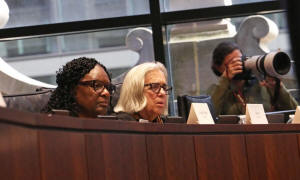
Illinois Accountability Commissioners Cindy Sam, left, and Susan
Gzesh look on as Marimar Martinez provides testimony to the
commission on April 28, 2026. (Capitol News Illinois photo by Maggie
Dougherty)

“We’re going through some dark times, and I feel like my voice matters,”
Martinez testified. “I’m asking for change. I’ve been judged, I’ve been
criminalized, I’ve been shot, but I’m still here speaking, and I want
change.”
“I’m doing it for my community, for my immigrant community, for the
kids,” she added.
The commission also heard testimony about the importance of free and
fair elections, featuring testimony from former Illinois House Minority
Leader Jim Durkin, R-Western Springs.
Durkin, a longtime Republican who described himself as pro-law
enforcement, told the commission that Operation Midway Blitz was “the
furthest thing” from our nation’s finest hour.
Now, he says, the Trump administration is threatening the sanctity of
free and fair elections by floating the possibility that federal
immigration agents could be at polling sites this November.
“This form of voter suppression isn’t new in Illinois,” Durkin said.
“This trick is what has been used in Chicago for many years in
elections: place menacing people in front of precincts, cause a
disturbance, scare voters away. That’s a form of voter suppression.”
He urged the commission to take those words from senior Trump officials
seriously when forming their recommendations.
“The right to vote is the foundation on which every other right in this
country rests,” Durkin said. “When that right is suppressed not by law
but by fear, it is just not an attack on a community. It’s an attack on
the legitimacy of self-governance itself.”
Referring prosecutions
The final report detailing the commission’s findings and policy
recommendations is due to Pritzker by Thursday morning.
A primary purpose of the report has always been the creation of a public
record to document agent abuses and harm inflicted upon communities in
Chicago.
At the signing of the order that established the commission, its role
was likened to that of the Chilean National Commission on Truth and
Reconciliation, which issued a report documenting human right violations
under the military dictatorship of Augusto Pinochet.
And while the commission has no direct law enforcement or subpoena
power, it was tasked with recommending actions to Pritzker for harm
reduction and restoration of justice, including potential
recommendations for disciplinary actions against agents.
U.S. District Judge Rubén Castillo, who chairs the commission, confirmed
for the first time that the commission is planning to refer prosecutions
of agents who abused their power to Cook County State’s Attorney Eileen
O’Neill Burke.
But whether Burke will carry forward any prosecutions is uncertain; she
has already drawn criticism for her non-action on investigating crimes
of federal agents, and a Cook County judge is currently reviewing
arguments on a petition to appoint a special prosecutor to lead these
investigations in her place.
Castillo specifically named Border Patrol agent Charles Exum,
responsible for shooting Martinez, and Border Patrol agent Timothy
Donahue, who drew public attention for his particularly aggressive
conduct in Evanston.
The commission shared body camera videos of Donahue in Evanston last
Halloween, including one in which he can be heard saying “Ask him if
that [expletive]ing punch to his head was pretend,” about a young man he
had violently arrested.
When told the man was not fighting back, Donahue replied, “Yeah, because
he dropped like a little girl.”

Later, the detained man requested medical assistance from an Evanston
police officer who approached Donahue’s vehicle. Donahue dismissed the
officer, saying, “He’s fine. I’m a paramedic, he’s fine.”
Witnesses in the car said that Donahue had not examined the man’s
injuries or provided any medical care.
Another exhibit presented by the commission Tuesday compiled body camera
and social media footage of Donahue operating across Chicago, Evanston
and Los Angeles. The video labels Donahue a “repeat offender” and notes
that he has faced no disciplinary action to date.
No other agent received the same level of attention throughout the
commission’s hearings; not Donahue’s partner, agent Thomas Parsons, not
agent Exum, who shot Martinez, and not the agents who fatally shot
Silverio Villegas Gonzalez, a Mexican national, after he dropped off his
two young sons at school last September.
The governor is expected to appear with the commission in Chicago on
Thursday morning to introduce its findings and any recommendations for
disciplinary action.
Capitol News Illinois is
a nonprofit, nonpartisan news service that distributes state government
coverage to hundreds of news outlets statewide. It is funded primarily
by the Illinois Press Foundation and the Robert R. McCormick Foundation. |