|
Canada will be the headquarters for a
future NATO-linked financial institution, official says
[April 30, 2026]
By ROB GILLIES
TORONTO
(AP) — Canada has been selected as the headquarters for a new, financial
institution led by NATO and designed to reduce borrowing costs for
members of the alliance, a senior government official said on Wednesday.
According to the official, the decision was reached after negotiations
hosted by Canada involving nearly 20 founding members of NATO's proposed
Defense, Security and Resilience Bank, or DSRB.
|
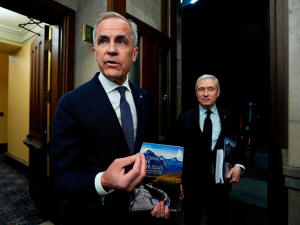
Canada's Prime Minister Mark Carney, left, and Minister of Finance and
National Revenue, Francois-Philippe Champagne, make their way to the
House of Commons before the tabling of the spring economic update, on
Parliament Hill, in Ottawa, Ontario, Tuesday, April 28, 2026. (Justin
Tang/The Canadian Press via AP) |
|
The
financial institution is meant to help NATO members and partner
countries meet their defense spending commitments and reduce
borrowing costs for military spending by pooling credit
strength.
The official spoke to The Associated Press on condition of
anonymity as they were not authorized to speak ahead of an
official announcement. The official said they did not know which
city in Canada would be the institution's headquarters.
Earlier, Ontario Premier Doug Ford cited a report about Canada
being selected as the headquarters and pitched in a post on
social media that it be in Toronto, saying it's "an opportunity
to put Canada” at the center of global defense finance and
manufacturing.
“As our nation’s financial capital, with a skilled workforce and
unparalleled global connectivity, there’s no better place for
the bank to be headquartered than Toronto,” Ford said.
Canadian Prime Minister Mark Carney’s government has said it
will meet NATO’s military spending guideline.
NATO countries, including Canada, have pledged to spend 5% of
their national GDP on defense. Carney said last year the
government would meet the earlier 2% target this year, then
later the same month committed Canada to reaching 5% by 2035.
European allies and Canada have already been investing heavily
in their armed forces, as well as weapons and ammunition, since
Russia launched an all-out invasion of Ukraine on Feb. 24, 2022.
U.S. President Donald Trump has previously complained that
Canada doesn’t spend enough on its military.
All contents © copyright 2026 Associated Press. All rights reserved

|
|
|