Social media companies sued over deaths of four teens as pressure,
lawsuits over child safety mount
[August 01, 2026] By
KAITLYN HUAMANI and BARBARA ORTUTAY
The families of four teenagers who died by suicide are suing Meta,
TikTok, Snapchat and YouTube over what they describe as “years of
escalating harms” from using their platforms that eventually resulted in
their deaths.
The lawsuit, filed Thursday in the Superior Court of Delaware, is the
latest in a flurry of suits filed against the social media giants that
alleges their platforms are addictive and dangerous.
The complaint was filed on behalf of four families from Texas, North
Carolina, Minnesota and Tennessee whose children died over a 14-month
period starting in July 2024 through September 2025.
The Social Media Victims Law Center is bringing the suit on behalf of
the families, and its founding attorney, Matthew Bergman, said it's
“particularly salient” that the children in this case died “long after”
similar suits had been filed.
“These platforms continue to kill kids, despite the platitudes of their
executives,” Bergman said in an interview. “This is a clear and present
danger to the health and safety of children, not just in the United
States but around the world.”
The four teens who died by suicide each experienced harms including
social media addiction, severe sleep deprivation, depression, anxiety
and suicidal ideation after years of using the social platforms, the
complaint states. Livi Castro died at age 13, Riv Kelleher at 14,
Nathaniel Chambers at age 17 and Dawson Holden at 18.
The complaint alleges the social media companies knew they were causing
harm to young users.

A spokesperson for Google, which owns YouTube, said in a statement that
“providing young people with a safer, healthier experience has always
been core to our work. In collaboration with mental health and parenting
experts, we’ve built services and policies to provide young people with
age-appropriate experiences, and parents with robust controls. We send
our deepest sympathies to the families and are reviewing the claims in
this lawsuit.”
Representatives for Meta, TikTok and Snap did not immediately respond to
requests for comment.
Sacha Haworth, executive director of The Tech Oversight Project, said in
a statement that parents, activists and whistleblowers have come forward
and met with lawmakers for years and “while Congress has dragged its
feet, more children have died."

[to top of second column] |

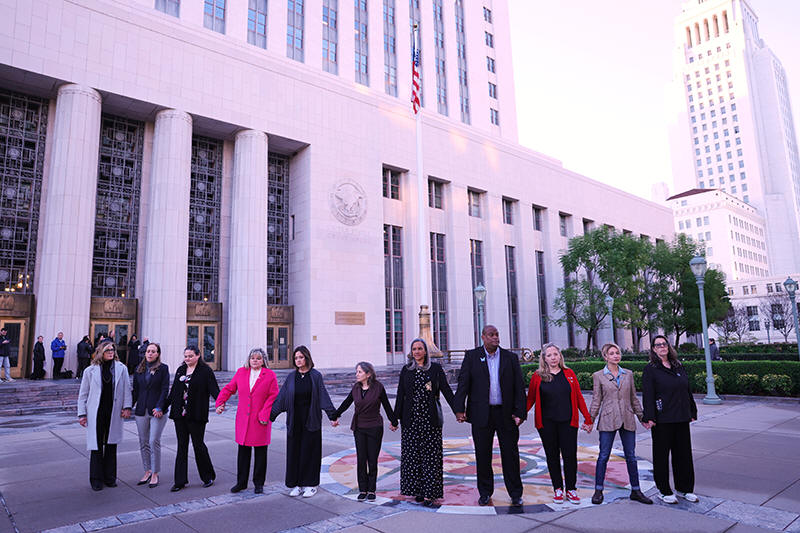
A group holds hands outside a landmark trial over whether social
media platforms deliberately addict and harm children, Wednesday,
Feb. 18, 2026, in Los Angeles. (AP Photo/Ryan Sun, File)
 Federal legislation of social media
has moved at a glacial pace. The Senate passed the Kids Online
Safety Act — which had the support of parents’ groups and children’s
advocacy organizations — exactly two years before this lawsuit was
filed. The House of Representatives never voted on that version of
the legislation, and the House and Senate are currently disagreeing
on key provisions they think should be included.
“Livi, Nathaniel, Dawson, and Riv’s stories are proof that Big Tech
companies continue to lie about the safety of their products,
choosing instead to pour hundreds of millions of dollars into false
advertising, deceptive paid partnerships with trusted education
programs and political lobbying,” Haworth's statement continued.
Meta, YouTube, TikTok and Snap are facing numerous state and federal
lawsuits over harms to minors. Meta is on trial in Tennessee this
week for a lawsuit brought by the state attorney general claiming
that the company deliberately designed its platforms, notably
Instagram, to make them addictive to young people, and did not warn
them of its dangers. And in August, Meta is heading to trial in
federal court in Oakland, California to face four of dozens of
states that sued the company in 2023. That lawsuit says the company
is contributing to the youth mental health crisis by designing
addictive features and violated federal law by collecting data on
kids under 13 without parental consent.
Not all lawsuits are successful, and many are settled out of court.
Last week, a Florida teenager dropped his case against Meta that was
set to go to trial in state court in Los Angeles, without receiving
any payment from the company. Meta had argued that the teen only
used his Instagram and Facebook for just minutes a day, on average,
and created most accounts only after hiring a lawyer in his case.
Still, the mounting court cases can get expensive, even for a
company like Meta Platforms. Earlier this week Meta said it had $2.4
billion in legal expenses in the second quarter, which contributed
to a relatively unusual 14% profit decline.
All contents © copyright 2026 Associated Press. All rights reserved |