Regulators propose overhaul to law governing how banks lend to
low-and-middle income communities
[August 01, 2026] By
KEN SWEET
NEW YORK (AP) — The Trump Administration has announced an overhaul to
the rules governing a critical piece of Civil Rights-era legislation,
most notably a reduction in the number of banks that will need to fully
comply with the law.
The Office of the Comptroller of the Currency and the Federal Deposit
Insurance Corporation on Friday jointly announced the proposed changes
to the Community Reinvestment Act, a law that requires regulators to
document how well banks do in lending to low-to-middle income
neighborhoods. It would be the first major revision of the law’s rules
and regulations in nearly three decades.
Under the proposed revisions, bank examiners would put more weight on
the lending banks do in certain communities and geographies, and less on
how many branches they open or how much in deposits they take in from a
local community.
The number of banks that would need to comply with the law would be
reduced as well. The definition of a small bank will increase from banks
with under $412 million in assets to banks with $1 billion in assets.
Banks between $1 billion and $10 billion in assets will now be
classified as an intermediate bank.
This would reduce the number of banks who need to comply with parts of
the CRA by 800 banks. Only 86 banks, or roughly 3% of all institutions,
would be subject to the full extent of CRA under the new regulations.

Another change that is likely to be fought over relates to how banks
give money to community development groups. Under the CRA, banks can
donate money to local organizations that do poverty or low-income
housing work in their communities to show they are providing resources
to a local community. The new regulations could narrow the groups and
programs that banks could donate to in order to meet those obligations.
In a summary of the changes, the bank regulators said these changes
would ensure community development grants “are not diverted to activist
causes or consumed by excessive operating costs.” Banks would also need
to collect more detailed information on who gets their community grants,
including addresses, which would give more transparency to who is
receiving grants from banks.
That change could negatively impact groups like the National Community
Reinvestment Coalition, an umbrella group for community development
groups that often receive money from banks under the CRA. The new rules
discourage banks making grants to national organizations and instead
focus their grants on local groups.
[to top of second column] |
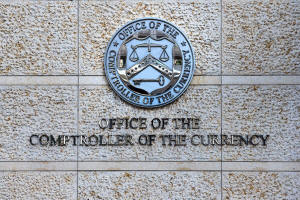
The official seal of the Office of the Comptroller of the Currency
is seen on an office building in Washington, Feb. 13, 2026. (AP
Photo/Cliff Owen, File)
 Jesse Van Tol, the CEO of NCRC, said
that it was “unfortunate” that the bank regulators were politicizing
grant making under the CRA.
“CRA was created to work for low-to-middle income people. A lot of
these changes are going to discourage banks from making grants,
particularly in rural areas, where I expect there will be
significant drops in activity,” Van Tol said.
The proposal announced Friday by the OCC and FDIC did not include
the other major bank regulator, the Federal Reserve. Banking groups
had been pushing for a joint proposal from all three regulators, to
make sure all three were aligned on the same requirements under the
CRA.
The CRA was passed in 1977 to combat redlining, a practice whereby
banks would discriminate against the poor and minorities by choosing
not to lend or open branches in minority-majority neighborhoods or
in poor neighborhoods.
The law is complex, requiring banks to document how they do business
in the cities and areas they operate in. Banks must sit for regular
examinations to see whether they are complying with the law. A bad
CRA examination could restrict a bank’s ability to open new branches
or merge with another bank or have other consequences. The data
collected through CRA is also used by the Department of Justice in
redlining cases.
The last major revision of the CRA’s regulations happened in 1995,
and there have been repeated attempts by administrations of both
parties to update the rules to reflect how banking and financial
services have changed in the past 30 years. But those revisions have
repeatedly failed, either due to opposition from other regulators,
the banks, or community groups, or have been blocked by courts. The
Biden administration tried its own revisions of the CRA rules but
those changes were blocked by courts in Texas.
The proposed rules will now go out for a 60-day comment period where
they will be finalized after banks, community groups and other
parties have a chance to weigh in on the changes.
All contents © copyright 2026 Associated Press. All rights reserved |