Why do these researchers want your baby teeth?
[August 01, 2026]
By ELLA KITCHENS/The Reporting Project
For more than four decades, oilfield brine has been spread across Ohio
roadways, but its radioactive contents are known to cause serious health
issues.
Oilfield brine, a byproduct of oil and gas development, is applied on
roads in some townships in Licking County in order to melt ice and
control dust. Researchers from the Ohio State University want to
understand how exposure to oilfield brine could be impacting the
long-term health of people who live in communities where it is spread.
That includes parts of Licking, Coshocton and Ashtabula counties.
Dr. Arbor Quist is an environmental epidemiologist and an assistant
professor at OSU, and is the principal investigator on this exploratory
study, leading and overseeing the team involved.
“I’ve been working on issues related to the health effects of oil and
gas development for the past decade,” Quist said. “But this project is
just starting this summer, and so the work in Licking County is just
starting this summer.”
This work will involve collecting data in unconventional ways: through
gathering toenail clippings, naturally shed baby teeth and soil samples.
Adults who have lived in Licking County for the past 12 months are
eligible to donate their toenail clippings. If they are donating a baby
tooth, the child who the tooth is from must have lived in the county for
the second and third trimesters of pregnancy and during their first year
of life. The researchers are offering gift cards for participation.
Oilfield brine is not just an issue in Licking County. The Ohio
Department of Natural Resources studied brine from 107 wells across 26
different counties and 10 different formations in Ohio. All of them were
considered too radioactive to discharge into the environment, according
to the Ohio Administrative Code.
Quist helped to create an interactive map that used an AI pipeline to
sort through data on where oilfield brine is spread on roads across the
state.

Chronic exposure to high levels of radium, like that found in wellfield
brine, can “result in an increased incidence of bone, liver or breast
cancer,” according to the federal Environmental Protection Agency.
Radium is chemically similar to calcium, meaning that our bones absorb
it as if it was calcium.
As radium decays, it creates radon, a colorless, odorless gas that is
the second leading cause of lung cancer in the country. Licking County
is considered “ground zero” for radon in the United States, according to
a 2025 investigation from The Columbus Dispatch.
The radium doesn’t just disappear after the brine is spread.
“The rain can wash it into people’s gardens where they grow food to feed
their kids,” said Jacque Morgan, a concerned Licking County resident who
has been heavily involved in advocacy work to ban oilfield brine on
roadways. “It can move down to the streams, get into our water. But it
doesn’t dissipate.”
[to top of second column]
|
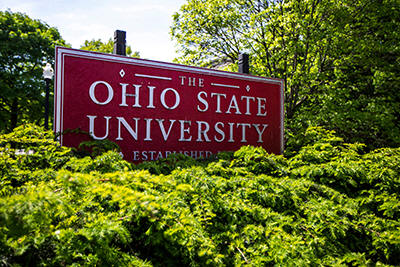
A sign for Ohio State University is seen on May 8, 2019, in
Columbus, Ohio. (AP Photo/Angie Wang, File)
 Spreading radioactive oilfield brine
has been legal in Ohio since 1985. Since the late 1800s, more than
100,000 conventional wells have been drilled in eastern Ohio,
according to ODNR. Because wellfield brine is considered waste
material that well owners must dispose of, some offer it free to
municipalities, counties and townships willing to take it for use on
the roads.
Activists like Morgan and those at the Buckeye Environmental Network
are fighting to change that.
Ohio Senate Bill 329 would ban the practice of spreading well brine
on roads in Ohio. The Senate Agriculture and Natural Resources
Committee had a second hearing on the bill in February, but no
action since.
Morgan said they met with Sen. Tim Shaffer, who represents
Fairfield, Licking and Perry counties.
“Shaffer gave us a lot of time,” Morgan said. “He listened to what
we had to say and asked questions. To me (Senate Bill 239) should be
a non-controversial, nonpartisan issue. It has to do with the health
and welfare of everybody that’s within the environment where this is
being spread.”
There are other solutions to control ice and dust on roads besides
oilfield brine. Granville Township has switched from oilfield brine
to making their own de-icer. Through using a water and road salt
mixture, Granville is able to avoid the contaminants in oilfield
brine. Morgan said that she wishes other Licking County townships
would choose to prioritize health like this.
“When I see greed being a higher priority than health and welfare,
that’s upsetting,” Morgan said. “If you’re getting the benefit of
the gas and the oil, then give us the benefit of healthy air to
breathe and ground to walk on and vegetables to eat and water to
drink.”
On Sept. 19, Quist will be at the Granville Farmers Market to
discuss the effects of radium on the body and to connect with
parents of children living in areas where oilfield brine is spread
in the hopes of talking about their research.
“People seem interested and curious,” Quist said.
Morgan said that she’s not sure whether Quist’s research will change
anything about the reality of oilfield brine in Licking County. But
she hopes that further knowledge about the brine’s impact can
someday make things better.
“I hope that it will put another couple of bricks on the scales of
justice and reasonable choices for our quality of life and health,”
said Morgan.
All contents © copyright 2026 Associated Press. All rights reserved |