New talks are 'last chance' for Iran to forge a deal and avoid
escalation of US strikes, Trump says
[August 04, 2026]
By AAMER MADHANI
WASHINGTON (AP) — President Donald Trump has played this hand before
during the 5-month-old Iran war — but this time, he insists it’s
different.
The president on Monday said that new talks between Washington and
Tehran are the “last chance” for Iran to forge a deal and avoid an
escalation of U.S. strikes on the country.
Trump, speaking at the Oval Office, said he expects negotiations will
focus on reopening the Strait of Hormuz and create a pathway for Iran to
address the United States’ concerns about its nuclear program. He told
reporters they would likely learn about the status of the negotiations
“today or tomorrow.”
“The first phase is the opening of the straits. The second phase will be
the denuclearization," the Republican president said. “And that will
take a little while.”
While Trump has reveled in the U.S. military decimating layers of
Tehran’s leadership and devastating its air force and navy, Iran is
betting it can outlast Trump as he faces diminished stockpiles of
munitions and the difficulty of executing a war that's unpopular with
the American electorate ahead of November’s midterm election.
Trump said he decided to hold off on ordering American forces to carry
out new massive strikes against Iran at the urging of Gulf allies Qatar,
Saudi Arabia and the United Arab Emirates.
He said a plan was in place for U.S. forces to carry out “the biggest
attack since World War II” on Sunday. But he decided to scrap the plan
and give diplomacy more time to play out after hearing from key Gulf
leaders — including Saudi Crown Prince Mohammed bin Salman — as well as
at the request of unnamed Iranian officials.

But Trump reiterated that he’s running out of patience with Iran.
“This the last chance for them to sign a good document,” Trump said.
Earlier Monday, Trump had criticized Iran on social media as being
“unbelievably duplicitous.”
His ire was raised by Iran claiming that its meetings with Oman on
Monday were focused solely on establishing a temporary route for safe
navigation through the Strait of Hormuz, a critical waterway for the
global oil trade.
“They ask for a meeting, some would say ‘beg,’ talks begin, with more
scheduled in the immediate future, and they say, openly and proudly,
that they’re not having any discussions, that nothing is being talked
about, and they’re only dealing with Oman,” Trump grumbled.
Trump said whether “Iran wants to admit it or not, we are, in fact,
talking” about preventing Iran from developing nuclear weapons.
Trump has threatened to escalate attacks on Iran only to edge away from
his threats several times since the start of U.S. and Israel strikes on
Feb. 28.
Asked by a reporter how Americans view him repeatedly making grim
threats on Tehran before backing away, Trump responded that he’s showing
patience out of a consideration for Iranian life.
“I want to give them every last chance before decapitation,” Trump said.
He added, “Hopefully, they’ll come to their senses.”
Critics see Trump reaching for a reset button as a pattern
Trump may still come to the conclusion that a massive escalation in the
conflict with Iran is necessary.
But critics say his hesitation also might reflect an unspoken
understanding inside the administration that U.S. military might alone
may not be enough to compel Iran to back down and bring an end to a now
monthslong war that Trump had earlier downplayed as a weekslong
excursion.

“I think what we’re seeing here is a president who has an approach
that’s just rather erratic,” said Sen. Mark Kelly, an Arizona Democrat
on the Senate Armed Services Committee, on CBS News' “Face the Nation.”
“At this point, he's trying to get us back to February. And I think if
he could — if he had a big reset button he could hit — he would
certainly take that option.”
There have been several moments over the course of the conflict when
Trump has demonstrated his proclivity for the bellicose only to back off
at the last minute, while declaring his threats spurred progress:
[to top of second column]
|
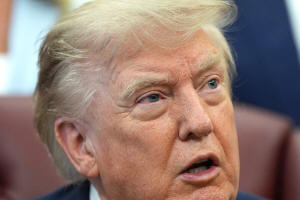
President Donald Trump speaks during a meeting about military
families, in the Oval Office of the White House, Monday, Aug. 3,
2026, in Washington. (AP Photo/Alex Brandon)

— In early April, the United States and Iran agreed to a two-week
ceasefire in an announcement that came less than two hours before a
deadline Trump had set for Tehran to capitulate or face attacks on
bridges and power plants — strikes he said would mean “a whole
civilization will die.”
— After days of dire threats against Iran, Trump announced on May 18
he was holding off on a major planned military strike because
“serious negotiations” were underway, crediting Gulf allies for
persuading him to show restraint.
— Then in June, Trump threatened on social media to hit Iran “VERY
HARD” and seize Iran’s energy base on Kharg Island to "assume total
control of their Oil and Gas Markets,” only to call off the strikes
in another post after claiming that peace negotiations had
progressed with high-level Iranian leaders.
Call with Saudi crown prince affected Trump's decision
With this latest episode, Trump suggested that the Saudi crown
prince played a particularly important role in him turning away from
escalating the fight.
The U.S. president spoke by phone with the de facto leader of the
kingdom on Saturday before announcing he was halting planned
strikes.
The crown prince conveyed that an escalation in fighting could have
a severe impact on the global economy if Tehran responded to a new
U.S. bombardment by targeting some of the United States’ Gulf
allies, according to a person briefed on the call who was not
authorized to comment publicly and insisted on anonymity.
Saudi officials, the person added, have underscored in their
engagements with the Trump administration that the kingdom is in a
good position to defend itself against further potential Iranian
strikes — as are fellow energy titans Qatar and the United Arab
Emirates — but that Kuwait could be more vulnerable to attacks by
Iranian-backed militias in Iraq.
As Trump threatens escalation, Republicans face tough polling
Trump has insisted that November’s midterm elections aren't shaping
his approach to the conflict, which has spurred unease across the
global economy.

But it's certainly on the minds of his fellow Republicans.
About two-thirds of U.S. adults say the war with Iran has not been
worthwhile, according to polling from The Associated Press-NORC
Center for Public Affairs Research published last week. That
includes the vast majority of Democrats and independents, as well as
about 37% of Republicans.
One of Trump's most outspoken allies on Capitol Hill suggested on
Sunday the administration needs to modulate its approach on Iran.
Louisiana Sen. John Kennedy said on NBC's “Meet the Press” that the
debate in Washington has lost perspective on the devastation the
U.S. military has inflicted on Iran since the start of the war.
Still, the Republican lawmaker acknowledged that further escalating
the conflict could lead to another surge in already elevated energy
prices and “a lot of inflation for the American people.”
Kennedy made the case that tightening sanctions and targeting Iran's
nuclear program — rather than escalating the conflict — might be the
best bet for the moment.
“They’re all hellish choices,” Kennedy said. “But for the moment I’d
maintain the status quo.”
___
AP writers Melanie Lidman in Tel Aviv, Israel, and Josh Boak in
Washington contributed reporting.
All contents © copyright 2026 Associated Press. All rights reserved |