Maryland lawmakers ask voters to clear the way for a congressional map
designed to boost Democrats
[August 05, 2026]
By GEOFF MULVIHILL
Maryland voters will decide in November whether to clear the way for a
new congressional map that would favor Democrats in all eight of the
state's U.S. House districts for the 2028 elections.
Both chambers of the Democratic-dominated state legislature on Tuesday
approved putting an amendment on the ballot to allow the change. Sending
it to voters required three-fifths approval of both legislative
chambers, which met in a special session to consider the change. It
cleared the House 96-38 and the Senate 32-13.
Gov. Wes Moore, a Democrat, praised lawmakers for putting the measure
before voters, and joined them in saying it was necessary to combat
President Donald Trump's push for a mid-decade redistricting that favors
Republicans.
“I continue to believe that our country needs national redistricting
reform. But until that happens, inaction is not an option,” Moore said
in a statement. “Maryland will not be caught flat-footed while
Republicans engage in political redlining that guts decades of progress
that the generations before us fought for.”
In a state where Democrats now occupy seven of the eight House seats,
Republicans are calling the effort a blatant power grab — and a move
that violates a new state law intended to give voters more time to
consider proposed amendments.

In debate in the House on Tuesday, Republican Delegate Kevin Hornberger
told his colleagues: “Just because we can go ultra-partisan doesn't mean
we should go ultra-partisan.” Other Republicans said constituents
weren't behind it and one Democratic lawmaker worried that the change
could cost rural parts of the state federal resources if they're put in
the same districts with suburban areas.
In the debate, Democrats emphasized that the amendment does not include
approval of any specific new maps.
If the amendment is ultimately approved, it would likely be part of a
rapid reconfiguration of congressional district lines that began last
year when Trump urged Republican-controlled states to adjust their maps
to help the party in the 2026 midterm elections. Normally, redistricting
happens just once a decade after new Census data is released.

[to top of second column]
|
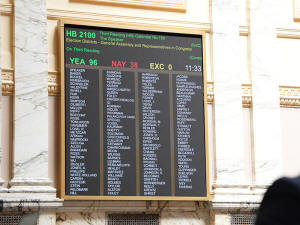
A screen in the Maryland House Chamber displays votes during the
third reading of a proposed constitutional amendment Tuesday, Aug.
4, 2026, in Annapolis, Md., that would allow a redrawn congressional
map. (AP Photo/Mingson Lau)

Eight states — Alabama, Florida, Louisiana, Missouri, North
Carolina, Ohio, Tennessee and Texas — have redrawn maps to help
Republicans, who could pick up as many as 16 seats due to the
redistricting. New maps in California and Utah could give Democrats
an advantage in six races.
Maryland moved more slowly — and with an approach that will not
change districts for this year's elections — because Democratic
state Senate President Bill Ferguson blocked an earlier initiative
aimed at putting new maps in place for this year. He was worried
that the state Supreme Court, with most of its members appointed by
a Republican former governor, could backfire — especially because a
judge in 2022 rejected a new map that could have boosted the
Democrats.
Ferguson said his view changed after the U.S. Supreme Court weakened
the Voting Rights Act in April, giving Republicans grounds for
reconfiguring districts with large minority populations in Southern
states.
The question that could go to voters is designed to make it hard for
the court to reject redistricting. It would make it clear that the
parameters the judge cited — including that districts be compact in
form and have regard given to “natural boundaries” — apply only to
state legislative districts, not congressional ones.
That would allow congressional districts to cross the Chesapeake
Bay, which is the only way Democrats could draw a map that gives
them an edge in every congressional district. Currently, the only
district on the rural Eastern Shore east of the Bay is also the only
one represented by a Republican, Rep. Andy Harris, the chair of the
conservative House Freedom Caucus.
All contents © copyright 2026 Associated Press. All rights reserved |