Gene-edited beagles may offer a future option for people with dog
allergies
[August 06, 2026]
By ADITHI RAMAKRISHNAN
NEW YORK (AP) — Matt Walker couldn’t pet a dog without sneezing — until
he and other scientists used a gene editing technique to produce a
hypoallergenic beagle named Bailey.
Now, he can feed Bailey spoons of peanut butter while she lies on his
lap and play fetch with her in Central Park. His allergies didn't go
away: Bailey's saliva and hair no longer contain a key allergy-causing
protein.
“The feeling right now is sort of a mix of relief and awe and gratitude
that it worked,” said Walker, a geneticist. His company, Kindred
Companion Sciences, created Bailey and her twin Alfie using a Nobel
Prize-winning technique called CRISPR.
It'll take years before the millions who suffer from dog-related
allergies can walk into a pet store and buy a pooch like Alfie or
Bailey.
Scientists have to monitor the long-term health effects of the genetic
tweak, and find ways to commercialize the approach to make it
affordable. And experts not involved with the effort say it could hurt
shelter and rescue animals waiting to be adopted.
“It opens the door to a lot more people being able to own pets. On the
negative side, it may discourage people from trying to use strays and
unwanted animals that are not engineered to be allergy-free,” said
bioethicist Arthur Caplan with New York University's Grossman School of
Medicine.
Researchers have tried to create hypoallergenic pets before, mostly
using cloning. But this led to sicker pups that were too genetically
similar. Two years ago, researchers used CRISPR to reduce levels of an
allergy-causing protein in a cat named Alsik. But it's not yet clear
whether this technique is safe to be tested on other cats.

Dogs that shed less, like poodles, are often thought of as
hypoallergenic. But these pups still produce allergy-causing proteins
that end up in their saliva, hair and dander, so they can still make
people sniffly.
To create Alfie and Bailey, scientists started in the lab. They edited
the genetic code inside dog skin cells, switching off the main gene
responsible for producing allergy-causing proteins. Then they
transferred the edited genetic code into eggs that went into a beagle
surrogate that gave birth to two healthy female pups in September 2024.
Scientists tested their saliva and fur and didn’t find signs of the
allergy-causing protein.
They also performed an allergy test, pricking Walker's skin with
extracts from Alfie and Bailey's saliva and dander. His skin reacted to
samples from a poodle and goldendoodle, but not from the beagles.
The research, published Wednesday in the CRISPR Journal, is the first
time such an approach has been tried successfully in dogs.
[to top of second column]
|
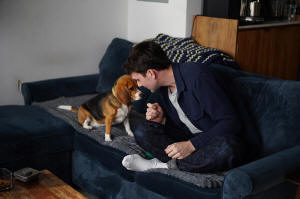
Matt Walker sits at home with Bailey, his gene-edited hypoallergenic
beagle, in New York on Aug. 4, 2026. (AP Photo/Mary Conlon)
 Walker says all dogs have the same
allergy-causing gene that was edited in Alfie and Bailey. Kindred
Companion Sciences hopes to test the technique on other dogs and
service animals to see if they can breed an allergy-free line of
pups beyond beagles.
Future research should test the gene-edited hypoallergenic dogs on
more people with pet allergies to be sure they can soothe symptoms
across a broader swath of the human population, said Dr. Jeff
SoRelle, a pathologist at University of Texas Southwestern Medical
Center.
Since the switched-off gene is the main — but not the only —
allergy-causing culprit in dogs that was tested, “we don't exactly
know just how effective or broadly useful this could be for stopping
dog allergy in humans,” said SoRelle, who had no role in the study.
Bailey lives with Walker in New York, and Alfie lives in Florida
with another Kindred scientist. The edit made to their genes is rare
but does occur naturally in some dogs, so Walker said it's unlikely
to have any negative effects on the pups. But it will still be
important to monitor them at routine vet visits and make sure they
stay healthy.
Walker has had Bailey for a little over a year and says she's become
a member of the family.
Despite being a lifelong dog lover, his allergies kept him away from
pups growing up. Even breeds that were supposed to be more
hypoallergenic, like his family's goldendoodle, gave him itchy eyes
and painful rashes.
But he and Bailey can play tug-of-war together in his living room,
and she snuggles at his feet to comfort him when he’s sick.
“It feels just amazing to get to have a dog,” Walker said.
___
The Associated Press Health and Science Department receives support
from the Howard Hughes Medical Institute’s Department of Science
Education and the Robert Wood Johnson Foundation. The AP is solely
responsible for all content.
All contents © copyright 2026 Associated Press. All rights reserved
 |