State of New Mexico sues Justice Department and Todd Blanche, saying
they blocked its Epstein probe
[August 06, 2026]
By SAVANNAH PETERS
CEDAR CREST, N.M. (AP) — New Mexico’s attorney general sued the U.S.
Department of Justice on Wednesday, accusing it of blocking the state
from investigating sex crimes at Jeffrey Epstein’s former ranch near
Santa Fe.
The lawsuit in federal court in Washington, D.C., said the department
and acting Attorney General Todd Blanche stonewalled New Mexico Attorney
General Raúl Torrez’s criminal investigation into Epstein and others,
taking action that “harms victims and undermines the public interest.”
The lawsuit sought judicial intervention to force the federal government
to turn over materials to New Mexico's investigators. It was filed the
same day that the New Mexico House of Representatives released a report
saying “those directly responsible for protecting New Mexicans relied on
others to do their job,” including federal prosecutors in New York.
Epstein took his own life in a federal jail in New York City in August
2019 after he was denied bail on sex trafficking charges lodged against
him when he was arrested a month earlier.
Epstein's former girlfriend and close associate, Ghislaine Maxwell, is
serving a 20-year prison sentence after her 2021 conviction on sex
trafficking charges in New York. Witness testimony at Maxwell's trial
alleged she and Epstein had sexually abused women at his New Mexico
ranch.
Justice Department says it’s following court orders to protect
victims
According to New Mexico's lawsuit, state prosecutors “have faced
sustained resistance” to the kind of information-sharing common between
state and federal investigators.

The Justice Department said in a statement it was not releasing some
information the state requested because of federal court orders that ban
disclosing victim-identifying information.
"New Mexico has provided no lawful basis to justify such sweeping
disclosures,” the agency said. It said protecting victim privacy remains
a top priority and the Justice Department "remains available to assist
New Mexico’s investigation consistent with the law and binding court
orders.”
The lawsuit claims the Justice Department and Blanche were hiding
information about Epstein and his co-conspirators when the state is one
of the few jurisdictions that may still be able to hold Epstein's
associates accountable or “provide some sense of justice to survivors.”
New Mexico's attorney general said his office made 10 requests for key
information that were ignored or denied.
“We have heard repeatedly they will cooperate and what our team has
experienced is anything but cooperation,” Torrez told reporters in a
video call.
State calls on Blanche to fix things with ‘a stroke of the pen’
“Todd Blanche today with a stroke of a pen could grant us the access
that he claimed,” Torrez said. “Instead they have decided to stonewall,
to obstruct and to frankly conceal for whatever reason.”
The interim report released by the New Mexico Survivors' Truth
Commission in part blamed federal prosecutors in Manhattan for a dearth
of information about Epstein's activities in New Mexico. The commission,
established in February by state lawmakers, said federal officials
focused on Epstein’s misdeeds in New York, Palm Beach, Florida, and the
Virgin Islands, while leaving his offenses in New Mexico unexamined.
But the commission also cited evidence gathered by federal prosecutors
in New York to describe women who recounted suffering sexual abuse from
Epstein at his Zorro Ranch.

[to top of second column]
|
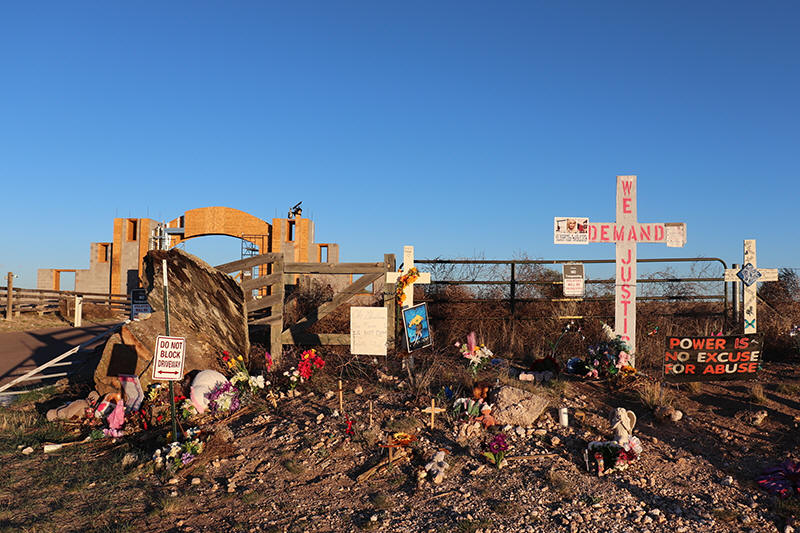
Crosses, flowers and other mementos are displayed outside Jeffrey
Epstein's former Zorro Ranch near Stanley, N.M., on Friday April 3,
2026. (AP Photo/Savannah Peters)

At Maxwell's trial, Annie Farmer, now a psychologist, testified she
was 16 when she agreed to go to the ranch, where Maxwell touched her
breast during a massage and Epstein unexpectedly crawled into bed
and pressed himself against her.
A spokesperson for federal prosecutors in New York sent along the
Justice Department statement on Epstein in response to a request for
comment.
Coinciding with the release of the report, about 50 members of the
media and the public gathered in a legislative hearing room at the
New Mexico state capitol on Wednesday to hear about the commission’s
preliminary findings.
Epstein accuser tells commission about abuse
Rachel Benavidez, the lone speaker in the “survivor testimony”
portion of the meeting, alleged that Epstein sexually abused her at
Zorro Ranch. Benavidez said Epstein’s connections with powerful
people in the state allowed him to “roam free here in New Mexico
unchecked” after he was convicted of sex crimes elsewhere.
“We don’t need more paper files sitting as artifacts,” Benavidez
said, urging the commission to question “co-conspirators” who helped
Epstein evade accountability in the state.
Benavidez has said in interviews that she was brought to the ranch
to work as a massage therapist beginning in the late 1990s. She said
Wednesday that Epstein exploited “the one thing that meant
everything to me at that time, my hard earned career.”
A group of Epstein victims and victims' family members accused
Blanche in a statement of “continuing to protect abusers” by
withholding the information sought by New Mexico.
“The DOJ’s argument that it won’t hand over files in order to
protect survivors’ identities is laughable when the DOJ has already
revealed their names and personal information,” they said.
Epstein purchased his expansive property in Stanley, New Mexico, a
sparsely populated ranching community about 30 miles (48 kilometers)
south of Santa Fe, in 1993 from former Democratic Gov. Bruce King
and built a hilltop mansion with a private airstrip and helipad.

Epstein's ranch has been renamed ‘San Rafael Ranch’
The property was sold by Epstein’s estate in 2023 to the family of
Don Huffines, a Republican recently appointed Texas' state
comptroller. In a February social media post, Huffines said the
property has been renamed San Rafael Ranch after a saint associated
with healing and that his family plans to operate a Christian
retreat there.
The Justice Department in December started releasing investigative
records pertaining to Epstein and Maxwell in accordance with the
Epstein Files Transparency Act.
Accusers and members of Congress who fought to pass the transparency
act quickly complained about shoddy redactions and too many sealed
materials. Records that were released, including photographs,
interview transcripts, call logs, court records and other documents,
were either already public or heavily blacked out, and many lacked
necessary context.
___
Associated Press writers Larry Neumeister in New York and Jeffrey
Collins in Columbia, South Carolina, contributed to this report.
All contents © copyright 2026 Associated Press. All rights reserved |